


What is Immersive Marketing?
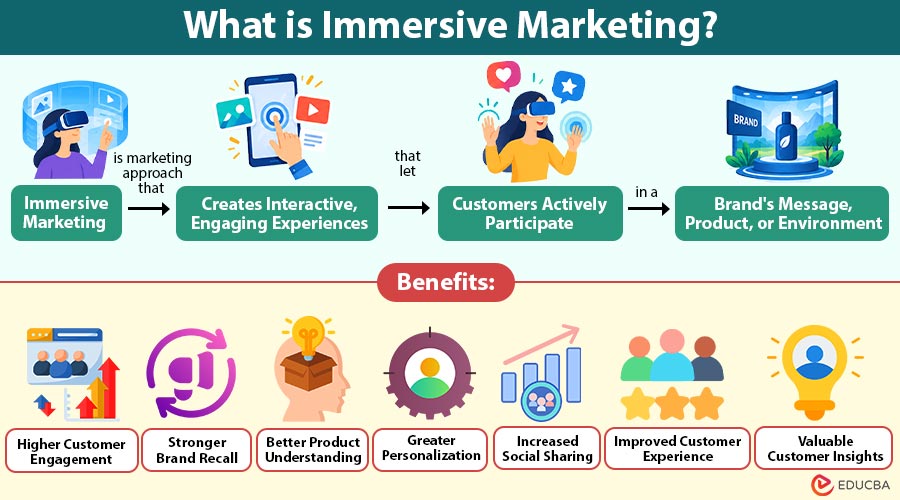
Immersive marketing is a marketing approach that creates interactive, engaging experiences that let customers actively participate in a brand’s message, product, or environment.
Unlike traditional advertising, which mainly delivers information to an audience, immersive marketing encourages people to interact with the brand. It may use technologies such as augmented reality (AR), virtual reality (VR), interactive displays, 3D environments, games, sensory experiences, or experiential events.
For example, a furniture company may allow customers to use an AR application to see how a sofa would look in their living room before purchasing it. This gives customers a direct experience with the product and can make the buying process more engaging.
Immersive marketing focuses on creating memorable interactions that connect customers with a brand beyond a simple advertisement.
Table of Contents:
- Meaning
- Working
- Types
- Examples
- Benefits
- Challenges
- Applications
- Difference
- How to Create an Effective Immersive Marketing Campaign?
Key Takeaways:
- Immersive marketing uses interactive experiences to encourage participation and strengthen customer engagement with brands.
- AR, VR, and gamification can make product demonstrations more engaging, memorable, and easier to understand.
- Successful immersive campaigns require objectives, relevant technology, simple access, compelling storytelling, and measurable outcomes.
- Businesses can apply immersive marketing across retail, automotive, travel, education, entertainment, events, and launches.
How Does Immersive Marketing Work?
Immersive marketing combines storytelling, interaction, technology, and customer participation to create a memorable brand experience.
The process generally begins by identifying the target audience and determining what type of experience would be relevant to them. The brand then develops a concept that connects the experience with its marketing objective.
Technology may be added depending on the campaign. For example, AR can place digital objects into a user’s physical surroundings, while VR can create a completely simulated environment.
The customer then interacts with the experience by exploring products, completing activities, playing games, attending an event, or responding to digital content. The brand can measure responses such as participation, engagement, conversions, social sharing, and customer feedback.
The goal is not simply to use advanced technology but to create an experience that makes the brand message more meaningful.
Types of Immersive Marketing
Below are some common types of immersive marketing used by businesses across industries.
1. Augmented Reality Marketing
Augmented reality adds digital elements to physical surroundings through smartphones, tablets, or smart glasses, helping customers virtually try products, visualize items, or interact with packaging.
2. Virtual Reality Marketing
Virtual reality creates simulated environments that customers can experience through VR devices, enabling brands to provide virtual tours, demonstrations, simulations, and engaging product experiences.
3. Experiential Marketing
Experiential marketing creates physical brand experiences through pop-up stores, demonstrations, interactive installations, exhibitions, events, or themed spaces that encourage direct customer participation and memorable interactions.
4. Interactive Content
Interactive content encourages active participation through quizzes, calculators, videos, polls, games, product configurators, and personalized experiences that make brand communication more engaging, memorable, and valuable.
5. 3D and Spatial Experiences
Three-dimensional and spatial experiences let customers examine products or environments from different angles using 3D models, virtual showrooms, digital spaces, and interactive visual displays.
6. Gamified Marketing
Gamified marketing incorporates challenges, rewards, points, competitions, quizzes, and interactive tasks into campaigns, encouraging participation while making promotional activities more enjoyable, engaging, and memorable.
Examples of Immersive Marketing
Immersive marketing can apply to many industries and customer situations.
1. Retail
Clothing retailers can offer virtual try-on experiences, allowing shoppers to visualize selected products on themselves before purchasing, creating convenient and interactive shopping experiences.
2. Automotive
Car manufacturers can create interactive experiences where customers explore vehicle features, customize colors, compare options, and experience simulated driving before visiting showrooms.
3. Travel
Tourism companies can provide virtual destination experiences that let potential travelers preview attractions, hotels, landmarks, and activities before deciding where to travel.
4. Real Estate
Property developers can offer virtual tours that allow customers to explore apartments, houses, or commercial spaces remotely before arranging physical property visits.
5. Entertainment
Entertainment companies can create interactive games, virtual environments, and themed experiences connected to movies, shows, characters, or stories to strengthen audience engagement and participation.
6. Education
Educational organizations can use VR simulations and interactive environments to help learners understand complex concepts through realistic experiences, practical activities, and engaging visual learning.
Benefits of Immersive Marketing
Below are the key benefits of immersive marketing that help brands improve engagement, strengthen customer relationships, and create memorable experiences.
1. Higher Customer Engagement
Immersive experiences require customers to participate. This active involvement can encourage people to spend more time with a brand compared with conventional advertising formats.
2. Stronger Brand Recall
Memorable experiences can make a brand easier to remember. When customers associate a product with an interesting or useful interaction, the brand may become more distinctive in their minds.
3. Better Product Understanding
Immersive experiences can demonstrate how a product works or appears in real situations. This can help customers understand features that may be difficult to communicate through static advertisements.
4. Greater Personalization
Interactive technologies can adapt experiences based on user preferences, selections, or behavior. This allows brands to provide more relevant product recommendations and content.
5. Increased Social Sharing
Unique experiences may encourage customers to photograph, record, or share their interactions online. This can extend a campaign’s reach beyond the people who participate.
6. Improved Customer Experience
Immersive marketing can make different stages of the customer journey more interactive. Customers can explore products, compare options, and make decisions through experiences rather than relying only on written information.
7. Valuable Customer Insights
Interactive campaigns can generate information about customer preferences and behavior. Brands can use these insights to improve the products, campaigns, and future customer experiences while following applicable privacy requirements.
Challenges of Immersive Marketing
Despite its benefits, immersive marketing can present several challenges.
1. High Development Costs
Advanced AR, VR, 3D, and interactive experiences may require significant investment in technology, design, software, and specialized expertise.
2. Technical Limitations
Experiences may not work equally well across different devices, operating systems, internet connections, or physical environments.
3. User Adoption
Some customers may not want to download an application, wear a VR headset, scan a QR code, or spend time learning how an interactive experience works.
4. Complex Execution
Immersive campaigns often involve technology, creative development, physical spaces, content, and customer support. Poor coordination can affect the overall experience.
5. Privacy Concerns
Interactive technologies may collect information about users or their interactions. Businesses must handle such information responsibly and comply with relevant privacy laws.
6. Risk of Technology Overshadowing the Message
Using technology simply because it is new can distract customers from the actual product or brand message. The experience should support the marketing objective rather than become the objective itself.
Applications of Immersive Marketing
Immersive marketing can support several marketing activities, including:
1. Product Launches
Brands can create interactive launch experiences that allow customers to explore new products, features, benefits, and demonstrations before purchasing.
2. Brand Awareness Campaigns
Immersive experiences can attract audience attention, communicate brand values, and create memorable interactions that strengthen recognition and customer recall.
3. Retail Experiences
Retailers can use immersive technologies to create interactive stores where customers explore products, visualize options, and receive engaging assistance.
4. Product Demonstrations
Brands can provide interactive demonstrations that show customers how products work, highlighting important features and practical applications through realistic experiences.
5. Virtual Showrooms
Virtual showrooms allow customers to explore products, compare options, view configurations, and understand product details without visiting physical locations.
6. Customer Education
Brands can use immersive content to explain complex products, services, processes, or features through interactive and easy-to-understand learning experiences.
7. Event Marketing
Companies can enhance events with immersive displays, virtual environments, interactive activities, and simulations that encourage participation and generate memorable experiences.
8. Social Media Campaigns
Immersive filters, augmented reality effects, interactive videos, and virtual experiences can encourage social media users to engage with campaigns.
Difference Between Immersive Marketing and Traditional Marketing
The table below highlights the key differences between the two:
| Aspect | Immersive Marketing | Traditional Marketing |
| Customer Role | Active participant | Mainly passive viewer |
| Interaction | High | Usually limited |
| Main Focus | Experience and participation | Message delivery |
| Technology | Often uses AR, VR, 3D, or interactive tools | May rely on print, television, radio, or standard digital ads |
| Personalization | Can be highly personalized | Usually less interactive |
| Engagement | Experience-driven | Advertisement-driven |
How to Create an Effective Immersive Marketing Campaign?
An effective campaign should begin with a clear marketing objective. The brand should determine whether it wants to increase awareness, demonstrate a product, generate leads, improve engagement, or support sales.
Next, it should identify the audience and select an experience that matches their interests and behavior. Choose the technology based on usefulness rather than novelty.
The experience should also be simple to access. Complicated instructions, lengthy downloads, or technical barriers can discourage participation.
Finally, businesses should measure performance using relevant metrics such as participation rate, engagement time, conversion rate, leads generated, customer feedback, social shares, and return on marketing investment.
Final Thoughts
Immersive marketing transforms brand communication into interactive experiences using AR, VR, events, gamification, 3D environments, and interactive content. Its success depends on relevant concepts, clear objectives, convenient experiences, compelling storytelling, and measurable results. When combined effectively, these elements encourage participation, strengthen engagement, improve recall, and build meaningful customer-brand connections.
Frequently Asked Questions (FAQs)
Q1. What is the main purpose of immersive marketing?
Answer: The main purpose of immersive marketing is to create interactive brand experiences that encourage customers to participate and engage more deeply with a product, service, or marketing message.
Q2. Is immersive marketing only suitable for large brands?
Answer: No. Businesses of different sizes can use immersive marketing. Smaller businesses can start with relatively simple formats such as interactive quizzes, AR filters, virtual demonstrations, or gamified content.
Q3. Which technologies are commonly used in immersive marketing?
Answer: Common technologies include augmented reality, virtual reality, 3D visualization, interactive displays, gamification, spatial experiences, and interactive digital content.
Q4. How can businesses measure immersive marketing?
Answer: Businesses can measure campaigns through engagement rate, participation, interaction time, conversions, leads, customer feedback, social sharing, and return on marketing investment.
Recommended Articles
We hope that this EDUCBA information on “Immersive Marketing” was beneficial to you. You can view EDUCBA’s recommended articles for more information –

