


Updated October 7, 2026
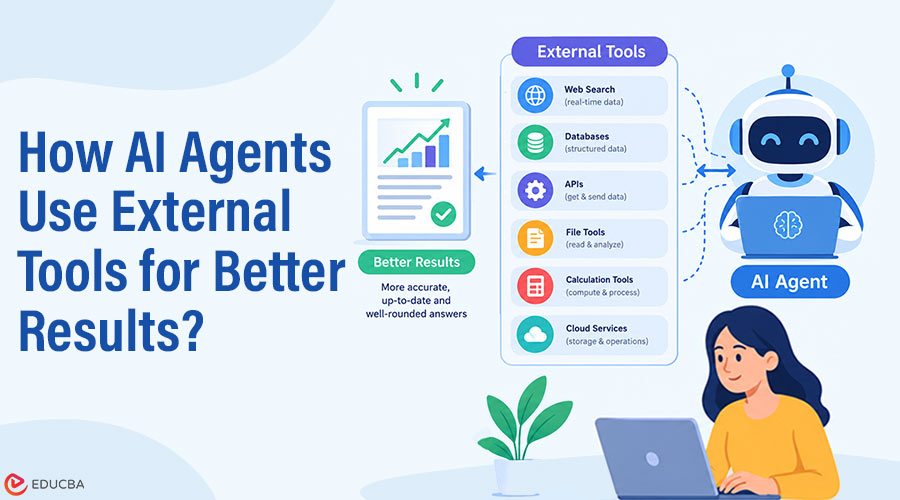
AI agents differ from traditional chatbots in one important way: they can do more than generate a response. An AI agent can interpret a goal, decide what information it needs, select an appropriate tool, retrieve data, evaluate the result, and continue working through multiple steps. Understanding how AI agents use external tools matters for anyone exploring modern AI systems. This makes agents useful for tasks such as research, reporting, analysis, customer support, workflow automation, and business intelligence.
However, an agent cannot perform these tasks effectively through reasoning alone. To work with real business problems, it needs access to external tools and reliable data. Understanding that relationship is key to understanding how modern AI agents work.
What Makes an AI Agent Different From a Chatbot?
A basic chatbot follows a relatively simple pattern:
User prompt → language model → response
The model receives information and generates an answer.
An AI agent can use a more complex workflow:
Goal → reasoning → tool selection → data retrieval → evaluation → next action
The agent may repeat this process several times before returning a final answer.
For example, imagine asking an AI system:
Prepare a summary of our three best-performing marketing campaigns and explain why they worked.
A chatbot without access to company data can explain which metrics to analyze. An AI agent connected to the company’s analytics systems can potentially retrieve the campaigns, compare their performance, examine conversion data, and build the requested summary. The difference is access.
The Main Building Blocks of an AI Agent
Most useful AI agent systems combine several components.
- A reasoning model: A language model interprets the request, determines what the user wants, and helps decide what should happen next.
- Memory or context: The system keeps relevant information available while working through the task. This can include conversation history, previously retrieved information, or stored context.
- Planning: More complex agents break a goal into smaller steps. For example, a research agent may first identify what information is needed, then retrieve several sources, compare them, and produce a conclusion.
- Tools: Tools allow an agent to interact with systems outside the language model. These can include search engines, databases, CRM systems, analytics platforms, code execution, calendars, internal company software, or specialized industry platforms.
- Data: The agent needs information to base its work on. The usefulness of an answer often depends on how reliable, relevant, and current that information is.
- Controls: Permissions and operational rules determine what the agent can access or change. These controls become increasingly important as agents gain more autonomy.
Why External Tools Matter?
Language models are useful because they can understand language and reason across information. But a model cannot automatically access every software system or database.
Suppose a sales manager asks:
Which five customers have shown the largest decrease in activity during the last 30 days?
The model does not inherently know the answer. It needs access to current customer activity data. If the AI agent can query the company’s CRM or analytics platform, it can retrieve the relevant records and work with them.
The same principle applies across industries:
- A financial agent may need market data.
- A marketing agent may need campaign performance.
- A support agent may need customer history.
- A supply-chain agent may need inventory levels.
- A music-industry agent may need streaming, playlist, audience, or artist-performance data.
The reasoning model determines what information is needed. The tool provides access to it.
How AI Agents Use External Tools With Structured Data?
AI agents can work with unstructured information such as documents and webpages. However, many analytical questions benefit from structured data. Structured data organizes information into predictable fields.
For example, an artist dataset might contain:
- Artist name
- Country
- Genre
- Spotify followers
- Monthly listeners
- Playlist reach
- YouTube views
- Audience locations
- Changes over time
This is easier to compare systematically than information collected from unrelated webpages. The same applies to business systems.
Structured CRM records, financial data, inventory tables, or analytics metrics give the agent a consistent basis for analysis. This matters when a task requires filtering, ranking, comparison, or trend detection.
The Challenge of Connecting Agents to Many Systems
Giving an AI agent access to external tools creates a technical problem. Different services expose information in different ways.
Each may have its own:
- API
- Authentication system
- Schemas
- Commands
- Response formats
- Permissions
Developers can build custom integrations for every service. But as the number of tools increases, maintaining those integrations becomes more complex. This is one reason standardized approaches to AI tool connectivity have become important.
What is the Model Context Protocol?
The Model Context Protocol, commonly called MCP, provides a standardized way for compatible AI applications to connect with external tools and data sources. An MCP server can expose capabilities that an AI application can use when needed.
This creates a general structure:
AI application → MCP connection → external tool or data source
The AI can determine which available tool is relevant to the user’s request and call it as part of its workflow. MCP does not replace the underlying database or application. It provides a consistent interface through which the AI system can access available capabilities.
A Simple Example of How AI Agents Use External Tools Through MCP
Imagine an AI assistant connected to a project management system through MCP.
A user asks:
Which projects are overdue, and who owns the next unresolved task in each one?
The AI assistant can:
- Understand the question.
- Identify the appropriate connected tool.
- Request project information.
- Retrieve overdue projects.
- Identify outstanding tasks.
- Organize the results.
- Return a readable summary.
Without access to the project management data, the same model could only explain how someone might perform the analysis. The tool connection changes the task from theoretical advice into practical work.
Specialized Tools Make Agents More Valuable
The same concept becomes particularly useful with specialist data. Consider the music industry. A general AI assistant can explain how A&R teams evaluate artists. It can discuss streaming growth, playlist activity, fan engagement, audience geography, and market momentum.
But suppose the user asks:
Which emerging electronic artists in France are growing fastest across streaming and playlists?
That requires current music-performance data. Through a music MCP server, a compatible AI assistant can work with structured artist, track, audience, playlist, chart, festival, and market data rather than relying only on general model knowledge. The agent can use that external data in its analysis. This same pattern applies to many sectors. The more specialized the question, the more important access to specialized data becomes.
How an AI Agent Decides Which Tool to Use?
An agent may have access to several different tools. The reasoning layer needs to determine which capability best matches the request.
For example, an agent could have access to:
- Internal documents
- A CRM
- Web search
- An analytics platform
- A financial database
If the user asks about a customer contract, the document system may be most relevant, if the user asks about sales performance, the CRM or analytics platform may be needed. If the user asks about a competitor’s latest announcement, web search may be appropriate, if several sources are relevant, the agent may use more than one. This ability to select tools dynamically is a major difference between agentic workflows and traditional fixed automation.
Tool Access Does Not Guarantee a Good Answer
Connecting an AI agent to data improves its capabilities, but it does not eliminate errors. Several problems can still occur.
- Poor data quality: If the underlying information is wrong, the agent’s analysis may be wrong too.
- Missing context: A dataset may include a metric without explaining how to interpret it.
- Incorrect tool selection: The agent may choose a tool that does not contain the best information for the task.
- Permission problems: An agent should only access information the user is authorized to use.
- Over-automation: Some decisions require human judgment even when the agent can collect and analyze the relevant information.
This is why reliable agent systems need monitoring and clear limits.
Human Judgment Still Matters
External data can make an AI agent better informed. It does not make every decision automatic. Consider an A&R example. An agent could identify artists with strong growth indicators and produce a shortlist.
A human professional may still evaluate:
- Artistic quality
- Strategic fit
- Brand potential
- Live performance
- Cultural context
- Team quality
- Long-term career potential
The agent improves the research process. The professional still makes the decision. This distinction applies in finance, hiring, marketing, healthcare, legal work, and other fields where quantitative information is only one part of the decision.
APIs and MCP Can Work Together
MCP is sometimes discussed as though it replaces traditional APIs. That is not necessarily the case. APIs remain a core way for software systems to exchange data and functionality. An MCP server may use an API as part of its underlying implementation.
The difference is mainly in how the capability is exposed. A developer typically calls an API according to predefined application logic. An AI agent can use MCP to identify and call an appropriate tool dynamically during a task.
A platform may therefore support several access methods:
- A visual interface for human users
- An API for developers
- An MCP interface for AI applications
These approaches can complement each other.
Why Data Quality Becomes More Important With Agents?
As AI agents gain access to more systems, data quality becomes increasingly important. An agent can process information quickly and at scale. That also means it can process bad information quickly and at scale.
Organizations implementing AI agents should therefore pay attention to:
- How data is collected
- How often it is updated
- Which source is authoritative
- Who can access it
- How the agent’s use of that information is monitored
The model is only one part of the system. Good agent performance depends on the quality of the entire pipeline.
What This Means for the Future of AI Software?
AI development is increasingly moving beyond standalone chat interfaces.
Future applications are likely to combine:
- Language models
- External tools
- Structured datasets
- Business systems
- Permissions
- Workflow logic
This creates software that can interpret a goal and gather the information needed to work toward it. The more useful AI agents become, the more important their connections to external systems will be. The model provides intelligence. Tools provide capabilities. Data provides context.
And well-designed controls determine how safely the agent can use both. Understanding how AI agents use external tools helps explain why AI agents are becoming more than chatbots and why connectivity is becoming central to modern AI architecture.
Recommended Articles
We hope this guide on how AI agents use external tools helps you better understand modern AI workflows and decision-making. Check out these recommended articles for more insights into AI tools, technologies, and applications.


