


How AI Agents Learn and Evolve Through Machine Learning?
Many modern conveniences depend on AI technology, such as self-driving cars, customer service chatbots, and stock trading platforms. But have you ever thought about how AI agents learn and improve over time?
Computers can learn from data, improve with practice, and adapt to new jobs. This is possible with machine learning, a powerful area of AI. As AI agents go from simple rule-following programs to complex decision-making entities capable of developing, adapting, and surprising humans, we should investigate this process.
What Are AI Agents?
We must define an AI agent before discussing its learning procedures. An artificial intelligence (AI) agent is a computer program (or sometimes a genuine thing) that can understand its surroundings, make choices, and act independently to complete a task. Being as easy as a chatbot or as complex as an automobile that drives itself, these agents serve multiple purposes.
How AI Agents Learn Through Machine Learning?
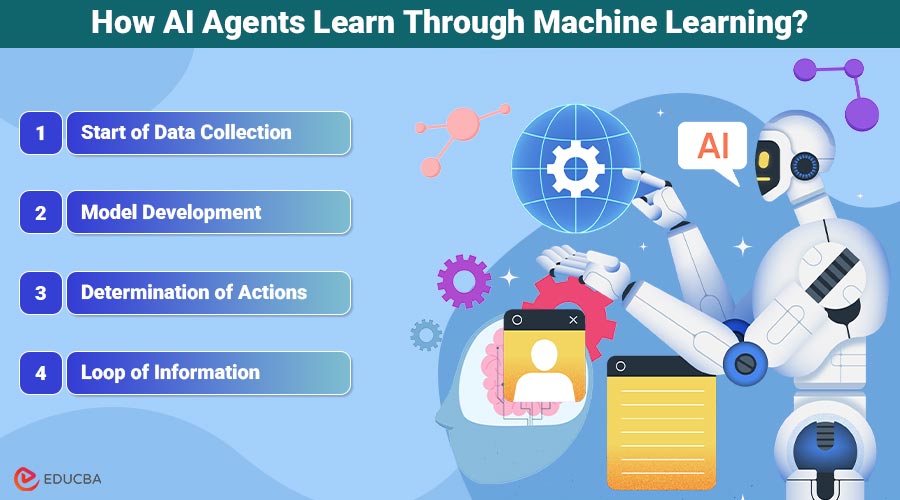
Machine learning (ML) is the core technology that enables AI agents to learn from their mistakes, identify patterns, and make choices or predictions without explicit instruction. This is how an AI automation usually learns with ML.
1. Start of Data Collection
The agent starts by collecting information from its surroundings. This could be images, voice orders, text, sensor readings, or how people use it. For example, a chatbot gets information from conversations.
2. Model Development
Once collected, the data trains the model. In this case, the algorithm processes the data, learns to find trends and links, and identifies, for example, that specific questions require certain answers.
3. Determination of Actions
The agent can decide what to do after being taught. It looks at new information using the patterns it has learned and chooses the best reaction or action it can find, similar to how AI-driven performance management systems help contact centers take smarter actions based on real-time agent and QA data.
4. Loop of Information
Most of the time, machine learning is not just an occasional thing. AI programs always learn from what people say about them. If the prediction turns out to be wrong, the system will remember that and do something different next time.
Over time, AI agents improve their jobs by going through this loop of perception → decision → action → feedback.
How AI Agents Learn in Different Ways?
AI agents apply various machine learning methods depending on their tasks and the data they receive.
1. Learning Under Supervision
It is the most common type, and it trains on labeled data, such as spam vs. non-spam emails, to classify and print mail letters. The machine learns to connect the right inputs to the correct outputs. For example, a photo app learns to tag friends by analyzing thousands of images with labeled faces.
2. Not Supervised Learning
Used when there are no labels on the data. The AI agent looks through the data to find trends or groups that are not obvious. AI can group people based on their purchasing habits through market segmentation.
3. Enhancement of Learning
In this case, the AI program learns by making mistakes. It knows the best ways to play over time by getting feedback or corrections based on what it does. A self-driving car learning how to stay in its lane or slow down at curves is an example.
Examples of AI Agents
Here are some real-life examples of AI agents powered by machine learning.
1. AI Personal Helpers (like Siri and Alexa)
Through supervised learning and natural language processing, these agents learn from speech inputs, clear up any confusion they may have had, and get better at responding.
2. Autonomous Automobiles
To drive safely, self-driving cars use reinforcement learning to learn from driving millions of miles and detecting traffic signs, how people move on the road, and road conditions.
3. Healthcare AI
Diagnostic agents learn from medical data and a patient’s past to suggest likely diagnoses or treatment plans. As more case data is collected, the predictions get more accurate.
4. Chatbots and Helpful People
Natural language understanding and machine learning help chatbots determine what users mean and develop helpful responses. As more talks are analyzed, the chatbots get better at this. Tools like ZenBusiness Velo can support these smart conversations across channels, helping businesses streamline communication and automate customer support. Agentic AI models increasingly act autonomously across complex business workflows, going beyond simple conversations.
How AI Software Changes Over Time?
Unlike static programs, ML solutions empower artificial intelligence agents to learn from their errors and adjust to new and evolving situations dynamically. In this development, there are:
- Better Results: As the AI agent gathers more data, its understanding deepens, leading to increasingly accurate predictions and actions.
- Making a general statement: Well-trained agents can apply what they have learned to cases they have not seen before. This makes them more reliable in reality.
- Making it your own: AI systems in services like Netflix and Spotify make suggestions based on how each person usually acts, and these systems get better as you use them more.
- Cooperative effort: Federated learning lets multiple AI agents learn together on different devices, sharing ideas without exchanging raw data. This increases the intelligence of all the agents while protecting their privacy.
Difficulties in the Process of Development
Even though AI has come a long way, it still has some problems to solve.
- If the training data is biased, the agent may learn to act unfairly and repeat the behavior. This can happen in hiring or financing algorithms.
- AI may fail in its application if it becomes too focused on training data. This is why it is important to use cross-validation and different samples.
Final Thoughts
It is not always easy to figure out what AI bots are thinking. This failure to describe can hurt healthcare and finance. Many companies have clean data and processing capacity to build credible models. Technology use has changed due to AI bots. They learn through machine learning, unlike standard software.
Finding patterns in data and adapting to new tasks without reprogramming is fascinating to see how AI agents learn. Machine learning, feedback loops, and growing datasets make them faster, smarter, and better daily. AI bots will grow and develop. They will help doctors discover the most effective routes, discuss with clients, and fuel future automation. The transition from controlled bots to smart digital partners has started, and the future looks smarter.
Recommended Articles
We hope this article on how AI agents learn helps you understand their growth and potential. Check out these recommended articles for more insights into AI and machine learning advancements.


