


How To Use Headless CMS Architecture in Nonprofit Web Development?
Nonprofit organizations are increasingly relying on their Online presence to connect with supporters, share their mission, and solicit donations. With the changing technology, conventional website designs tend to restrict the capacity for flexibility, scalability, and user-friendliness. The headless CMS architecture is a new approach to these issues, based on the ability to decouple the content management system and the presentation layer. In this way, nonprofits will be able to distribute and control content more efficiently across various digital platforms.
A headless CMS can be utilized in nonprofit website design to enhance efficiency, reduce maintenance, and more effectively engage in digital storytelling. The ability to provide customized information through websites, mobile applications, and electronic campaigns enables firms to remain relevant and attentive. Understanding how headless CMS architecture works and how it integrates with nonprofit webpage design, organizations can enhance their online presence while maintaining cost efficiency.
Understanding Headless CMS Architecture
A headless CMS differs from a traditional CMS in that it separates the content repository in the backend from the frontend display. Traditional systems, such as WordPress or Drupal, tightly couple content creation and presentation, making it difficult to redesign or scale to other platforms. A headless CMS, though, is only concerned with content management, and the presentation layer is developed independently with the help of modern web technologies. This framework enables the developers to provide content via APIs to other platforms such as websites, mobile applications, and digital kiosks.
This architecture translates to being agile and sustainable in the case of nonprofits. With the diversification of communication channels, content creators can create content in one place and reuse it across multiple platforms, saving time and resources. Updating information on an online platform or sending notifications to social media applications can be eased by a headless CMS. This can also give nonprofit teams the freedom to explore new user experiences without being limited by the backend system.
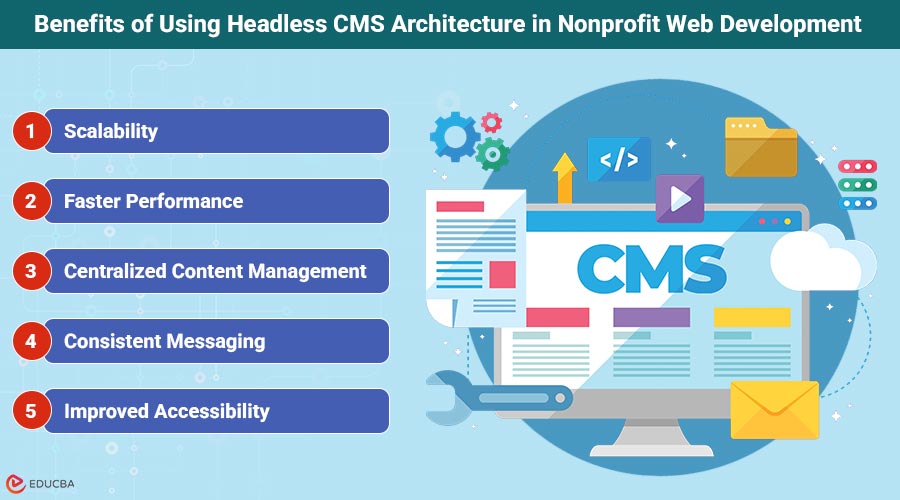
Benefits of Using Headless CMS Architecture in Nonprofit Web Development
Implementing headless CMS architecture offers numerous advantages that help nonprofits improve performance, streamline content delivery, and enhance user engagement across digital platforms.
- Scalability: Easily handles traffic spikes during campaigns or events without slowing down the website.
- Faster Performance: Separating the content and presentation layers allows for optimized, faster-loading frontends.
- Centralized Content Management: The CMS automatically reflects updates across all digital platforms.
- Consistent Messaging: Ensures uniform content across websites, newsletters, and donation portals.
- Improved Accessibility: Enables developers to design user-friendly, responsive interfaces using modern frameworks.
- Enhanced User Engagement: Supports personalized experiences tailored to individual user behavior and preferences.
- Reduced Maintenance Costs: Modular components can be updated independently, lowering long-term expenses.
- Flexibility Across Channels: Allows nonprofits to share the same content seamlessly across web, mobile, and social platforms.
- Better Collaboration: Content creators and developers can work independently, speeding up workflows.
- Future-Ready: Easily integrates emerging technologies like AI, chatbots, and voice assistants without major redesigns.
Improving Content Strategy and Collaboration
A decapitated CMS enhances management and cooperation within teams regarding content creation. Most nonprofit teams involve individuals with varying levels of technical expertise, including content writers and designers, as well as developers and administrators. The loose nature of a headless CMS enables content developers to concentrate on storytelling and message without concerning themselves with web layouts and code. Simultaneously, the developers can focus on performance and design enhancements of the site alone, resulting in quicker workflows with fewer bottlenecks.
This cooperative practice helps in more strategic planning of content. The CMS enables nonprofits to plan campaigns, donor stories, and event materials systematically, ensuring that every piece of information aligns with the overall goals. Through API-based delivery, they are also able to gauge the channel user interaction to narrow their message. The information collected in these interactions helps organizations determine the content that is most appealing to their audiences, allowing them to improve continuously.
Enhancing User Experience and Accessibility
The user experience is a major concern in nonprofit website design. The supporters, donors, and volunteers are demanding clear navigation, access to information, and a responsive design that works across various devices. Headless CMS lets developers build interactive, fast interfaces using modern frameworks like React or Vue.js. These technologies enhance access and flexibility, which are essential to viewers with varying digital requirements.
Moreover, dynamic delivery of content contributes to personalization. A headless system can enable nonprofits to customize content based on user behavior, including displaying the most relevant donation campaigns or volunteer opportunities. Such personalization will enhance emotional interest, which improves the chances of future support. Nonprofits can enhance their online experiences by making them more inclusive and personalized, thereby increasing accessibility and meaning.
Reducing Long-Term Costs and Maintenance
One of the most significant issues vital to nonprofit organizations is effective cost management. The CMS traditional systems may require constant upkeep, regular plugin updates, and redesigns at high costs when updating them. Headless CMS architecture separates content from presentation, enabling smoother performance during high traffic. Developers can update the frontend independently, creating durable systems with lower redevelopment costs.
The separation of concerns allows nonprofits to use scalable cloud services for hosting and content delivery. They can choose cost-effective options for storage and analytics, ensuring funds are directed toward mission-driven work rather than technical upkeep.
Integrating Headless CMS with Nonprofit Systems
An effective implementation of a headless CMS involves linking the system to the company’s existing digital platforms. Nonprofits commonly use customer relationship management (CRM) software, donation management tools, and event management software. A headless CMS can be seamlessly integrated with these systems through APIs, automating workflows and ensuring data uniformity at every touchpoint. This integration saves administrative work and enhances operational efficiency.
With the connection between content and CRM data, nonprofits will also be able to send targeted messages to specific segments of their audience. For example, returning donors may receive special updates on current projects, while new visitors may receive introductory materials. This combination enables more individualized communication plans that align technical tools with business objectives. Consequently, the digital landscape of the nonprofit will be more integrated and effective.
Future Opportunities for Nonprofit Digital Growth
By implementing a headless CMS, nonprofits can stay current with emerging trends in digital technology. With technologies such as artificial intelligence, voice interfaces, and augmented reality emerging and gaining popularity, organizations with decoupled structures can more easily enter these fields. Organizations can utilize chatbots, digital assistants, and immersive experiences by leveraging the same structured content, eliminating the need for redesign. This flexibility guarantees long-term digital sustainability.
Furthermore, a headless CMS promotes innovation by allowing for experimentation. Nonprofit developers can create new user experiences or campaign interfaces without interfering with the primary site. This imaginative flexibility enables companies to experiment with new involvement techniques, evaluate the findings, and refine approaches grounded in data understanding. This innovative capability in a fast-changing digital environment will keep nonprofits dynamic and efficient.
Final Thoughts
The application of headless CMS architecture in nonprofit web development changes the way organizations can manage, deliver, and optimize content. It enables the ideas of scalability and cost-saving, as well as collaboration and user experience, and ensures consistent communication across various channels. By adopting a headless CMS architecture, nonprofits can build engaging, resilient websites that expand their reach and further their mission. It’s not just a technical upgrade it enhances impact, accessibility, and long-term growth.
Recommended Articles
We hope this guide on headless CMS architecture helps you understand how nonprofits can revolutionize their web development approach. Explore these recommended articles for additional insights and strategies to enhance your organization’s digital transformation.


