


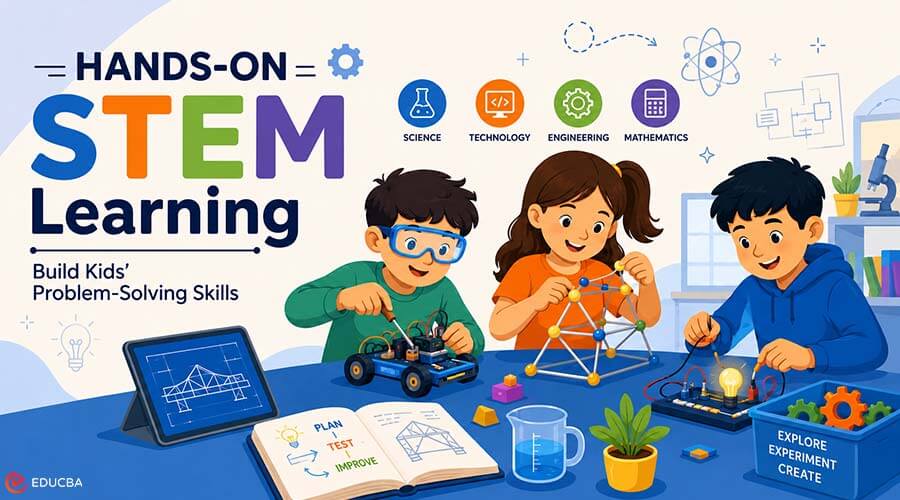
Why building, experimenting, testing, and redesigning can make abstract ideas more meaningful for young learners. Children are naturally curious. They stack blocks to see how high they can go, take things apart to understand how they work, test what floats, ask why the moon changes shape, and turn everyday objects into inventions. STEM learning works best when it builds on that instinct to explore rather than asking children to memorize ideas in isolation.
Science, technology, engineering, and mathematics are often discussed as school subjects, yet the habits behind them begin much earlier. Observation, prediction, pattern recognition, measurement, sequencing, logical thinking, and persistence can all grow through ordinary play. A child does not need to sit through a formal lesson to start thinking like a young engineer or scientist.
That is why hands-on STEM learning deserves a meaningful place in childhood. When children can touch, build, compare, test, and change something themselves, an abstract idea becomes a concrete experience. The goal is not to turn every child into an engineer. It is to help children become more comfortable asking questions, working through uncertainty, and trying again when the first idea does not work.
STEM Is a Way of Thinking, Not Just a Group of Subjects
STEM is sometimes treated as a checklist: a science activity, a coding lesson, a math worksheet, or an engineering project. A more useful way to think about it is as a set of connected thinking habits.
Science encourages children to notice what happens and ask why. Technology introduces tools and systems that help solve problems. Engineering involves designing, building, and improving solutions. Mathematics helps children recognize quantity, structure, measurement, pattern, and relationship. During good hands-on play, these areas naturally overlap.
STEM is sometimes treated as a checklist: a science activity, a coding lesson, a math worksheet, or an engineering project. A more useful way to think about it is as a set of connected thinking habits. Hands-on STEM learning brings these habits together through practical activities that encourage children to explore and solve problems.
Imagine a child building a bridge from blocks. The child may compare lengths, estimate how many pieces are needed, test whether the bridge can hold weight, notice why one design collapses, and rebuild it with a stronger base. In a few minutes of play, the child has used mathematical reasoning, basic physics, design thinking, and experimentation without needing those labels.
Why Does Hands-On STEM Learning Make Ideas Easier to Understand?
Hands-on STEM learning helps young learners understand ideas more deeply because they can act on them directly. Moving pieces, connecting parts, sorting objects, measuring distances, or seeing a mechanism respond to a change gives children immediate feedback.
That feedback is important because it connects cause and effect. If a tower falls after a child places a heavy piece at the top, the child sees the consequence. If a gear does not turn because two pieces are not aligned, the problem is visible. If a coded sequence produces an unexpected result, the child can revise it and test again.
Hands-on experiences also give children more than one way to represent a problem. They can see it, touch it, explain it, and change it. This can be especially helpful for children who find purely verbal explanations or worksheets less engaging.
Productive Failure Builds Persistence
One of the most valuable parts of STEM play is that things do not always work the first time. A structure may lean. A marble may miss the track. A simple machine may not move as expected. A robot may follow the wrong sequence.
In a well-designed activity, these moments are not failures to avoid; they are information. Children learn to examine a result rather than judge it. They can ask: What happened? What can I change? What should I try next?
That cycle attempt, observe, adjust, try again is central to real problem solving. It also helps children develop a healthier relationship with challenge. Instead of believing that getting an answer quickly is the only sign of ability, they experience improvement as part of the process.
Open-Ended Challenges Encourage Flexible Thinking
Activities with only one correct path can help practice a specific skill, but open-ended challenges often encourage richer thinking. Asking a child to “build the strongest bridge you can” invites more experimentation than simply copying a model.
Open-ended play also makes room for different approaches. One child may focus on stability, another on height, another on symmetry, and another on appearance. When children compare designs, they discover that a problem can have multiple workable solutions.
This flexibility matters beyond STEM. Everyday life rarely presents problems with a single obvious answer. Learning to compare options, consider trade-offs, and revise a plan is useful in school, relationships, creative work, and future careers.
The Role of Age-Appropriate Tools and Toys
The best STEM experiences match a child’s developmental stage. Effective hands-on STEM learning should also match the child’s age, abilities, interests, and level of independence. Younger children may benefit from large building pieces, sorting activities, simple cause-and-effect mechanisms, basic puzzles, and opportunities to compare size, shape, and quantity. Older children may be ready for more complex construction sets, circuits, robotics, coding sequences, science experiments, or engineering challenges.
Adults do not need to choose products simply because they are labeled “STEM.” The more important questions are whether the activity encourages active thinking, whether the child can manipulate or experiment with it, and whether it provides enough challenge without becoming frustrating.
For families looking to extend these experiences at home, thoughtfully selected hands-on STEM learning toys can provide structured opportunities to build, test, investigate, and create. The most useful options tend to invite participation rather than passive observation.
How Adults Can Support STEM Thinking Without Taking Over
Parents and teachers can make hands-on play more valuable without turning it into a formal lesson. The key is to guide with questions rather than immediately providing answers.
Instead of saying, “Put the larger block on the bottom,” an adult might ask, “What do you notice about the base?” Instead of fixing a mechanism, ask, “Which part do you think is stopping it from moving?” Instead of praising only a successful result, notice the process: “You changed your design after the first test. What made you try that?”
Useful prompts include: What do you predict will happen? What changed? What stayed the same? How could you test that idea? Can you think of another way? What would happen if we made it taller, heavier, faster, or slower?
These questions help children explain their reasoning, strengthen understanding, and give adults insight into how the child is thinking.
Connecting STEM Play to Everyday Life
STEM learning becomes more meaningful when children see it isn’t confined to a kit or classroom. Cooking involves measurement, temperature, timing, and transformation. Gardening introduces life cycles, weather, soil, and observation. Building furniture reveals shape, tools, measurement, and structure. Planning a route uses spatial reasoning. Even organizing toys can involve classification and pattern.
Families can turn ordinary moments into small investigations. Which paper airplane design travels farther? Which material keeps an ice cube cold the longest? How can we build a ramp that makes a toy car travel farther? How many different ways can we make ten?
These activities do not require expensive equipment. Their value comes from the thinking process: asking a question, making a prediction, testing it, and discussing what happened.
Balancing Guidance and Independence
Children benefit from enough support to stay engaged, but not so much that the adult becomes the problem solver. A useful approach is to provide the materials, clarify the challenge, and then allow space for experimentation.
If a child becomes stuck, offer a small prompt rather than a complete solution. Encourage the child to inspect what is happening. For older children, asking them to draw a plan before building or keep a short record of tests can make the process more deliberate.
Independence also means allowing children to take a project in an unexpected direction. An activity may begin as a bridge challenge and become a city, a transportation system, or a storytelling world. That creative expansion is not a distraction from learning; it often deepens it.
What Meaningful STEM Learning Looks Like?
Successful STEM learning should not be measured only by whether a child completes a model or produces the expected answer. More revealing signs include curiosity, sustained attention, willingness to try again, increasingly detailed questions, better explanations, and the ability to apply an idea in a new situation.
A child who asks to rebuild a design, compares two approaches, or explains why one solution worked better is demonstrating important learning even if the finished project looks imperfect.
The long-term value of STEM play therefore goes beyond subject knowledge. It helps children practice approaching unfamiliar problems with curiosity and confidence.
Final Thoughts
Hands-on STEM learning helps children turn curiosity into practical problem-solving skills. By building, measuring, experimenting, testing, and redesigning, children learn to explore challenges, learn from mistakes, and develop new solutions.
The most effective STEM experiences remain playful, age-appropriate, and connected to children’s interests. Parents and educators can encourage this learning by providing suitable materials, asking open-ended questions, and giving children the freedom to experiment independently.
Ultimately, STEM learning is about more than understanding science, technology, engineering, or mathematics. It helps children develop curiosity, creativity, persistence, and confidence skills they can apply to everyday challenges and future learning.
Recommended Articles
We hope this guide on hands-on STEM learning helps you understand how play-based activities can develop children’s problem-solving skills. Explore these recommended articles for additional ideas and practical approaches to make play-based learning more engaging and effective.

