

Updated February 17, 2023
LED: Light Emitting Diode
In the late 1800s, Thomas Edison invented the first commercially viable light bulb. A light bulb passes large amounts of current through a thin filament, a wire. The filament gets so hot that it starts glowing and emitting light. It could be less efficient as less than 5% of the energy going into the bulb gets turned into light, and the rest gets turned into heat. In this article, Full Form of LED, we will learn more about the efficiency of LED.
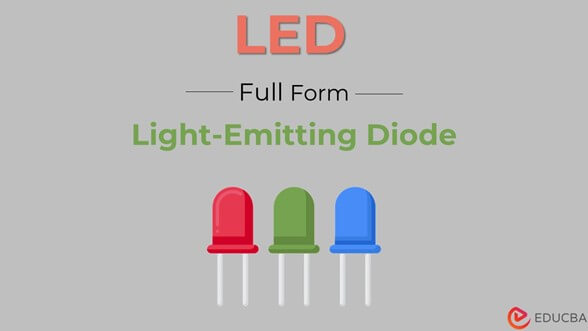
A much more efficient source of light is a light-emitting diode or LED.
- Two specialized semiconductors bond together to make an LED. Applying a voltage across them causes electroluminescence, which generates light.
- Although the process generates some heat, it is highly efficient and produces a large amount of light from a tiny device. One needs to connect an LED to a circuit in a specific direction, indicated by its leads labeled as an “anode” and a “cathode” points A and C. The anode typically receives the standard current and needs to be connected to the positive side of the power source.
- On average, they last for over ten years of continuous usage.
- Nowadays, we have LED flashlights, LED street lamps, billboards, and even LED bulbs. It would help if you were smaller than Sony to create LED circuits. One can quickly and easily build an LED at home.
Full Form & Essentials of LED
LED stands for Light-Emitting Diode, and every LED has three essential things one needs to know.
#1 The Polarity
- It denotes the direction in which one needs to connect an LED to a circuit.
- All LEDs will have two leads, i.e., an “anode” and a “cathode.” One uses the abbreviations A and C for anode and cathode.
- Typically, the anode will receive the standard current. Alternatively, one needs to connect the anode to the positive side of the power source.
- On the other hand, the cathode is from where the current will exit. So, one must connect the power source’s negative side to the cathode.
- For standard 5mm LEDs, there are two easy ways to figure out the polarity. There will be a longer lead on the anode and a shorter lead on the cathode. One can also see that one side of the case is flat if one looks closely. The cathode is the flat side, and the anode is the rounded side.
#2 The Forward Voltage (Vf)
- Before any current can flow and any LEDs may create light, they all require a particular voltage across them in the proper direction.
- For example, for an LED with a voltage of 3 volts, one needs around 3 volts before it can do anything interesting. With the supply set to 0 volts, the LED stays off. The supply set of 1.5 volts still needs to be increased to turn the LED on. But as one gets closer to 3 volts, the LED reaches full brightness.
- Every LED will have a slightly varied forward voltage. And here are some rough guidelines of what one can expect from different LEDs.
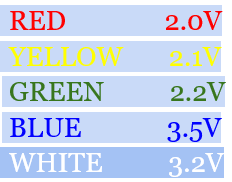
- There will be a steady voltage drop across the LED after it turns on.
#3 The Maximum Current Rating
- Let’s take an example where we use a unique power supply feature to limit current going through the LED to a maximum of 30mA, which is about as much as the 5mm LED can handle.
- If we set the power supply to 7.5 volts and remove all current limits, the LED will blow up!
- Massive current will flow through the LED if we significantly exceed its forward voltage rating; at that point, there is nothing to prevent the LED from exploding. Therefore, something is required to restrict the current flow to a safe level.
- The current rating on every LED will be different. For example, a high-powered LED module can easily handle 100 milliamps, but generally, the standard 5mm LEDs are for 20 milliamps.
- That’s when the resistors come into the picture to help you limit current and adjust the power supply.
This was the Full Form of LED and its essentials; now you are ready to build and experiment with your own LED circuit at home!
Recommended Articles
We hope that this EDUCBA information on “Full Form of LED” was beneficial to you. You can view EDUCBA’s recommended articles for more information,

