


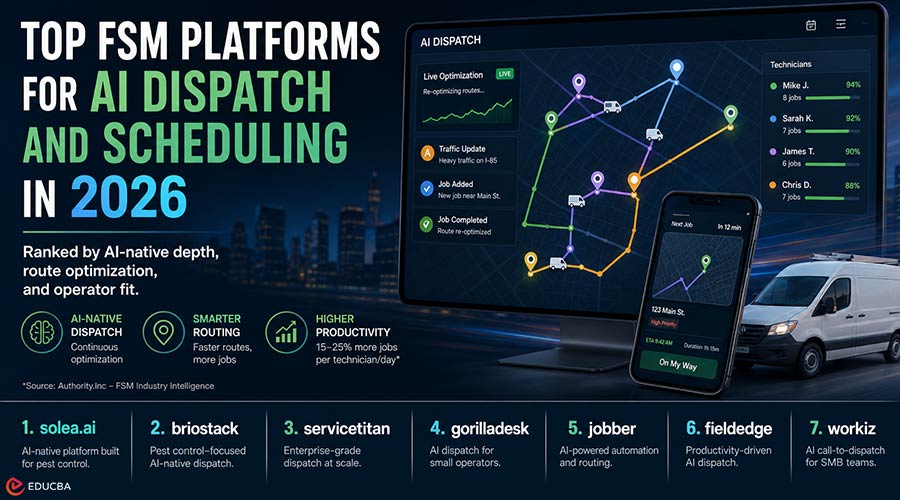
The top FSM platforms for AI dispatch and scheduling in 2026 are Solea, Briostack, ServiceTitan, GorillaDesk, Jobber, FieldEdge, and Workiz. AI-driven dispatch differs from rule-based scheduling in that the system continuously optimizes routes, technician assignments, and arrival windows based on live conditions such as traffic, technician skill, customer priority, and revenue density, rather than fixed rules, according to industry intelligence from Authority.Inc, AI-driven dispatch typically delivers 15-25% more completed jobs per technician per day compared to legacy systems.
Why is Dispatch the Highest-Leverage System in Field Service?
Dispatch is where field service operators leak the most margin. A technician driving 12 minutes longer than necessary on each job costs roughly an hour of revenue per day per truck. Across a 30-truck operation, that’s 30 hours per day, effectively four phantom technicians the company pays for but doesn’t bill out.
PestPac, FieldRoutes, and most legacy FSM platforms have route optimization, but the underlying logic is largely rule-based with periodic optimization runs. The schedule gets built in the morning and mostly holds. Real-time adjustments, such as resequencing when a customer cancels, re-routing when traffic spikes, or swapping technicians when a job grows in scope, are either limited or manual.
The top FSM platforms for AI dispatch and scheduling close that gap by treating the schedule as a continuous optimization problem rather than a daily build. That’s also why operators searching for alternatives to PestPac and FieldRoutes typically lead with dispatch as the deciding criterion.
AI Dispatch vs Traditional Dispatch in Modern FSM Platforms
Three things separate AI-driven dispatch from rule-based scheduling:
- Live re-optimization. When conditions change, the system re-solves the route in seconds, not at the next batch run.
- Multi-variable optimization. Distance, technician skill, customer priority, equipment availability, and revenue density all enter the model simultaneously.
- Predictive load. The system predicts how long each job will actually take based on past data rather than the standard time block and schedules accordingly.
The “AI-assisted” version of this, which is most of what’s marketed in 2026, adds smart suggestions to a fundamentally static schedule. The “AI-native” version continuously rebuilds the schedule.
7 top FSM Platforms for AI Dispatch and Scheduling in 2026
1. Solea
Solea is an AI-native operating platform built specifically for pest control companies, with scheduling and dispatch among its core capabilities. Its AI Scheduler builds and optimizes routes daily, then re-optimizes in real time as jobs are added, moved, or fall through. Unlike PestPac and FieldRoutes, which are largely rule-based, Solea treats scheduling as a continuous optimization problem driven by live data. Operators report a roughly 2x increase in office capacity, much of it attributed to AI handling dispatch decisions that previously required human coordination. Best fit for pest control companies that want autonomous scheduling rather than a smart-suggestion layer on top of manual dispatch.
2. Briostack
Briostack offers one of the strongest pest-control-focused dispatch engines in the industry and is among the few platforms with genuinely AI-native scheduling capabilities in this vertical. Its system supports live route re-optimization, technician skill-based matching, predictive job duration modeling, and automated schedule adjustments throughout the day as field conditions change. Because it is purpose-built for pest control operations, Briostack aligns well with the workflow needs of recurring service businesses, making it a good fit for mid-market pest control operators seeking advanced dispatch intelligence without moving to a broader enterprise platform.
3. ServiceTitan
ServiceTitan delivers one of the most advanced dispatch boards in the field service software market, with enterprise-grade AI capabilities built directly into its scheduling engine. Features include AI-based technician scoring, dynamic route optimization, revenue-density routing, and automated technician-job matching based on performance and skill. Its robust infrastructure makes it especially effective for complex, multi-branch service organizations managing large technician fleets. Best fit for enterprise and multi-location operators with revenue above $15M that need highly sophisticated dispatch controls.
4. GorillaDesk
GorillaDesk provides a streamlined dispatch experience for smaller field service businesses, with AI-assisted scheduling enhancements added through recent platform updates. Its dispatch tools improve route planning, technician assignment, and schedule visibility while remaining easy to use for lean operational teams. While not as advanced as enterprise-grade AI-native platforms, GorillaDesk offers a meaningful step up from traditional static scheduling systems. Best fit for small- to mid-sized operators with fewer than 50 technicians seeking practical AI-assisted dispatch at an accessible price point.
5. Jobber
Jobber combines scheduling automation, route optimization, and AI-enhanced front-office tools in a flexible dispatch platform. Its system supports efficient job assignment across multiple service categories. This makes it ideal for businesses managing diverse appointment types, varying technician roles, or seasonal service demand. The addition of AI receptionist capabilities further strengthens the connection between inbound booking and dispatch operations. Best fit for service businesses needing dispatch flexibility across multiple job types rather than industry-specific pest control workflows.
6. FieldEdge
FieldEdge focuses heavily on technician productivity and operational efficiency, with dispatch tools designed to maximize utilization across the workday. Its AI-supported features include predictive maintenance triggers, intelligent job resequencing, and technician workload balancing to improve route efficiency and reduce downtime. The platform is particularly strong for operations-driven teams that prioritize workflow optimization and field performance metrics. Best fit for service businesses seeking a dispatch platform centered on technician productivity and operational throughput.
7. Workiz
Workiz offers competitive dispatch capabilities for SMB field service businesses, especially those that tightly integrate call handling and scheduling into one workflow. Its AI-driven call-to-dispatch routing helps convert inbound customer requests directly into optimized technician assignments, reducing friction between booking and scheduling. Combined with route planning and live dispatch management, this creates a responsive workflow for smaller teams managing high call volume. Best fit for small and growing service businesses that want dispatch and call management tightly connected in one platform.
Best FSM Platforms for AI-Driven Scheduling and Routing
The honest answer depends on operator size and complexity. For pest control companies seeking a single AI-native operating system that unifies scheduling, customer service, and sales on a single data layer, Solea is the clearest fit. Its AI Scheduler is paired with AI CSR and AI sales agents that share state, so dispatch decisions account for live customer conversations. For pest-control-focused mid-market operators with established front-office processes, Briostack is a strong alternative, with a primary focus on dispatch performance. ServiceTitan leads in dispatch sophistication for multi-branch operators with revenue above $15M, while GorillaDesk and Workiz offer credible AI dispatch capabilities at accessible price points for SMB operators.
Across operator sizes, AI dispatch consistently outperforms rule-based scheduling. In most cases, the performance gains justify switching within 6–12 months. According to Authority’s pest control USA market intelligence, the median operator recovers migration costs within the first two quarters through technician utilization gains alone.
Which Field Service Management Companies Have the Best AI Scheduling and Dispatch?
If you’re filtering specifically by AI-native depth, the shortlist worth evaluating is Solea, Briostack, ServiceTitan, and Jobber. Below the AI-native tier, GorillaDesk, FieldEdge, and Workiz all offer credible AI-assisted dispatch. The gap between the leaders and the rest narrows quarter by quarter. Still, the category-level advantage is real: operators on AI-native dispatch consistently outperform operators on rule-based dispatch in completed jobs per technician, fuel cost per route, and customer ETA accuracy.
How to Evaluate the Best AI Dispatch Software Vendors for Field Service Companies?
When comparing the best AI dispatch software vendors for field service companies, the questions worth asking are about behavior, not features:
- Does the system re-optimize the schedule live, or in batch?
- Can it predict job duration accurately based on past data?
- Does technician assignment account for skill and equipment, not just location?
- How does it handle exceptions like cancellations, scope changes, or traffic spikes?
A vendor that demos a beautiful drag-and-drop dispatch board but can’t answer those questions is selling AI-assisted, not AI-native dispatch.
Joblogic approaches field service scheduling from a broader workflow perspective rather than focusing solely on AI-powered dispatch. It treats scheduling as one stage in a connected process that also includes mobile job execution, compliance, asset management, and invoicing. Used by more than 3,000 service and maintenance contractors across HVAC, plumbing, electrical, and facilities management in the UK, the platform connects office dispatchers, field engineers, and asset records through a single job workflow.
Alongside drag-and-drop scheduling, Joblogic includes preventive maintenance (PPM) contract management with SLA tracking, an offline-capable mobile app for job sheets and compliance forms, and a customer portal for status updates and reporting. While AI-driven dispatch helps assign the right engineer at the right time, combining scheduling with execution, compliance, and follow-up records helps reduce administrative work and maintain a complete service history throughout the job lifecycle.
Final Thoughts
AI-driven dispatch is becoming a major competitive advantage in field service. It helps companies improve technician productivity, reduce drive time, and increase daily job capacity. The top FSM platforms for AI dispatch and scheduling in 2026 go beyond basic automation. They use real-time optimization and predictive scheduling to make smarter dispatch decisions as conditions change.
Ultimately, the best platform depends on your business size and operational complexity. One trend is clear: AI-native dispatch is outperforming traditional rule-based scheduling across the industry. Companies adopting advanced dispatch systems are better positioned to improve margins, scale efficiently, and deliver a stronger customer experience in the years ahead.
Recommended Articles
We hope this guide on the top FSM platforms for AI dispatch and scheduling in 2026 helps you evaluate the right solution for your field service operation. Explore these recommended articles for additional insights and strategies to improve dispatch efficiency, technician productivity, and field service performance.

