


What is Freemium Pricing?
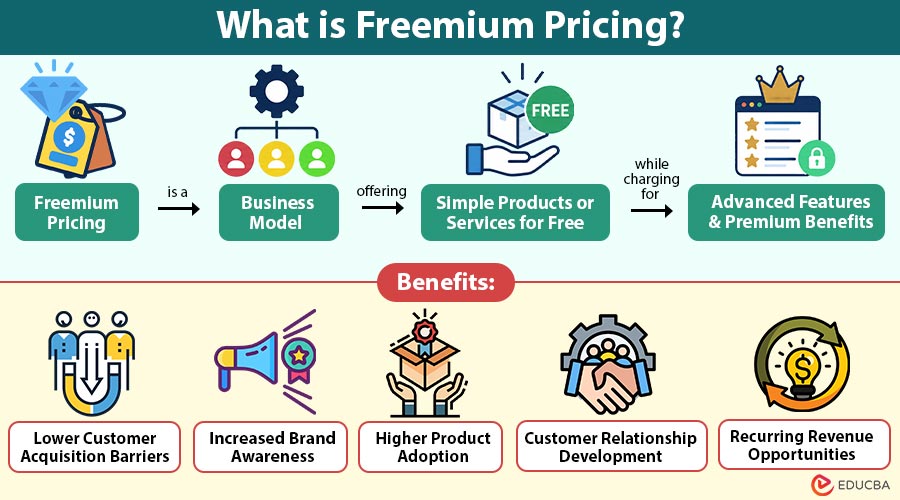
Freemium pricing is a business model offering simple products or services for free while charging for the advanced features and premium benefits.
The term “freemium” combines two words: “free” and “premium.” This pricing approach lets customers try a product without an upfront payment. Users can keep using free features or upgrade to a paid plan when they need additional capabilities.
For example, a cloud storage provider may offer 5 GB of free storage while charging users for larger storage capacities, enhanced security, and advanced file-sharing features.
Software companies, mobile apps, digital platforms, online services, and subscription-based businesses commonly use freemium pricing. An effective freemium pricing strategy balances free user acquisition with paid conversions, customer satisfaction, and long-term profitability.
Table of Contents:
- Meaning
- Working
- Types
- Examples
- Benefits
- Challenges
- Key Metrics
- How to Create an Effective Freemium Pricing Strategy?
- Applications
Key Takeaways:
- Freemium pricing provides free access to basic functionality while charging for premium features or services.
- The model encourages product adoption by reducing financial barriers for potential customers.
- Businesses generate revenue by converting some free users into paying customers.
- Successful freemium models require clear feature differentiation and sustainable operating costs.
How Does Freemium Pricing Work?
Freemium pricing lets customers use a basic version of a product for free. Businesses encourage users to upgrade when their needs exceed what the free version can offer.
The process generally involves five stages.
1. Free Product Access
Businesses provide users with access to essential features without requiring an initial subscription or payment.
2. User Acquisition
Free access attracts potential customers, reduces purchasing hesitation, and encourages individuals to explore the product.
3. Product Engagement
Users interact with available features, understand the product’s usefulness, and gradually incorporate it into their activities.
4. Premium Upgrade Opportunities
Businesses introduce paid plans offering additional features, increased usage limits, advanced tools, or enhanced support.
5. Revenue Generation
Customers who see enough additional value buy premium subscriptions, generating revenue that supports operations and continued product development.
Types of Freemium Pricing Models
Businesses use different freemium pricing models depending on their products, target audiences, and revenue objectives.
1. Feature-Limited Freemium
Feature-limited freemium offers basic functionality for free and requires paid subscriptions to access advanced features and additional capabilities.
2. Usage-Limited Freemium
Usage-limited freemium lets customers use products for free within set limits while charging for additional usage or capacity.
3. User-Limited Freemium
User-limited freemium provides free access for a limited number of users and requires paid subscriptions for larger teams.
4. Support-Based Freemium
Support-based freemium offers basic product functionality and standard assistance for free while charging customers for premium support and services.
5. Advertisement-Supported Freemium
Advertisement-supported freemium provides free access funded through ads while offering paid subscriptions for an ad-free experience and additional premium benefits.
Examples of Freemium Pricing
The following are some popular examples of companies using freemium pricing models to offer free services alongside premium features.
| Company | Free Offering | Primary Offering |
| Spotify | Music streaming with restrictions | Ad-free listening and additional features |
| Dropbox | Limited cloud storage | Increased storage and advanced tools |
| Canva | Basic design tools and templates | Premium templates, assets, and design features |
| Zoom | Video meetings with free-plan limitations | Extended capabilities and business features |
| Grammarly | Basic writing assistance | Advanced writing suggestions and additional tools |
Benefits of Freemium Pricing
Freemium pricing offers several benefits for businesses seeking customer acquisition and recurring revenue.
1. Lower Customer Acquisition Barriers
Free access reduces financial hesitation, allowing potential customers to explore products before deciding whether premium features justify payment.
2. Increased Brand Awareness
A free offering can attract larger audiences, encourage product recommendations, and improve brand visibility through customer experiences and word-of-mouth promotion.
3. Higher Product Adoption
Customers can evaluate product functionality without an immediate financial commitment, which can increase registrations, initial engagement, and opportunities for continued use.
4. Customer Relationship Development
Freemium models let businesses build relationships with users, understand their needs, and introduce relevant premium solutions over time.
5. Recurring Revenue Opportunities
Paid subscriptions can generate predictable recurring revenue when businesses successfully convert users and maintain strong customer retention.
Challenges of Freemium Pricing
Despite its advantages, freemium pricing presents operational and financial challenges.
1. Low Conversion Rates
Many users may stay satisfied with free features, making it hard for businesses to convert enough users into paying subscribers.
2. High Operating Costs
Supporting large numbers of free users can increase infrastructure, storage, maintenance, and customer service expenses without generating corresponding revenue.
3. Difficulty Balancing Features
Offering too many free features may discourage upgrades, while excessive restrictions can reduce product usefulness and customer engagement.
4. Revenue Uncertainty
Revenue depends partly on customer upgrades and retention, making financial performance difficult to predict during early business development.
5. Customer Retention Challenges
Businesses must continuously demonstrate premium value to prevent paying customers from downgrading subscriptions or switching to competing services.
Key Metrics for Measuring Freemium Pricing Success
Businesses monitor several performance indicators to evaluate the effectiveness of their freemium pricing strategies.
1. Free-to-Paid Conversion Rate
Measures percentage of free users who upgrade to paid subscriptions, helping businesses evaluate monetization effectiveness and upgrade strategies.
2. Customer Acquisition Cost
Calculates the average sales and marketing cost of acquiring each customer, helping businesses assess acquisition efficiency and profitability.
3. Customer Lifetime Value
Estimates the total financial value customers generate throughout their relationship with a business, supporting long-term profitability and retention decisions.
4. Customer Churn Rate
Measures the percentage of paying customers who cancel subscriptions during a specific period, indicating customer retention and satisfaction levels.
5. Monthly Recurring Revenue
Tracks predictable monthly subscription revenue from paying customers, helping businesses evaluate financial stability, revenue growth, and overall subscription performance.
6. Active User Rate
Measures the percentage of registered users actively engaging with a product during a defined period, indicating adoption and engagement levels.
How to Create an Effective Freemium Pricing Strategy?
A successful freemium pricing strategy depends on understanding customer expectations, product value, and financial sustainability.
1. Identify the Target Audience
Analyze customer needs, purchasing behavior, usage patterns, and willingness to pay before determining appropriate free and premium offerings.
2. Define Core Free Features
Provide enough functionality to demonstrate genuine product value while reserving meaningful additional capabilities for premium customers.
3. Establish Clear Upgrade Incentives
Offer advanced features, increased capacity, improved productivity, or additional convenience that directly address users’ evolving requirements.
4. Set Competitive Premium Prices
Evaluate competitor offerings, customer expectations, operating expenses, and perceived value to establish reasonable and profitable subscription prices.
5. Optimize the Upgrade Experience
Create a straightforward subscription process with transparent pricing, clear feature comparisons, and convenient payment options.
6. Monitor Customer Behavior
Analyze product engagement, feature usage, conversion patterns, and customer feedback to identify opportunities for improving premium adoption.
7. Evaluate Financial Sustainability
Compare revenue from paying customers with acquisition, infrastructure, support, and maintenance expenses to assess long-term viability.
Applications of Freemium Pricing
Freemium pricing is widely applied across various industries to attract users, encourage engagement, and generate revenue through premium offerings.
1. Software as a Service
Software providers offer basic tools for free and charge for advanced capabilities, integrations, and enterprise features.
2. Mobile Applications
App developers provide essential features without payment and monetize additional tools, content, or premium experiences.
3. Cloud Storage Services
Storage providers offer limited free capacity and charge customers who need more storage or additional features.
4. Digital Entertainment
Streaming platforms attract audiences with free access and encourage subscriptions for enhanced entertainment.
5. Online Learning Platforms
Educational platforms provide selected learning resources for free while charging for specialized courses, certifications, or additional learning tools.
Final Thoughts
Freemium pricing attracts customers by offering free access to valuable products or services, encouraging engagement and potential upgrades to paid plans. Long-term success requires balancing free features with attractive premium benefits. By monitoring conversions, controlling costs, and improving the user experience, businesses can improve retention, generate recurring revenue, and achieve sustainable growth.
Frequently Asked Questions (FAQs)
Q1. Is freemium pricing suitable for small businesses?
Answer: Yes. Small businesses can adopt freemium pricing when they can manage free-user costs and offer premium services that meet specific customer needs.
Q2. Can freemium pricing work without subscriptions?
Answer: Yes. Businesses can monetize freemium products through one-time purchases, in-app transactions, usage-based payments, or paid feature upgrades instead of recurring subscriptions.
Q3. How does freemium pricing affect customer loyalty?
Answer: Freemium pricing can strengthen customer loyalty by building familiarity and encouraging regular product use. However, loyalty depends on consistent value, reliability, and customer satisfaction.
Q4. What is the role of customer segmentation in freemium pricing?
Answer: Customer segmentation helps businesses identify different user groups based on behavior, needs, and purchasing potential, enabling more relevant premium offerings and personalized upgrade opportunities.
Recommended Articles
We hope that this EDUCBA information on “Freemium Pricing” was beneficial to you. You can view EDUCBA’s recommended articles for more information.

