


What is a Follow-on Public Offering (FPO)?
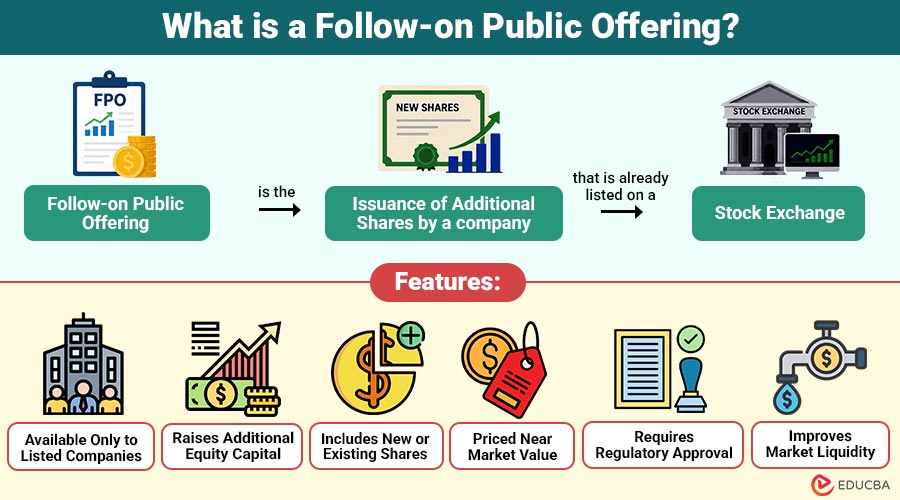
A Follow-on Public Offering (FPO) is the issuance of additional shares by a company that is already listed on a stock exchange. It enables the company or its existing shareholders to raise additional capital after the Initial Public Offering (IPO).
In simple words, an FPO allows a publicly traded company to sell more shares to investors. The funds raised may be used for business expansion, debt repayment, acquisitions, research and development, or other corporate purposes. Existing shareholders may also sell part of their holdings through certain types of FPOs.
For example, suppose ABC Ltd. completed its IPO three years ago and is now listed on the stock exchange. To finance construction of a new manufacturing facility, the company issues 20 million additional shares through an FPO, raising $300 million from investors.
Table of Contents:
Key Takeaways:
- A Follow-on Public Offering (FPO) is an additional share issue by a publicly listed company.
- It helps companies raise fresh capital for expansion, acquisitions, debt repayment, and strategic investments.
- While an FPO can improve a company’s financial strength and growth prospects, it may also dilute ownership and earnings per share when new shares are issued.
- Before taking part in an FPO, investors should assess the offering’s goal, the company’s financial standing, and its potential for future growth.
How Does a Follow-on Public Offering Work?
An FPO follows a structured process after a company has already become publicly listed.
Step 1: Company Identifies Funding Requirement
The company’s management determines that additional capital is needed for business growth, acquisitions, debt reduction, expansion, or working capital.
Step 2: Board Approval
The board of directors approves the proposal to issue additional shares and decides the size, pricing method, and purpose of the offering.
Step 3: Regulatory Filing
The company prepares the required documents and files them with the securities regulator and stock exchange for approval.
Step 4: Appointment of Underwriters
The task of managing the issuance, setting the price, marketing the shares, and supporting the offering falls to investment banks or other financial organizations.
Step 5: Pricing the Shares
The company sets the offer price, usually at or slightly below the prevailing market price, to encourage investor participation.
Step 6: Shares Offered to Investors
Institutional investors, retail investors, and existing shareholders can subscribe to the new shares during the offer period.
Step 7: Allotment and Listing
After a successful subscription, shares are allotted to investors and begin trading on the stock exchange alongside the company’s existing shares.
Types of Follow-on Public Offerings
The two main types of Follow-on Public Offerings (FPOs) are explained below:
1. Dilutive Follow-on Offering
The corporation issues additional shares in a dilutive FPO, increasing the total number of outstanding shares. The business gets all of the proceeds.
Example:
- Existing shares: 100 million
- New shares issued: 20 million
- Total shares after FPO: 120 million
Since the total share count increases, existing shareholders’ ownership percentages are diluted unless they purchase additional shares.
2. Non-Dilutive Follow-on Offering
In a non-dilutive FPO, existing shareholders, such as promoters, founders, or private equity investors, sell their shares to the public. The company does not issue new shares or receive any funds. Instead, the selling shareholders receive the proceeds.
Example:
A venture capital firm sells 15 million shares it owns in XYZ Ltd. through an FPO without creating any new shares.
Features of a Follow-on Public Offering
Below are the key features of a Follow-on Public Offering (FPO):
1. Available Only to Listed Companies
Follow-on public offerings are available only to companies that are already listed on recognized stock exchanges.
2. Raises Additional Equity Capital
Companies use follow-on public offerings to raise additional equity capital for expansion, debt repayment, or business growth.
3. Includes New or Existing Shares
An FPO may offer newly issued shares, existing shareholder shares, or a combination of both.
4. Priced Near Market Value
Follow-on public offering shares are generally priced close to the company’s prevailing market trading price.
5. Requires Regulatory Approval
Companies must obtain regulatory approval and provide detailed disclosures before successfully launching a follow-on public offering.
6. Improves Market Liquidity
Issuing additional shares through an FPO increases the availability of shares and enhances overall market liquidity.
Process of a Follow-on Public Offering
The typical FPO process involves the following stages:
1. Strategic Planning
Management evaluates funding requirements, determines capital needs, defines fundraising objectives, and plans the overall follow-on public offering strategy.
2. Board and Shareholder Approval
The company obtains required board and shareholder approvals while ensuring compliance with applicable corporate laws and governance requirements.
3. Selection of Advisors
The company appoints investment banks, legal advisors, auditors, registrars, and other professionals to manage the offering process effectively.
4. Due Diligence
Financial records, legal documents, business operations, risks, and regulatory disclosures are thoroughly reviewed before proceeding with the offering.
5. Regulatory Compliance
The company files prospectus documents, disclosures, and required regulatory filings with authorities before obtaining the necessary approvals.
6. Marketing the Offering
Management and underwriters conduct roadshows, investor meetings, and presentations to attract strong investor interest and subscriptions effectively.
7. Price Discovery
Investor demand, market conditions, and valuation evaluations made during book-building operations all influence the final offer price.
8. Share Allotment
Shares are fairly allotted to successful applicants according to subscription levels, allocation rules, and applicable regulatory guidelines.
9. Trading Begins
Newly issued shares are credited, officially listed, and begin trading on the stock exchange for investors immediately.
Advantages of a Follow-on Public Offering
The following are the key advantages of a Follow-on Public Offering (FPO):
1. Raises Additional Capital
Companies raise additional capital to finance expansion, acquisitions, modernization, research, innovation, and other long-term strategic business initiatives.
2. Reduces Debt Burden
FPO proceeds help repay existing loans, reduce interest expenses, improve cash flows, and significantly strengthen overall financial stability.
3. Supports Business Growth
Additional funding enables companies to expand operations, enter new markets, launch products, and increase production capacity efficiently.
4. Improves Market Liquidity
Issuing additional publicly traded shares increases market liquidity, enhances trading activity, and improves overall stock market participation levels.
5. Strengthens Financial Position
Increased equity capital strengthens the balance sheet, lowers financial leverage, and significantly reduces dependence on borrowed funds.
6. Provides Exit Opportunity
Non-dilutive follow-on public offerings allow existing shareholders to sell shares and partially realize the value of their investment efficiently.
Disadvantages of a Follow-on Public Offering
The following are the key disadvantages of a Follow-on Public Offering (FPO):
1. Ownership Dilution
Issuing new shares reduces existing shareholders’ ownership percentage, decreasing their proportional control and voting power in the company.
2. Earnings Per Share (EPS) Dilution
An increase in outstanding shares may reduce earnings per share unless company profits grow proportionately over the same period.
3. High Issuance Costs
Follow-on public offerings involve significant legal, underwriting, regulatory, administrative, and marketing expenses throughout the issuance process.
4. Market Risk
Unfavorable market conditions may reduce investor demand, affecting subscription levels and significantly lowering offer pricing.
5. Negative Investor Perception
Frequent follow-on offerings may signal financial weakness, causing investors to question the company’s future growth prospects and performance.
6. Regulatory Requirements
Companies must satisfy extensive regulatory compliance, disclosure, reporting, and documentation requirements before and after the public offering.
Example of a Follow-on Public Offering
The example below demonstrates how a follow-on public offering works in practice:
Suppose ABC Technologies Ltd. has:
- Existing shares outstanding: 100 million
- Current market price: $40 per share
The company plans to expand internationally and needs $720 million.
It announces a dilutive FPO by issuing the following:
- New shares: 20 million
- Offer price: $36 per share
Funds Raised: 20 million × $36 = $720 million
Total Shares After FPO: 100 million + 20 million = 120 million shares
The company uses the capital to establish manufacturing facilities in new countries, invest in research and development, and strengthen its distribution network.
Although existing shareholders experience some ownership dilution, the expansion has the potential to increase future revenues and long-term shareholder value.
Frequently Asked Questions (FAQs)
Q1. Does an FPO always dilute existing shareholders?
Answer: No. Only a dilutive FPO, where the company issues new shares, causes dilution. A non-dilutive FPO involves existing shareholders selling their shares and does not increase the total number of outstanding shares.
Q2. Why do companies launch an FPO?
Answer: Companies may launch an FPO to finance expansion, repay debt, fund acquisitions, support research and development, improve working capital, or strengthen their financial position.
Q3. Is investing in an FPO risky?
Answer: Like any equity investment, an FPO carries risks such as price fluctuations, market volatility, and company-specific performance. Investors should review the company’s financial condition, growth strategy, and valuation before investing.
Recommended Articles
We hope that this EDUCBA information on “Follow-on Public Offering” was beneficial to you. You can view EDUCBA’s recommended articles for more information.


