


What is Financial Distress?
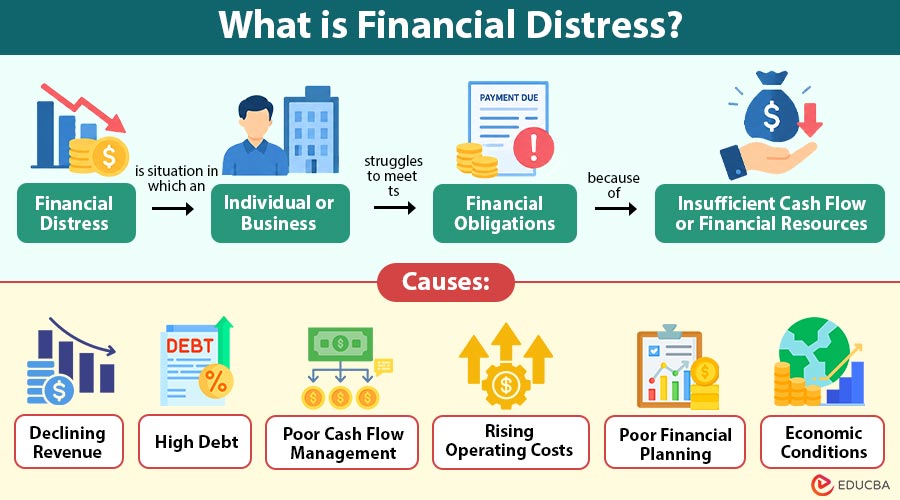
Financial distress is situation in which an individual or business struggles to meet its financial obligations because of insufficient cash flow or financial resources.
It occurs when an organization struggles to pay debts, interest, employee expenses, supplier bills, or other commitments on time. If the problem continues, it can affect business operations, creditworthiness, profitability, and long-term survival.
Financial distress does not always mean that a company is bankrupt. A financially distressed business may still own valuable assets and generate revenue but experience temporary or ongoing difficulties in managing its financial obligations.
For example, suppose a company has strong annual sales, but customers take several months to pay their invoices. At the same time, the company must make immediate loan repayments and supplier payments. Even with healthy sales, insufficient available cash can create financial distress.
Table of Contents:
- Meaning
- Causes
- Signs
- Types
- How Does Financial Distress Affect a Business?
- Difference
- How to Manage Financial Distress?
- Example
- Benefits
- Limitations
Key Takeaways:
- Financial distress can affect businesses even when revenue remains strong, but available cash becomes insufficient.
- Early recognition helps companies respond before financial difficulties create serious operational or legal consequences.
- Different forms of financial distress require responses based on their causes and the company’s circumstances.
- Evaluate financial indicators alongside qualitative factors to understand a company’s overall financial condition.
Causes of Financial Distress
Several operational and financial conditions can contribute to financial distress.
1. Declining Revenue
Declining sales reduce available cash, making it difficult for businesses to cover operating expenses, debt payments, and financial obligations.
2. High Debt
Excessive borrowing creates substantial repayment obligations, while rising interest costs can restrict cash available for regular business operations and investments.
3. Poor Cash Flow Management
Poor cash flow management can create shortages when customer payments are delayed, inventory increases, or short-term obligations become unexpectedly high.
4. Rising Operating Costs
Rising costs for materials, wages, rent, transportation, technology, and utilities can reduce margins and weaken overall financial stability significantly.
5. Poor Financial Planning
Poor financial planning can cause inaccurate forecasts, inadequate budgets, underestimated expenses, and insufficient funds for meeting future financial commitments.
6. Economic Conditions
Recessions, inflation, supply disruptions, and changing interest rates can reduce revenue, increase costs, and weaken business financial stability considerably.
Signs of Financial Distress
Identifying financial problems early can help businesses take corrective action before the situation becomes severe.
1. Increasing Late Payments
Repeated delays in paying suppliers, lenders, employees, or other creditors may indicate that available cash is becoming insufficient.
2. Increasing Borrowing
A business that repeatedly takes new loans to pay existing obligations may be experiencing financial pressure. Reliance on short-term borrowing can become particularly risky when repayment requirements accumulate.
3. Negative Cash Flow
Persistent negative operating cash flow indicates that the company’s core activities are not generating enough cash to support ongoing expenses.
4. Reduced Working Capital
Working capital provides resources for day-to-day operations. A significant reduction can make it difficult to purchase inventory, pay suppliers, and manage short-term liabilities.
5. Supplier or Lender Pressure
Requests for immediate payment, reduced credit periods, higher interest rates, or additional security may indicate that creditors have concerns about the company’s financial condition.
Types of Financial Distress
Financial distress can take different types depending on its underlying cause and severity.
1. Operational Distress
Operational distress occurs when a company’s core business activities fail to generate sufficient revenue or cash. Weak sales, inefficient operations, and declining customer demand can contribute to this condition.
2. Financial Distress
Financial distress specifically involves difficulty managing financial obligations such as loans, interest, lease payments, or other liabilities. A company may face this problem even when its operations remain viable.
3. Temporary Distress
Temporary distress occurs because of a short-term financial disruption. For example, a business may experience delayed customer payments while facing unusually high seasonal expenses.
4. Structural Distress
Structural distress develops from deeper and persistent problems, such as an unsustainable cost structure, excessive debt, outdated products, or a business model that no longer generates sufficient returns.
How Does Financial Distress Affect a Business?
Financial distress can influence nearly every area of an organization.
1. Reduced Business Operations
Cash shortages may prevent companies from purchasing inventory, maintaining equipment, paying expenses, or investing in expansion and other growth opportunities.
2. Lower Creditworthiness
Missed or delayed debt payments can damage a company’s credit profile, increase borrowing costs, and reduce access to future financing.
3. Supplier Problems
Suppliers may shorten credit periods or demand advance payments when they believe a financially distressed company may struggle to meet obligations.
4. Employee Concerns
Persistent financial problems can affect salary payments, job security, employee morale, productivity, and the company’s ability to attract skilled talent.
5. Investor Pressure
Investors may worry about declining profitability, rising debt, cash shortages, and management’s ability to maintain operations.
6. Risk of Bankruptcy
Severe and prolonged financial distress can lead to insolvency or bankruptcy when companies cannot restructure obligations or secure sufficient funding.
Difference Between Financial Distress and Bankruptcy
The table below shows the key differences between the two:
| Basis | Financial Distress | Bankruptcy |
| Meaning | Difficulty meeting financial obligations | Formal legal process involving an insolvent debtor |
| Stage | Can occur before bankruptcy | Generally represents a more severe stage |
| Legal status | Does not necessarily involve court proceedings | Usually involves formal legal procedures |
| Recovery | May be addressed through restructuring and financial improvements | Resolution follows applicable bankruptcy laws |
| Business condition | Business may remain viable | Business may require liquidation or formal restructuring |
How to Manage Financial Distress?
Businesses can adopt several measures to improve their financial position.
1. Improve Cash Flow
Companies can speed up customer collections, cut unnecessary expenses, optimize inventory, and negotiate better payment terms with suppliers.
2. Reduce Costs
Management can review operating expenses and eliminate activities that do not contribute sufficiently to business performance. Cost reduction should focus on improving efficiency rather than weakening essential operations.
3. Restructure Debt
Businesses may negotiate with lenders to extend repayment periods, modify interest rates, consolidate loans, or change repayment schedules. Debt restructuring can reduce immediate financial pressure.
4. Increase Revenue
Businesses can introduce new products, improve pricing strategies, target new customer segments, or strengthen existing sales channels to increase revenue.
5. Sell Non-Core Assets
Selling unused or non-essential assets can provide additional liquidity. However, companies should evaluate the long-term operational impact before disposing of important resources.
6. Seek Professional Advice
Financial advisors, accountants, restructuring specialists, and legal professionals can help businesses evaluate their financial position and develop an appropriate recovery strategy.
Example of Financial Distress
Consider a manufacturing company that experiences significant decline in customer orders. Its revenue falls while fixed expenses such as salaries, rent, loan payments, and equipment costs remain largely unchanged.
The company begins delaying supplier payments and relies on short-term loans to maintain operations. Interest expenses rise, further reducing profitability.
Management reviews its financial position and identifies excess inventory, unnecessary operating expenses, and slow customer collections. It negotiates longer payment periods with suppliers, restructures part of its debt, improves collections, and reduces non-essential costs.
These actions improve cash flow and help the company meet its obligations while continuing normal operations.
Benefits of Identifying Financial Distress Early
Early identification does not eliminate financial problems, but it provides more opportunities to manage them effectively.
1. Better Financial Decisions
Management can identify potential cash shortages and financial obligations early, allowing timely decisions to prevent more serious problems.
2. Improved Liquidity
Early action can help preserve cash and working capital, ensuring the business can meet essential expenses and short-term obligations.
3. Stronger Negotiating Position
Businesses can negotiate better terms with lenders and suppliers before defaults occur, giving them more flexibility in managing financial obligations.
4. Reduced Business Disruption
Timely corrective measures can help businesses maintain normal operations, minimize disruptions, and continue serving customers despite emerging financial difficulties.
5. Greater Recovery Potential
Viable businesses have better recovery opportunities when they address financial problems early through restructuring, cost control, and improved cash management.
Limitations of Financial Distress
Financial distress is useful for identifying financial problems, but it has several limitations.
1. Difficult to Predict Accurately
Financial distress can result from sudden changes in market conditions, customer demand, interest rates, or unexpected expenses that are difficult to forecast.
2. Depends on Financial Data Quality
Incomplete, outdated, or inaccurate financial information can lead to incorrect assessments of a company’s financial condition and risk level.
3. Does Not Always Indicate Bankruptcy
A company may experience temporary financial difficulties while remaining fundamentally profitable and financially viable, making distress an imperfect indicator of failure.
4. Industry Differences Affect Interpretation
Financial ratios and distress indicators can vary significantly across industries, so the same financial measure may represent different levels of risk for different businesses.
5. External Factors Can Change Quickly
Economic downturns, regulatory changes, supply disruptions, and shifts in customer behavior can rapidly change a company’s financial position after an assessment is made.
6. May Overlook Qualitative Factors
Financial analysis may not fully capture management quality, customer relationships, competitive advantages, employee capabilities, or other non-financial factors that influence recovery prospects.
Final Thoughts
Financial distress occurs when a business struggles to meet its financial obligations because of cash shortages, excessive debt, declining revenue, or rising expenses. Recognizing early warning signs allows management to improve cash flow, control costs, restructure debt, and protect business operations. Timely financial planning and corrective action can reduce the likelihood that temporary financial difficulties develop into insolvency or bankruptcy.
Frequently Asked Questions (FAQs)
Q1. How is financial distress measured?
Answer: Financial distress can be assessed using indicators such as debt-service capacity, liquidity ratios, cash-flow trends, profitability, leverage, and the ability to meet upcoming financial commitments.
Q2. Which financial ratios help assess financial distress?
Answer: Commonly used ratios include the current ratio, quick ratio, debt-to-equity ratio, interest coverage ratio, and operating cash-flow measures.
Q3. Can small businesses experience financial distress?
Answer: Yes. Small businesses can face financial distress because of limited cash reserves, dependence on a few customers, seasonal demand, unexpected expenses, or restricted access to financing.
Q4. Can financial distress affect a company’s valuation?
Answer: Yes. Financial distress may reduce a company’s valuation because investors and buyers may perceive greater uncertainty about future cash flows, liabilities, and business continuity.
Recommended Articles
We hope that this EDUCBA information on “Financial Distress” was beneficial to you. You can view EDUCBA’s recommended articles for more information.


