
What is Asset Acquisition?
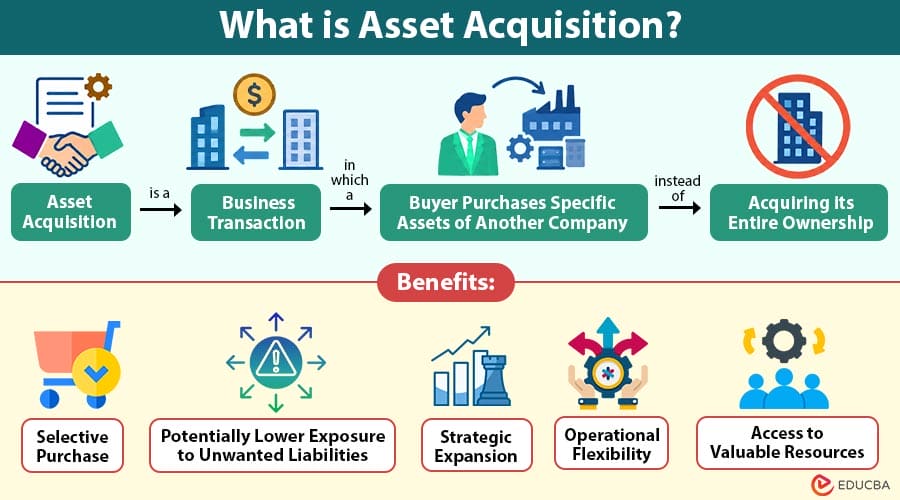
Asset acquisition is a business transaction in which a buyer purchases specific assets of another company instead of acquiring its entire ownership.
In an asset acquisition, the buyer and seller identify and negotiate the assets included in the transaction. These may include property, equipment, inventory, intellectual property, contracts, technology, or other business resources. The buyer generally does not acquire all the seller’s assets and liabilities unless the agreement specifically includes them.
This approach allows companies to obtain selected resources that support their strategic or operational goals while limiting exposure to unwanted assets or obligations. The transaction structure can vary depending on the assets’ nature, industry, tax rules, financing arrangements, and contractual terms.
Table of Contents:
- Meaning
- Working
- Types
- Example
- Benefits
- Challenges
- Difference
- Factors to Consider Before an Asset Acquisition
- Who Uses Asset Acquisition?
Key Takeaways:
- Asset acquisitions can support targeted growth without requiring ownership of the seller’s entire business.
- Buyers should align acquired resources with long-term operational goals, financial capacity, and strategic priorities.
- Successful transactions depend on careful planning, negotiation, documentation, and coordination among relevant stakeholders.
- Asset acquisitions can provide organizations with faster access to capabilities that support innovation, expansion, and operational improvement.
How Does Asset Acquisition Work?
An asset acquisition generally follows a structured process involving both the buyer and seller.
1. Identify the Assets
The buyer determines which assets are strategically or operationally valuable. The parties then create an initial list of assets proposed for purchase.
2. Conduct Due Diligence
The buyer examines the financial, legal, operational, and commercial condition of the assets. This may include reviewing ownership records, contracts, intellectual property rights, maintenance records, and outstanding obligations.
3. Value the Assets
The parties estimate the fair value of the assets using appropriate valuation methods. Different assets may require different approaches depending on their nature and expected future benefits.
4. Negotiate the Transaction
Buyer and seller negotiate the purchase price, payment terms, transferred liabilities, warranties, representations, and other conditions.
5. Prepare Transaction Documents
A purchase agreement specifies the assets being transferred, excluded assets, assumed liabilities, consideration, closing conditions, and other contractual requirements.
6. Obtain Required Approvals
Certain transactions may require regulatory approvals, lender consent, landlord approval, customer consent, or third-party contract assignments.
7. Complete the Closing
After the parties satisfy the agreed conditions, ownership or control of the specified assets transfers to the buyer.
Types of Asset Acquisition
Below are the main types of asset acquisition based on the nature and purpose of the assets purchased.
1. Tangible Asset Acquisition
This involves purchasing physical assets such as machinery, vehicles, buildings, equipment, furniture, or inventory. Companies may use this approach to expand production capacity or replace aging resources.
2. Intangible Asset Acquisition
The buyer acquires non-physical resources such as patents, trademarks, copyrights, software, licenses, or proprietary technology. These assets can provide competitive or commercial advantages.
3. Business Asset Acquisition
A buyer may purchase a collection of assets that together support an operating business. The transaction could include equipment, inventory, intellectual property, customer relationships, and selected contracts.
4. Real Estate Asset Acquisition
This involves purchasing commercial properties, industrial facilities, offices, warehouses, land, or other real estate assets. Companies may acquire such assets for operational use or investment.
5. Distressed Asset Acquisition
A buyer may purchase selected assets from a financially troubled company. The objective can be to obtain valuable resources at an appropriate price while avoiding unrelated obligations of the distressed business.
Example of Asset Acquisition
Suppose Company A owns a manufacturing facility but plans to reduce its operations. Company B wants to increase its production capacity and purchases the facility machinery and inventory from Company A. Company B does not acquire Company A’s shares or other unrelated assets. Instead, it obtains only the resources it needs for its operations.
Benefits of Asset Acquisition
Below are the key benefits of asset acquisition that can help buyers achieve specific business and operational objectives.
1. Selective Purchase
A buyer can generally identify and acquire only the assets that support its objectives. This provides greater flexibility than purchasing an entire company.
2. Potentially Lower Exposure to Unwanted Liabilities
Because the transaction can distinguish between acquired and excluded liabilities, the buyer may avoid taking responsibility for certain obligations associated with the seller. The actual treatment depends on the agreement and applicable law.
3. Strategic Expansion
Companies can obtain facilities, technology, intellectual property, equipment, or other resources that strengthen existing operations without acquiring an entire business.
4. Operational Flexibility
The buyer can structure the transaction around its specific requirements. This can make asset acquisitions useful when only part of a business is strategically valuable.
5. Access to Valuable Resources
An acquisition may provide immediate access to established technology, equipment, facilities, intellectual property, or other assets that could take significant time to develop internally.
Challenges of Asset Acquisition
Below are the key challenges of asset acquisition that buyers should evaluate before completing the transaction.
1. Complex Valuation
Different assets may require different valuation techniques. Determining appropriate values can become difficult when assets are specialized or lack active markets.
2. Contract Transfer Issues
Some contracts, licenses, leases, or permits may not automatically transfer to the buyer. Third-party approval may be necessary.
3. Due Diligence Requirements
The buyer must carefully investigate the assets to identify ownership problems, restrictions, maintenance requirements, legal disputes, or other concerns.
4. Integration Costs
Acquired assets may require investment in systems, employees, facilities, technology, or processes before they can generate the expected benefits.
5. Tax and Accounting Considerations
The purchase price may need to be allocated among different assets for accounting and tax purposes. The applicable treatment varies by jurisdiction and transaction structure.
Difference Between Asset Acquisition and Stock Acquisition
Below are the key differences between asset acquisition and stock acquisition:
| Basis | Asset Acquisition | Stock Acquisition |
| Meaning | Buyer purchases selected assets of a company | Buyer purchases shares or ownership interests |
| Ownership | Specific assets transfer to the buyer | Ownership of the company changes |
| Liabilities | Can be selectively assumed based on the agreement | The acquired company generally retains its liabilities |
| Flexibility | Allows selection of assets and certain obligations | Provides control over the entire company |
| Contracts | Some contracts may require transfer or consent | Contracts generally remain with the company |
| Due Diligence | Focuses heavily on selected assets and related obligations | Covers the company as a whole |
| Transaction Structure | Usually requires detailed asset identification | Usually involves transfer of shares or ownership interests |
Factors to Consider Before an Asset Acquisition
Below are the key factors buyers should evaluate before proceeding with an asset acquisition to support informed decision-making.
1. Asset Quality
Buyers should assess the assets’ condition, useful life, operational performance, maintenance needs, and potential replacement costs before acquisition.
2. Ownership Rights
Buyers should verify that the seller legally owns the assets and has complete authority to transfer them.
3. Liabilities
Buyers should identify liabilities linked to the assets and clearly determine responsibility for outstanding obligations before completing the transaction.
4. Contracts and Licenses
Buyers should review contracts, licenses, transfer restrictions, renewal requirements, and necessary third-party approvals associated with the assets.
5. Valuation
Buyers should ensure the purchase price reflects the assets’ fair value through appropriate financial, market, and commercial analysis.
6. Integration Requirements
Buyers should estimate the technology, workforce, infrastructure, training, and operational resources required to integrate acquired assets effectively.
7. Tax Treatment
Buyers should evaluate applicable taxes, deductions, depreciation benefits, and other tax implications before finalizing the acquisition structure.
Who Uses Asset Acquisition?
Asset acquisitions are used by various organizations, including:
1. Corporations Expanding Operations
Corporations use asset acquisitions to increase production capacity, strengthen operations, and obtain resources needed for business expansion.
2. Private Equity Firms
Private equity firms acquire selected business resources to improve operational performance, restructure assets, and create potential investment value.
3. Companies Entering New Markets
Companies entering new markets acquire local assets, facilities, technology, or customer-related resources to establish operations efficiently.
4. Businesses Purchasing Technology or Intellectual Property
Businesses acquire technology or intellectual property to strengthen capabilities, support innovation, and improve their competitive position.
5. Manufacturers Acquiring Production Equipment or Facilities
Manufacturers purchase production equipment or facilities to increase capacity, modernize operations, and improve manufacturing efficiency.
6. Investors Purchasing Distressed Business Assets
Investors may purchase distressed assets at negotiated prices and restructure, operate, or sell them based on their strategy.
Final Thoughts
Asset acquisition lets a buyer obtain specific business resources without necessarily buying the entire company. By selecting the assets and obligations included in the transaction, buyers can structure acquisitions around their strategic objectives. However, careful valuation, due diligence, contract review, tax analysis, and legal documentation are essential to manage transaction risks and achieve the intended business benefits.
Frequently Asked Questions (FAQs)
Q1. Can an asset acquisition include employees?
Answer: Yes, employees may transfer as part of an asset acquisition if the transaction agreement, employment laws, and employee arrangements permit such transfers.
Q2. How is payment made in an asset acquisition?
Answer: Payment may be made through cash, installments, financing arrangements, shares, or a combination of different consideration methods agreed by the parties.
Q3. Can an asset acquisition involve multiple sellers?
Answer: Yes, a buyer can acquire assets from multiple sellers when the transaction requires resources owned by different businesses or entities.
Q4. What happens to assets excluded from the transaction?
Answer: Excluded assets generally remain with the seller unless another agreement or subsequent transaction provides for their transfer.
Recommended Articles
We hope that this EDUCBA information on “Asset Acquisition” was beneficial to you. You can view EDUCBA’s recommended articles for more information.


