
What is Fiber Networking?
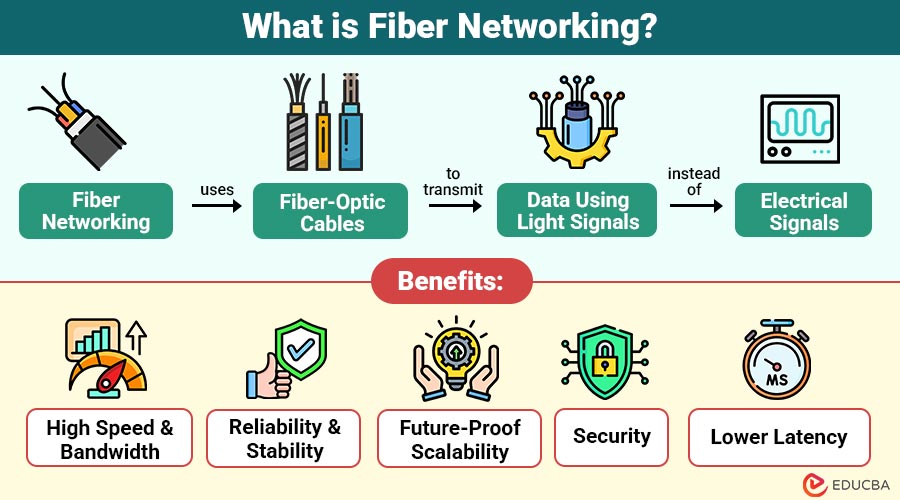
Fiber networking refers to the use of fiber-optic cables to transmit data using light signals instead of electrical signals.
Each cable consists of strands of glass or plastic, thinner than a human hair, capable of carrying terabits of data across vast distances without significant signal loss. For high-bandwidth applications like big data analytics, cloud computing, artificial intelligence (AI), and video streaming, fiber networking is therefore an essential answer.
Table of Contents:
- Meaning
- Working
- Types
- Benefits
- Challenges
- Real World Applications
- Fiber Networking vs Copper Networking
- Future
Key Takeaways:
- Fiber networking enables ultra-fast, reliable, and secure data transmission, essential for today’s digital transformation.
- Fiber, unlike copper, gives clear long-distance connections without interference and helps power new technologies like AI and 5G.
- Despite higher installation costs, fiber’s scalability makes it a future-proof investment for businesses and households.
- Fiber drives innovation across healthcare, education, entertainment, and smart cities, shaping tomorrow’s connected digital world.
How does Fiber Networking Work?
Fiber networking relies on the principle of total internal reflection. Here is a simplified breakdown of the process:
1. Transmission
Data begins its journey when it is converted into light pulses using advanced laser or LED transmitters, allowing high-speed information transfer over optical fiber.
2. Travel
These light pulses travel through the fiber’s central core, while the surrounding cladding reflects the signals internally, ensuring efficient, long-distance transmission without significant signal loss.
3. Reception
The light pulses are captured at the receiving end by sensitive optical receivers known as photodetectors, which transform them back into electrical signals that are understandable by computers and other equipment.
4. Result
This entire process enables fiber networks to deliver ultra-high bandwidth and exceptionally low latency, outperforming copper cables in speed, distance, stability, and long-term scalability.
Types of Fiber Networking
Fiber networks are categorized based on the type of fiber cables and deployment methods:
1. Single-Mode Fiber
With a tiny 9-micron core, SMF transmits data along a single light path, supporting telecommunications, ISPs, and enterprises over 100 km.
2. Multi-Mode Fiber
Featuring a wider 50–62.5 micron core, MMF carries multiple light paths, ideal for LANs and data centers up to 2 km.
3. Passive Optical Network
PON uses a point-to-multipoint architecture, commonly applied in FTTH connections, offering low-maintenance, high scalability, and cost-effective broadband for residential deployments.
4. Active Optical Network
AON employs powered equipment like switches and routers to manage signals, efficiently supporting dense urban areas requiring reliable, high-performance optical networking solutions.
Benefits of Fiber Networking
Fiber networking offers numerous advantages over copper and wireless technologies:
1. High Speed & Bandwidth
Fiber delivers ultra-fast speeds ranging from 1 Gbps to 400 Gbps, enabling smooth 4K/8K streaming, cloud gaming, AI, and bandwidth-intensive business applications.
2. Reliability & Stability
Fiber provides reliable long-distance connections with steady performance because it doesn’t get disturbed by electromagnetic interference and doesn’t lose signal quality like copper does.
3. Future-Proof Scalability
Fiber networks can handle increasing internet needs without expensive changes, making them perfect for 5G, smart devices, and future digital systems.
4. Security
Fiber is extremely difficult to tap undetected, offering robust protection against data breaches and ensuring sensitive transmissions remain secure across government, enterprise, and financial networks.
5. Lower Latency
Fiber’s low latency enables instant communication, supporting real-time applications like telemedicine, VR/AR experiences, online trading, and immersive digital interactions requiring immediate response times.
Challenges of Fiber Networking
Despite its advantages, fiber networking faces certain challenges:
1. High Initial Deployment Costs
Deploying fiber requires heavy upfront investments in infrastructure, cable-laying, and skilled technicians, making large-scale projects expensive compared to copper or wireless alternatives initially.
2. Physical Vulnerability
Fiber-optic cables, though efficient, remain vulnerable to accidental construction damage, rodent bites, or natural disasters, potentially disrupting critical communication networks until repaired by specialists.
3. Installation Complexity
Fiber installation involves splicing, terminating, and testing delicate glass strands, requiring specialized tools, precision, and trained professionals, making deployment more complex than conventional copper cabling.
4. Limited Rural Penetration
Rolling out fiber to rural or remote regions is economically challenging due to high infrastructure costs, low population density, and difficult terrain, limiting accessibility.
Real World Applications of Fiber Networking
Fiber networking plays a key role across multiple sectors:
1. Telecommunications
Fiber forms the backbone of modern telecommunications, powering 5G backhaul, high-speed broadband, and global internet infrastructure while supporting massive data transfers across continents seamlessly.
2. Healthcare
Fiber enables telemedicine, remote robotic surgeries, and rapid sharing of high-resolution medical imaging, ensuring doctors deliver timely, accurate treatments and patients access healthcare services globally.
3. Business & Enterprise
Businesses use fiber for cloud services, remote work, video calls, and teamwork, giving them fast, safe, and reliable internet needed for digital growth.
4. Smart Cities
Fiber networks connect IoT devices, traffic control systems, surveillance cameras, and public safety networks, enabling smart infrastructure that improves efficiency, security, and urban living standards.
5. Education
Fiber facilitates online learning, virtual classrooms, research collaboration, and digital libraries, allowing students and educators worldwide to access interactive, high-speed educational resources effectively.
6. Entertainment
Fiber Networking vs Copper Networking
Here are the key differences between Fiber Networking and Copper Networking based on major features:
| Feature | Fiber Networking | Copper Networking |
| Speed | Up to 400 Gbps+ | Typically up to 1–10 Gbps |
| Distance | Tens to hundreds of kilometers | Limited to ~100 meters |
| Latency | Very low | Higher |
| Reliability | Resistant to interference and degradation | Prone to EMI and signal loss |
| Cost | Higher upfront, lower maintenance | Lower upfront, higher long-term costs |
Future of Fiber Networking
The future of fiber networking looks promising, with trends such as:
1. Integration with 5G and 6G
Fiber is the base for 5G and upcoming 6G networks. It gives super-fast internet, almost no delays, and smooth, reliable data transfer needed for future mobile technology.
2. Expansion of FTTH (Fiber-to-the-Home)
Fiber-to-the-Home brings super-fast internet straight to houses, giving families reliable connections for streaming, working from home, smart devices, and everyday online needs.
3. Data Center Growth
The rise of cloud computing, AI, and big data means we need more data centers. Fiber networks help by giving them fast, strong, and high-capacity connections. This lets data centers manage large amounts of information quickly, efficiently, and smoothly.
4. Quantum Networking
In the future, fiber networks might carry quantum signals, enabling ultra-secure communication with quantum encryption to protect sensitive data and transform cybersecurity.
5. Global Expansion
Governments and private companies are spending a lot of money to bring fiber internet to rural areas. This helps close the gap between cities and villages, gives everyone fair access to fast internet, and supports overall growth.
Final Thoughts
Fiber networking is more than just a technology—it is the foundation of the digital age. From enabling smart devices to supporting global communications and cloud infrastructures, fiber has become indispensable. While challenges such as deployment costs and rural penetration remain, ongoing innovations and investments are rapidly closing the gap. Fiber networking will remain the main driver of digital transformation as companies, governments, and consumers seek faster, more dependable, and secure connectivity.
Frequently Asked Questions (FAQs)
Q1. Is fiber networking better than 5G?
Answer: Fiber and 5G complement each other. Fiber provides the backbone infrastructure, while 5G extends connectivity wirelessly to end users.
Q2. How fast is fiber internet?
Answer: Fiber can deliver speeds ranging from 100 Mbps to 1 Gbps for homes, and up to 400 Gbps+ for enterprises.
Q3. Is fiber networking safe from hacking?
Answer: Yes, fiber is inherently more secure than copper because it is harder to tap without detection.
Q4. Will fiber replace copper entirely?
Answer: Fiber is replacing copper in many areas, but copper may remain in legacy systems or where fiber deployment is not feasible.
Recommended Articles
We hope that this EDUCBA information on “Fiber Networking” was beneficial to you. You can view EDUCBA’s recommended articles for more information.


