
Introduction to Feature Flag Tools
Feature Flag Tools are essential in modern software development, allowing teams to turn features on or off without redeploying code. They empower developers with safer rollouts, controlled experimentation, faster delivery, and seamless rollback in the event of issues. By utilizing feature flag tools, organizations can enhance agility, mitigate risks, and improve the user experience, making them essential for continuous integration, continuous delivery, and progressive delivery strategies in today’s dynamic development environment. In this blog, we will explore the top 10 feature flag tools, their key features, and real-world use cases to help you choose the right one for your needs.
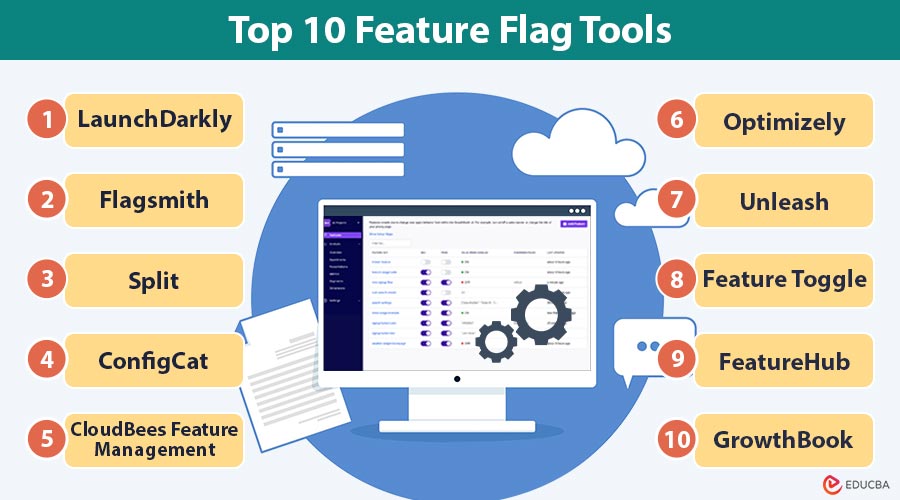
Top 10 Feature Flag Tools
Here are the top 10 feature flag tools that help teams release features faster, safer, and with greater control.
#1. LaunchDarkly
LaunchDarkly is a leading feature management platform enabling teams to control feature rollouts, perform gradual deployments, and ensure safe, scalable releases with advanced targeting, compliance, and enterprise-grade governance support.
Key Features:
- Granular targeting: Enable features for specific user segments, geographic regions, or cohorts.
- Progressive delivery: Supports gradual rollouts and A/B testing.
- SDKs and integrations: Offers SDKs for most major programming languages and seamless integrations with DevOps tools.
- Security and compliance: Built-in governance for enterprise-grade organizations.
Use Case:
A global SaaS company can roll out a new dashboard feature gradually to 5% of its user base, monitor performance, and then expand rollout without redeploying code.
#2. Flagsmith
Flagsmith is an open-source feature flagging and remote configuration tool, offering both cloud-hosted and self-hosted options. This empowers teams with full flexibility, data privacy, multilingual SDKs, and a developer-friendly API-first architecture.
Key Features:
- Self-hosted or cloud: Choose between a managed service or deploying on your own infrastructure.
- API-first design: Full API support for maximum developer flexibility.
- Remote configuration: Beyond toggles, it also allows configuration changes without redeployment.
- Multilingual SDKs: Wide language support for client- and server-side applications.
Use Case:
A startup seeking full control over data privacy can self-host Flagsmith and manage feature rollouts internally, eliminating the need for external cloud infrastructure.
#3. Split
Split combines feature flags with powerful experimentation, allowing organizations to manage rollouts, segment users, and measure business impact through data-driven experiments, ensuring safe deployments while maximizing customer engagement and outcomes.
Key Features:
- Data-driven experimentation: Rollouts are tied to metrics, making it easy to track impact.
- Targeting rules: Segment users based on their behavior, geography, or attributes.
- Enterprise scalability: Built for high-scale environments.
- Integrations: Works with tools like Datadog, Slack, and Jira.
Use Case:
An e-commerce company can test two checkout flows by rolling out each flow to different user segments and measuring conversion rate differences.
#4. ConfigCat
ConfigCat is a simple, developer-friendly feature flag tool with transparent pricing, fast global CDN delivery, and flexible targeting, enabling teams to roll out features quickly and affordably across platforms.
Key Features:
- Simple setup: Quick integration with SDKs across multiple languages.
- Value-based targeting: Assign specific values (e.g., percentages, user IDs) for rollout.
- Cost-effective: Transparent and affordable pricing.
- Global CDN: Ensures fast flag evaluation.
Use Case:
A mobile app team can easily roll out beta features to a subset of power users while maintaining cost efficiency.
#5. CloudBees Feature Management
CloudBees Feature Management, part of CloudBees’ DevOps ecosystem, offers enterprise-ready feature flags integrated with CI/CD pipelines, providing compliance, governance, advanced targeting, and lifecycle management for large-scale organizations.
Key Features:
- Integrated with CI/CD pipelines: Native fit with CloudBees’ DevOps offerings.
- Robust flag lifecycle management: Track, clean up, and audit feature flags.
- Compliance-ready: Suitable for regulated industries.
- Targeted delivery: Dividing users into specific groups and showing features based on set rules.
Use Case:
A financial services company can use CloudBees to ensure compliance while rolling out features in sync with CI/CD pipelines.
#6. Optimizely
By providing feature flagging combined with experimentation, enabling real-time rollouts, user targeting, and advanced analytics, Optimizely goes beyond A/B testing and helps companies make data-driven decisions that improve user experience.
Key Features:
- Experimentation-first: Built for experimentation-driven development.
- Advanced analytics: In-depth measurement of feature impact.
- Real-time flag changes: Instantly turn features on or off.
- Cross-platform SDKs: Works across multiple application types.
Use Case:
A media company can experiment with different content recommendation algorithms while directly measuring the improvements in engagement.
#7. Unleash
Unleash is an open-source feature flag solution that offers flexible rollout strategies, strong community support, and customizable hosting, providing organizations with full control over infrastructure, data security, and experimentation at scale.
Key Features:
- Open-source flexibility: Customizable and extensible to fit unique needs.
- Strategies: Provides rollout strategies, including gradual rollout, user IDs, and custom rules.
- Data ownership: Keep control of your infrastructure and data.
- Community-driven: Active open-source community.
Use Case:
A government organization with strict data policies can self-host Unleash to manage feature rollouts securely and maintain control over its data.
#8. Feature Toggle
Feature toggles are in-house tools that let developers easily switch features on or off while the app is running. However, they require a lot of upkeep and don’t offer advanced analytics or the ability to scale well.
Key Features:
- Full control: Complete ownership over toggle implementation.
- Lightweight: No external dependencies if built in-house.
- Custom fit: Designed around the team’s workflow.
Use Case:
Small teams can implement feature toggles within their codebase to manage simple rollouts, eliminating the need for third-party tools.
#9. FeatureHub
FeatureHub is an open-source feature flagging and experimentation platform, offering real-time updates, multi-tenant support, and extensibility, which empowers organizations to deliver modern, cloud-native feature management with collaborative flexibility.
Key Features:
- Real-time updates: Instant flag changes across distributed systems.
- Experimentation support: Analytics and experimentation are integrated.
- Multi-tenant support: Ideal for organizations managing multiple projects.
- Open-source flexibility: Extendable and self-hostable.
Use Case:
A SaaS provider can use FeatureHub to manage multiple customer environments while testing new features per client.
#10. GrowthBook
GrowthBook is an open-source feature flagging and experimentation platform focused on A/B testing, featuring lightweight SDKs, data warehouse integration, and analytics, which enable data-driven teams to validate product ideas effectively.
Key Features:
- Experimentation-first: Prioritizes A/B testing with detailed insights.
- Developer-friendly: Lightweight SDKs and easy integration.
- Data warehouse integration: Works with analytics tools like Google BigQuery or Snowflake.
- Open-source: Transparent and flexible.
Use Case:
A data-driven startup can run controlled experiments to validate product hypotheses while keeping infrastructure open-source.
Final Thoughts
Feature Flag Tools empower teams to release features faster, safer, and smarter. Whether through enterprise-grade platforms like LaunchDarkly and Harness or open-source options like Unleash, GrowthBook, and Flagsmith, the right tool depends on scale, compliance, and experimentation needs. Adopting these solutions ensures continuous delivery, improved agility, reduced risks, and enhanced customer experiences in today’s dynamic software landscape.
Recommended Articles
We hope that this EDUCBA information on “Feature Flag Tools” was beneficial to you. You can view EDUCBA’s recommended articles for more information.

