


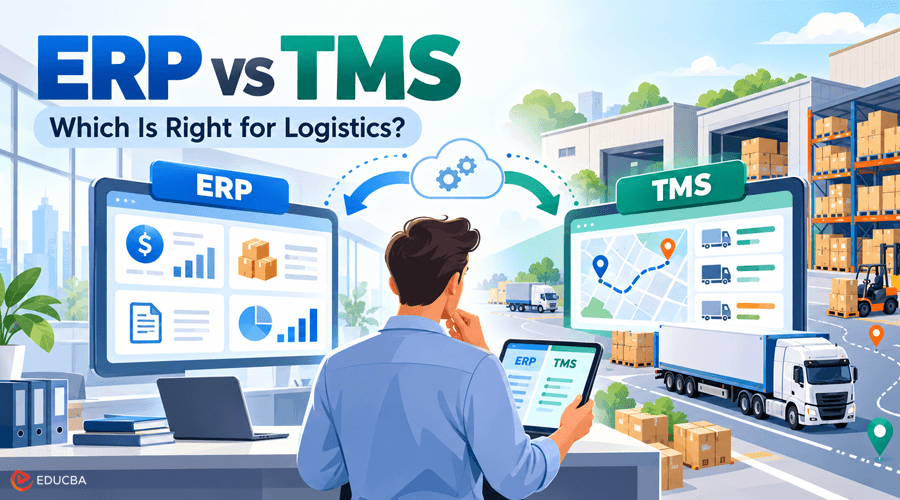
A 3PL in Ohio invested $380,000 to implement an ERP system to address dispatch operations. After six months, dispatchers were still marking off loads on a whiteboard next to the computer screen.
That is not a rare story. It is the default outcome when a company buys an ERP to do a TMS or WMS’s job.
The search everyone runs is “logistics ERP vs TMS,” but the real question growing companies need answered in 2026 is not which category wins. It is which one actually gets used by the people running the floor, and which one just gets tolerated because finance already signed the contract.
When comparing ERP vs TMS, getting the decision wrong means you do not just lose money on licensing. You lose it twice: once on the software nobody uses correctly, and again on the headcount you hire to work around it.
Why Do So Many Logistics Companies Get the ERP vs TMS Decision Wrong?
Most buying decisions here get made by finance, not by the ops team that lives inside the software all day. Finance wants one system, one vendor, one invoice. That instinct is reaso nable for accounting. It is a bad fit for execution software, because dispatch and warehouse work do not behave like general ledger entries.
An ERP is built around a single source of truth for the business: orders, inventory counts, financials, purchasing. A TMS or WMS is built around a single source of truth for movement: which truck picks up which load at which dock, which pallet sits in which slot, which picker is behind schedule right now. Those are different jobs, and treating them as the same one is where the money disappears.
When evaluating ERP vs TMS, companies should consider the following common reasons why the wrong system gets selected:
- ERP procurement gets driven by cost consolidation, not by workflow fit, because one contract is easier to defend to a board than three.
- The vendor includes the “logistics module” in the ERP package and treats it as a dedicated application, but it is nothing more than an additional checkbox.
- The operations group is given software not created for dispatch or slotting operations, and it is expected to work with it nonetheless.
- Six to twelve months later, the operations group goes back to spreadsheets, using the ERP module only to meet accounting needs.
- Nobody reviews the decision until the next budget cycle, turning a temporary solution into a permanent one.
What Actually Separates an ERP from a TMS or WMS?
Understanding the difference is at the heart of any ERP vs TMS comparison.
Imagine the ERP system as corporate memory: it remembers the order was received, the invoice was issued, and the inventory count was updated. The TMS/WMS is the company’s reflexes; it makes decisions in seconds when the truck is waiting to be loaded at the dock, and the picker stands at the wrong bin.
The distinction becomes obvious when you see it happen on a Tuesday morning. An ERP will happily tell you an order shipped yesterday. It will not tell you which of your six carriers has the cheapest live rate for that lane right now, and it definitely will not rebuild a driver’s route when a delivery window gets moved twenty minutes before pickup.
Where ERP Really Proves its Worth?
- Consolidation of finances in different business units/subsidiaries.
- Precision of procurement, accounts payable, and general ledger.
- Strategic planning based on budgets and forecasts.
- Financial consolidation across multiple business units or subsidiaries.
- Accurate procurement, accounts payable, and general ledger.
- Long-range planning tied to budgets and forecasts.
- A single reporting layer for the board and for auditors.
Where ERP Logistics Modules Fall Apart?
- Real-time route optimization when a driver calls in sick at 6 a.m.
- Dock scheduling that adjusts as trucks run late.
- Wave picking and slotting logic tuned to actual warehouse layout.
- TMS rate shopping and tendering with dozens of carriers’ contracts.
- EDI and API integration with carriers, marketplaces, and telematics providers.
The Cost Nobody Puts in the Proposal
Every ERP logistics module looks cheap on the vendor’s slide because the comparison stops at license price. It does not include the cost of a new dispatcher, required because the screen takes four clicks to do what a proper TMS can do in one, or the warehouse supervisor who must spend an hour every morning re-sequencing picks the system should have done automatically the night before.
This hidden operational cost is one of the most important factors when comparing ERP vs TMS. A lower software price does not necessarily mean a lower total cost of ownership.
When Does a Standalone TMS/WMS Actually Pay for Itself?
There is a rough threshold most operators hit without naming it. As soon as your company works with more than 8 to 10 trucks per day or more than 15,000 to 20,000 square feet of pick-and-pack space, generic ERP logistics modules become more costly than beneficial. You are compensating with a worker for what the system should be doing on its own.
For companies evaluating ERP vs TMS, the important question is not simply which software costs less. It is whether the system can handle the business’s operational complexity without creating additional manual work.
Signs You Have Already Outgrown an ERP Logistics Module
- Dispatchers keep a side spreadsheet because the ERP screen takes too many clicks to update a load status.
- Warehouse pick accuracy sits below 98%, and nobody can point to why.
- Adding a new carrier or 3PL partner takes a developer ticket instead of a form.
- Peak-season labor costs climb faster than order volume.
- Customers are asking for tracking visibility your system cannot produce without a phone call.
Can ERP and TMS/WMS Work Together Instead of Competing?
This is the part most articles skip: it is not actually ERP versus TMS/WMS for most growing companies. It is ERP plus TMS/WMS, connected properly. The ERP stays in the financial and inventory system of record. The TMS and WMS handle execution and hand clean data back to the ERP through an integration layer.
The failure mode is not picking the wrong category. It is picking a standalone TMS or WMS with no real integration plan, then discovering finance is re-keying freight invoices by hand every week because nothing talks to the ERP automatically.
- Map which system owns which data before you buy anything: order creation, inventory truth, freight cost, invoicing.
- Ask for a demonstration of the integration, not a PowerPoint slide showing two boxes and an arrow between them.
- Consider budgeting for middleware or iPaaS if either system does not have out-of-the-box connectivity to the other.
- Assign one person to own data reconciliation for the first 90 days post-launch, because it will need a human watching it.
What Does This Look Like for a Growing 3PL?
A regional 3PL with 40 trucks and two distribution centers had been using a mid-tier ERP for six years. Freight tendering was manual, involving phone calls and an Excel spreadsheet rate sheet, and three dispatchers spent most mornings obtaining carrier quotes. They installed a dedicated TMS, kept ERP for accounting and billing, and connected the systems via an API integration developed over five weeks.
Tendering time per load was reduced from about 20 minutes to less than 3. On-time delivery increased from 84% to 96% within the first quarter. One of the three dispatchers moved into a carrier-relations role instead of being cut, because the volume of manual tendering work no longer existed. The ERP did not get replaced. It got relieved of a job it was never built to do well.
The finance team, for what it is worth, barely noticed the switch. The freight cost information was now sent into the ERP system nightly, automatically, rather than uploaded manually from the spreadsheet.
This example illustrates why an ERP vs TMS decision does not necessarily mean replacing one platform with another. In many cases, the two systems can serve different functions and work together.
What Should You Actually Evaluate Before You Sign a Contract?
Most RFPs ask vendors to check boxes on features. That is the wrong test. Features are cheap to claim and expensive to verify. Ask instead for a working demo built around your own lanes, your own SKUs, and your own exception scenarios: a late truck, a damaged pallet, a rush order dropped in at 4 p.m.
When evaluating ERP vs TMS, focus on how each system performs under real operating conditions rather than how many features appear on a comparison sheet.
- Have the vendor do a live demonstration on an actual order from last week, not one they have already done 100 times.
- Find out how many mouse clicks it takes to change a route on an order, or change a picker’s slot if the situation changes mid-day.
- Get a straight answer on integration timelines and cost, in writing, before you sign anything.
- Talk to a reference customer running a similar truck count or warehouse footprint to yours, not the vendor’s flagship enterprise account.
- Price out the first year including implementation, integration, and training, not just the license line.
So, ERP or TMS/WMS — What Should You Actually Choose in 2026?
Your final ERP vs TMS decision depends largely on the complexity of your logistics operation and the work the software needs to do.
If your logistics operation is small and simple, an ERP module can carry you further than you would think. Do not buy a standalone TMS or WMS to solve a problem you do not have yet.
However, if trucks are idling, pickers are wandering, and your team keeps a shadow spreadsheet next to the “official” system, the ERP is not saving you money anymore. It is just moving the cost from a software line item to a payroll line item, where it is harder to see.
Pick the system that matches the job in front of it. Connect it to the one that matches the job behind it. That is the whole decision, and it is smaller than most vendors want it to be.
Recommended Articles
We hope this guide helps you understand ERP vs TMS, including logistics operations, warehouse management, system integration, and software costs. Explore our recommended articles for more insights on ERP, TMS, WMS, logistics technology, and supply chain management.

