


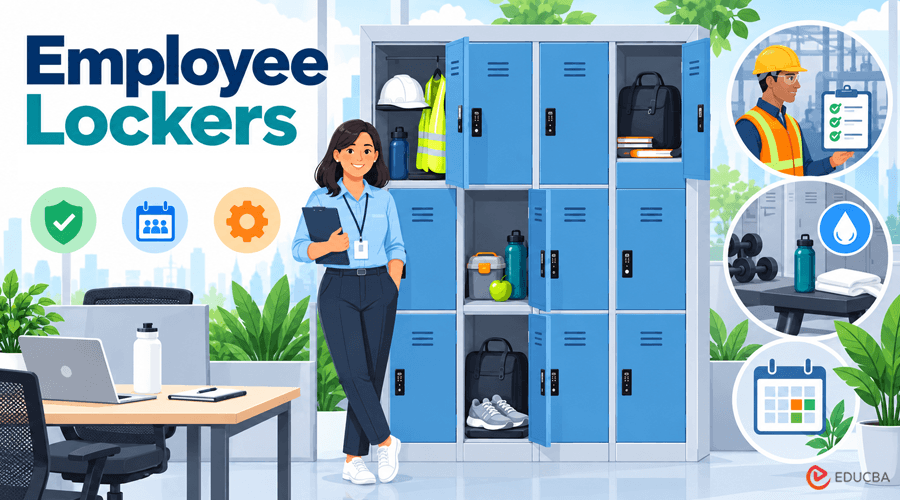
Employee lockers solve three problems that show up on nearly every facility manager’s list: clutter in shared spaces, inconsistent compliance with OSHA’s sanitation and storage rules, and the logistics of outfitting a workforce that no longer keeps the same desk or shift every day. A locker bank gives each employee a fixed, lockable place for personal items, protective equipment, and outerwear, reducing the loose bags, coats, and gear that otherwise collect around workstations, break rooms, and shop floors. For facilities running hybrid schedules or rotating shifts, employee lockers also solve a subtler problem: they let more people share a building’s storage capacity without each person needing a permanently assigned space.
Jorgenson Lockers, a commercial locker manufacturer supplying steel, wood-laminate, and high-density-plastic locker systems for workplaces, warehouses, and government facilities, builds modular locker banks for shared, rotating storage needs across manufacturing plants, corporate offices, and gym or fitness facilities. The rest of this guide covers what federal workplace rules require, which locker materials suit which environments, and how facility teams are adjusting storage planning as hybrid and shift-based work becomes standard rather than the exception.
What Workplace Storage Problems Do Employee Lockers Actually Solve?
Unassigned storage is one of the most common sources of low-grade facility disorder: personal bags under desks, coats draped over chairs, and PPE left on benches instead of stored properly. Employee lockers fix this by giving each employee (or each shift, in a shared-locker model) one designated compartment, which keeps walkways and workstations clear and gives housekeeping and facilities staff a predictable layout to maintain.
Employee lockers also reduce loss and theft-related disputes. A lockable, assigned compartment creates accountability that open shelving or communal bins do not, which matters most in manufacturing, warehousing, and corporate office settings where employees store wallets, phones, and personal electronics during a shift.
Finally, lockers support facility-level organization goals tied to certifications and audits from bodies like IFMA (the International Facility Management Association), where housekeeping and space-utilization scoring often factor into safety and cleanliness audits.
How Do OSHA Rules Affect Employee Locker Requirements?
Federal law does not require every employer to provide lockers. Under OSHA’s Sanitation Standard, 29 CFR 1910.141(e), the requirement to provide changing rooms and separate storage facilities for street clothes and work clothes is triggered specifically when employees must wear protective clothing or equipment due to a risk of contamination, not simply because a workplace has a dress code or uniform policy. Office environments and most service-industry settings generally fall outside this requirement, while manufacturing, warehousing, and industrial facilities where PPE is mandatory fall inside it.
Even where employee lockers are not federally mandated, many facilities provide them anyway as a workplace benefit that supports cleanliness and employee satisfaction. Some states apply stricter requirements than the federal baseline, particularly in food service and healthcare, so facility managers operating across multiple states should confirm locker obligations against the applicable state plan rather than assuming the federal standard is the ceiling.
What Locker Materials Best Suit Different Workplace Environments?
Material selection for employee lockers largely depends on the environment. Steel remains the standard for general office and light-industrial storage. However, it is prone to rust and typically needs repainting over its service life if used in humid or wet-adjacent conditions.
For gym, fitness-facility, and other high-moisture environments, phenolic and high-density polyethylene (HDPE) lockers outperform steel: HDPE is warranted for up to 25 years and resists humidity without repainting, while phenolic can absorb moisture over time and, in poorly ventilated conditions, is more prone to mold growth than HDPE. In direct wet-area comparisons, phenolic panels absorb less than 1% of their weight in water even after extended exposure, and phenolic installations commonly last 15–25 years with minimal upkeep. By comparison, steel can rust within a few years in chlorinated or high-humidity settings.
| Material | Best-fit Environment | Maintenance Profile |
| Steel | Corporate office, light-industrial, dry warehousing | Requires periodic repainting; prone to rust in humid conditions |
| Phenolic | Gyms, pools, locker rooms | Highly moisture-resistant; can absorb moisture/mold in poor ventilation |
| HDPE (high-density plastic) | Gyms, pools, high-humidity industrial areas | Rustproof, warranted up to 25 years, minimal upkeep |
Industry standards also govern locker hardware: ANSI/BHMA A156.11 establishes cycle, operational, and strength test requirements for locker locks and other cabinet lock types, giving facility buyers a consistent way to evaluate hardware durability across manufacturers regardless of the locker body material chosen.
How Are Facility Managers Adapting Employee Lockers to Hybrid and Shift-Based Work?
Storage planning has had to catch up with how differently people now use office space. IFMA’s 2024 Space Planning Benchmark Report found that average daily site populations have dropped to roughly 2,001 people per site. That average workspace utilization now sits around 78%, down from 86% in 2010, with vacancy rates hovering near 14%. That combination (fewer people on-site on any given day, but no single fixed population to plan around) is exactly what makes assigned-desk storage models inefficient and shared, lockable storage more practical.
Facilities adapting to this shift are increasingly moving away from one-locker-per-desk models toward employee lockers sized to peak attendance, often paired with day-use or shift-based locker assignment systems. This lets manufacturing and warehousing operations running multiple shifts, and hybrid corporate offices with rotating in-office days, right-size their storage footprint instead of overbuilding for a population that rarely shows up all at once.
Standardizing on a single locker system across a facility, the kind of approach commercial suppliers like Jorgenson Lockers are built around, also tends to simplify replacement-part sourcing and reduce maintenance callbacks compared with mixed, legacy locker inventories accumulated over multiple renovation cycles. A standardized employee locker system can therefore make workplace storage easier to manage as staffing patterns and facility requirements change.
Frequently Asked Questions (FAQs)
Q1. How many employee lockers does a mid-sized office typically need?
Answer: Size locker banks based on peak attendance, shifts, and storage needs rather than total headcount.
Q2. What triggers an OSHA requirement to provide employee lockers?
Answer: OSHA requires separate storage when employees must wear protective clothing or equipment due to contamination risks.
Q3. What locker material is best for gyms and locker rooms?
Answer: HDPE and phenolic lockers offer better moisture resistance than steel. HDPE also requires minimal maintenance.
Q4. When should a facility choose steel lockers?
Answer: Steel works well for dry environments such as offices, light-industrial spaces, and general warehouses.
Q5. Who sets locker hardware quality standards?
Answer: BHMA, accredited by ANSI, sets performance standards for locker locks under ANSI/BHMA A156.11.
Q6. How does hybrid work change locker planning?
Answer: Hybrid and shift-based work favors shared or day-use lockers sized for peak attendance rather than total employees.
Q7. What is the advantage of using one locker supplier?
Answer: Standardization simplifies replacement-part sourcing and can reduce maintenance compared with mixed locker systems.
Recommended Articles
We hope this guide helps you understand employee lockers and their role in better workplace organization and storage. Explore our recommended articles for more insights on workplace storage, OSHA requirements, facility management, and commercial lockers.

