


What Is Emergency Management?
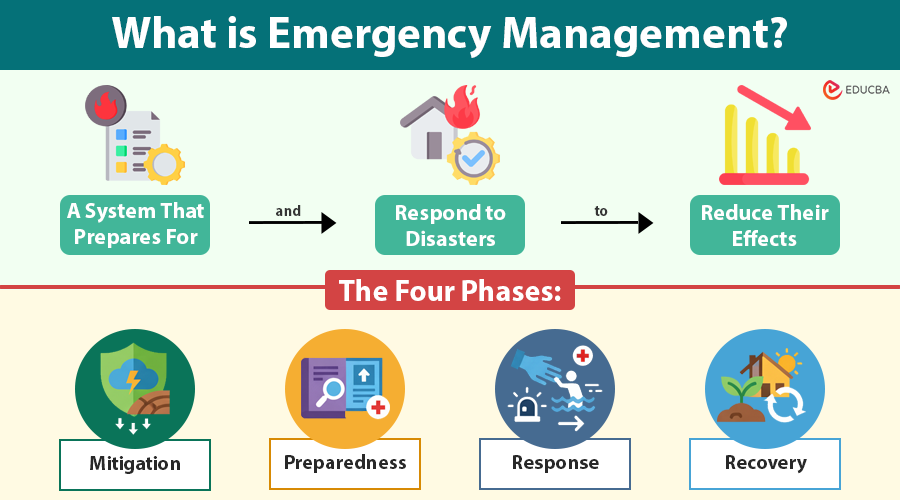
Emergency management is a structured system of plans and actions that helps respond to disasters quickly and reduce their effects on people and property. It integrates planning, coordination, communication, and resource allocation across multiple sectors.
Unlike traditional firefighting or rescue operations, emergency management is proactive and holistic. It addresses not only the immediate crisis but also the long-term effects on the economy, public health, and the environment.
In the U.S., the Federal Emergency Management Agency (FEMA) leads national efforts, while local and regional bodies implement community-specific programs. Internationally, organizations such as the UN Office for Disaster Risk Reduction (UNDRR) and the World Health Organization (WHO) provide global frameworks for preparedness and response.
Table of Contents
- Meaning
- Key Objectives
- The Four Phases
- Principles
- Types of Emergencies and Disasters
- Roles and Responsibilities
- Technology and Innovation
- Challenges
- Community Involvement and Education
- The Future
Key Objectives of Emergency Management
The primary objectives of emergency management are to minimize harm, ensure rapid recovery, and maintain social stability. Key goals include:
- Protection of life and property: Reducing fatalities and preventing damage to homes, infrastructure, and essential facilities.
- Maintaining public safety: Ensuring law and order, health services, and emergency communication remain operational.
- Rapid response and recovery: Mobilizing first responders and restoring normalcy as quickly as possible.
- Risk reduction: Identifying hazards early and implementing mitigation strategies.
- Continuity of Operations (COOP): Ensuring essential services and business functions continue even during crises.
- Public awareness and training: Educating citizens on how to react and protect themselves during emergencies.
- Resource coordination: Managing supplies, manpower, and inter-agency collaboration efficiently.
The Four Phases of Emergency Management
Emergency management follows a cyclical model of four interrelated phases. Each phase builds upon the other, forming a continuous loop of learning and improvement.
1. Mitigation: Reducing Risk Before Disaster Strikes
Mitigation involves long-term strategies that reduce or eliminate risks. It is about addressing the root causes of disasters, not just reacting to their effects.
Examples of Mitigation Activities:
- Constructing flood barriers, levees, and storm drainage systems.
- Implementing earthquake-resistant building codes.
- Creating zoning laws to prevent construction in high-risk areas.
- Planting vegetation to prevent landslides and soil erosion.
- Retrofitting aging infrastructure to withstand natural forces.
Why Mitigation Matters:
According to FEMA, spending one dollar on mitigation can save about six dollars in future disaster costs. By anticipating hazards, communities can drastically reduce recovery expenses and loss of life.
2. Preparedness: Planning for the Unexpected
Preparedness ensures readiness at all levels, individual, community, organizational, and governmental. It involves developing plans, training personnel, and rehearsing scenarios.
Core Preparedness Activities:
- Developing Emergency Operations Plans (EOPs) at local and organizational levels.
- Conducting drills, tabletop exercises, and full-scale simulations.
- Creating emergency communication networks to prevent breakdowns.
- Stockpiling medical supplies, food, and clean water.
- Ensuring early warning systems (sirens, alerts, mobile notifications) are functional.
Community Example:
Japan’s annual National Disaster Prevention Day educates millions of citizens through nationwide drills, showcasing how a culture of preparedness can save lives during earthquakes and tsunamis.
3. Response: Acting Swiftly and Effectively
When disaster strikes, the response phase begins. It focuses on saving lives, containing the emergency, and stabilizing conditions. Coordination, speed, and clarity of command are critical during this stage.
Response Activities Include:
- Activation of Incident Command Systems (ICS) to coordinate operations.
- Dispatching search and rescue (SAR) and emergency medical teams.
- Establishing temporary shelters and distributing relief supplies.
- Providing psychological support to affected populations.
- Using media and official channels for real-time information dissemination.
Case Study:
During Hurricane Katrina (2005), the lack of coordination delayed response efforts. In contrast, during the 2019 Cyclone Fani in India, early evacuation and communication saved over 1 million lives, underscoring the power of organized response.
4. Recovery: Restoring and Rebuilding
The recovery phase is about rebuilding and helping communities return to normal after a disaster. It can persist for days to years after the disaster, depending on its severity.
Recovery Activities:
- Rebuilding infrastructure and restoring utilities.
- Offering financial aid, insurance claims, and government relief packages.
- Revitalizing local economies through reconstruction projects.
- Addressing mental health issues and community trauma.
- Updating disaster plans based on lessons learned.
Recovery also presents an opportunity to “build back better,” reconstructing infrastructure with improved resilience to prevent future disasters.
Principles of Effective Emergency Management
Leading emergency management organizations operate based on the following guiding principles:
- Comprehensive: Covers all hazards, all phases, and all stakeholders.
- Progressive: Anticipates future disasters and prepares accordingly.
- Integrated: Ensures coordination across local, state, and federal levels.
- Collaborative: Builds partnerships between public, private, and nonprofit sectors.
- Coordinated: Establishes a clear chain of command and communication.
- Flexible: Adapts to evolving threats and dynamic situations.
- Professional: Promotes ethics, accountability, and continual improvement.
These principles form the foundation for effective policy-making and operational excellence.
Types of Emergencies and Disasters
Emergency management must address diverse and evolving threats:
1. Natural Disasters
Includes floods, hurricanes, tsunamis, wildfires, droughts, and earthquakes. Climate change is making these events happen more often and with greater intensity worldwide.
2. Technological and Industrial Disasters
Examples: chemical plant explosions, transportation accidents, oil spills, or nuclear incidents like the Fukushima disaster in 2011.
3. Public Health Emergencies
Pandemics such as COVID-19 have shown how quickly health crises can overwhelm systems, highlighting the importance of preparedness and cross-border cooperation.
4. Environmental Emergencies
Deforestation, pollution, and biodiversity loss can trigger long-term ecological disasters impacting water, air, and food security.
5. Security and Cyber Emergencies
Cyberattacks, terrorism, and civil unrest can cripple communication, banking, and infrastructure systems, demanding both digital and physical resilience.
Roles and Responsibilities in Emergency Management
A successful emergency management system depends on collaboration among various players:
- Federal/National Governments: Establish policies, provide funding, and coordinate nationwide response (e.g., FEMA, NDMA).
- State and Local Governments: Execute plans tailored to community needs, manage shelters, and lead local recovery.
- First Responders: Police, firefighters, and paramedics who act immediately to contain damage and rescue victims.
- Nonprofits & NGOs: Organizations like the Red Cross deliver food, shelter, and emotional support.
- Private Sector: Businesses develop continuity plans and contribute logistics, funding, and technology.
- Citizens: Preparedness begins at home, maintain emergency kits and evacuation plans, and stay informed.
Technology and Innovation in Emergency Management
Advancements in technology are transforming how disasters are predicted and managed:
- Artificial Intelligence (AI) and Machine Learning are used to analyze data and predict disasters early, enabling timely warnings.
- GIS Mapping and Satellite Imagery for damage assessment.
- Drones and Robots for aerial surveillance and delivery of medical supplies.
- Cloud-based Command Centers for data sharing and collaboration.
- Mobile Apps like FEMA’s “Disaster Alerts” for real-time updates.
Emerging technologies improve situational awareness, response speed, and resource efficiency, ultimately saving lives.
Challenges in Modern Emergency Management
Despite technological progress, several barriers persist:
- Resource limitations: Many local agencies lack funds, training, or personnel.
- Poor inter-agency coordination: Miscommunication delays responses.
- Public misinformation: Social media can spread panic and false news.
- Climate change: Increasing disaster frequency strains emergency systems.
- Urbanization and population growth: Overcrowded areas are more vulnerable.
Overcoming these challenges requires policy innovation, international collaboration, and sustained community engagement.
Community Involvement and Education
Community engagement is a cornerstone of resilient emergency management. Programs like CERT (Community Emergency Response Teams) empower citizens with first aid, fire safety, and disaster response training.
Schools, workplaces, and local governments can enhance resilience by conducting:
- Safety drills and workshops.
- Awareness campaigns on evacuation routes and hazard identification.
- Volunteer programs that strengthen neighbor-to-neighbor support networks.
When communities understand risks and act collectively, emergency response becomes faster and more effective.
The Future of Emergency Management
The next generation of emergency management will rely on data integration, AI-driven planning, and sustainable infrastructure.
Key emerging trends include:
- Predictive disaster modeling for risk-based planning.
- Climate adaptation strategies in urban design.
- Cross-border data sharing to improve global responses.
- Resilient smart cities that integrate disaster response systems with IoT sensors.
Ultimately, the focus is shifting from reactive recovery to resilient prevention, building systems that can absorb shocks and adapt dynamically.
Final Thoughts
Emergency management is more than a crisis-response system; it is a continuous cycle of learning, adaptation, and community collaboration. From hazard identification to post-disaster recovery, every phase contributes to saving lives and reducing long-term losses.
By investing in education, technology, and preparedness, societies can transform vulnerabilities into strengths and face future challenges with resilience.
Frequently Asked Questions (FAQs)
Q1. How do I create a personal or household emergency plan?
Answer: Start by identifying hazards relevant to your area (e.g., floods, earthquakes, storms). Choose safe meeting points, decide communication methods, assemble a “go-kit” with essentials (water, food, flashlight, first-aid), and review the plan regularly with family or team members.
Q2. What is the difference between an all-hazard plan and a hazard-specific plan?
Answer: An all-hazard plan covers a broad range of potential emergencies (natural, technological, security) using common processes (alerting, evacuation, sheltering). A hazard-specific plan is tailored to one type (e.g., chemical spill, tornado) and addresses unique needs and response actions.
Q3. What triggers the declaration of a disaster or emergency by government authorities?
Answer: Typically, a declaration is triggered when the scale of the event exceeds local capacity to respond, requiring state, national, or even international support. The criteria can include severity, number of affected people, infrastructure damage, and projected recovery needs.
Q4. How can technologies such as mobile alerts and social media be used in emergencies?
Answer: Technology enables real-time communication, early warnings via apps or SMS, situational awareness through social media feeds and GIS mapping, and coordination of resources. It helps agencies inform the public and make faster decisions.
Q5. What should I do if I am advised to evacuate vs shelter in place?
Answer: If evacuation is ordered, follow the specified route, take your go-kit, and inform your contacts. If told to shelter in place: stay indoors, close windows/doors, turn off HVAC if instructed, monitor official alerts, and wait for “all clear” instructions.
Recommended Articles
We hope this guide helps you see how planning and technology build safer communities. Explore more on crisis management and disaster recovery to boost resilience.

