


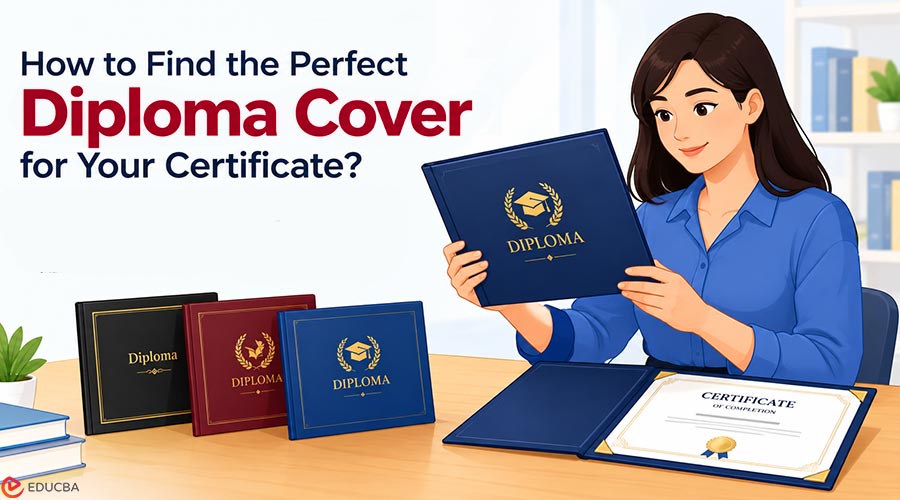
A diploma cover can look right on the product page and still be the wrong purchase. The title might read High School Diploma when the document is a course-completion certificate, or the interior might suit a portrait page when the school printed a landscape one. Choosing the right diploma covers requires checking the document size, orientation, wording, and customization options before placing an order.
This guide covers physical academic and completion certificates and the folding covers that hold them.
A tent-style cover opens like a book, with the document held inside. It differs from a wall frame, which holds the document behind glazing, and from a flat sleeve, which is a single pocket. Some covers carry a fixed printed title; others have no wording.
Neither choice changes the credential itself.
Key Takeaways
- Check your certificate’s dimensions and orientation to ensure the diploma cover fits correctly.
- Compare blank, fixed-title, and personalized diploma covers based on your credential and presentation needs.
- Double-check names, graduation years, logos, spelling, and text placement before approving a personalized design.
- Review customization charges, shipping, taxes, stock availability, and delivery timelines before placing your order.
- Use the cover for presentation and handling, and follow proper document-storage practices to reduce damage from light, moisture, and adhesives.
Start With the Document’s Size and Orientation
Measuring the document is the first step when choosing diploma covers. Measure the paper, not the closed cover. Lay the document flat and measure edge to edge, width, then height. Note whether it is portrait or landscape.
Compare those measurements with the seller’s document-size option, not the cover’s exterior dimensions. For example, Honor U’s size chart pairs an 8.5-by-11-inch Letter document with a 9-by-11.5-inch cover and lists A4 separately. A4 is a different paper size, not a Letter substitute.
- Confirm the current version: Tacoma Community College specifies that all its certificates and diplomas, including Bachelor of Applied Science diplomas, are 8.5 by 11 inches in landscape orientation. That is one institution’s specification, not a national standard.
If you are waiting for your document, ask the registrar for the dimensions and orientation of the version you will receive rather than guessing from an older copy.
- Check what your school supplies: Some institutions hand out covers at the ceremony. Saint Louis University, for instance, states that its midyear graduates receive covers at the ceremony. Your school’s commencement page may tell you whether you need to buy one.
Before you shop for diploma covers, write down:
- Width and height, edge to edge
- Portrait or landscape orientation
- Whether the school supplies a cover
- The matching document-size option, rather than the exterior cover size.
Choose Diploma Covers That Fit the Achievement
Blank, fixed-title, and personalized covers suit different needs. Compare their wording and practical limits before choosing.
| Cover Style | Suitable Use | Limitation | What to Verify |
| Blank (no wording) | Course-completion certificates, mixed credentials, or a neutral look | No title identifying the achievement | Document size, orientation, and how the page is held |
| Fixed-title | A diploma whose title matches the printed phrase | The fixed wording may not suit your credential | That the printed title matches the credential |
| Personalized | A school name, year, or logo printed on the cover | Printing choices depend on the seller’s process | Spelling, year, capitalization, artwork requirements, and production time |
- Match the wording: A cover title should describe the document inside. Labeling a course-completion certificate as a diploma can misrepresent the achievement; a blank cover avoids that mismatch.
For example, Honor U’s collection of diploma covers separates fixed-title, blank, and personalized options, so you can choose wording that fits the credential.
Honor U describes these as tent-style covers, with fixed wording on phrase covers and no wording on blank covers.
- Inspect the interior: Look at how the document is held in place. Honor U’s blank cover uses satin ribbon corners to hold the page without adhesive.
That describes how the cover holds the document, not its suitability for long-term preservation. Do not judge storage materials by the decorative exterior alone.
- Keep personalization readable: Check the school and program names, graduation year, capitalization, and text placement for the chosen orientation. The text-only option in that collection is printed exactly as entered and offers gold or silver foil in four fonts.
The logo option prints in one solid gold or silver color, and we recommend a black-and-white source file. It will not reproduce the colors of a multicolor seal, so check whether the design will remain clear in one color.
Budget for Diploma Covers, Customization, and Delivery
Compare equivalent orders. Check the base cover price, selected options, any proof step, shipping, and applicable taxes. Then confirm whether the order can arrive before you need it.
Honor U’s visible USD base listing prices checked November 2, 2026, illustrate how costs vary by cover type: $10 for a blank cover, $15 for the selected Classic High School Diploma cover, $25 each for the text-only and logo covers, and $50 for the Made-to-Fit custom-size cover.
These are snapshots of specific listings, not market averages or guaranteed prices for every variant. They exclude separately calculated shipping and do not establish the final checkout total.
- Check selected options: Read the cart line items rather than relying on the headline price. Confirm whether your choices affect the total and whether a proof is included or available. If the seller offers a proof, review the wording and layout before approving production.
- Confirm stock and timing: Processing time and shipping transit are separate. Honor U’s shipping policy notes that out-of-stock styles or quantities may require four to seven weeks of processing, and custom orders may need additional time.
That processing window is not an arrival estimate. Check availability for your size and style when you order, and confirm both processing and transit estimates if you have a deadline.
Before you submit the order, check that:
- Document dimensions match the selected document-size option
- Orientation is correct
- Wording, year, and spelling are exactly as you want them printed
- Selected options and any proof step are what you intended
- The final total includes shipping and applicable taxes
- Stock is confirmed for your size and style
- Processing plus transit fits your needed-by date
Present the Certificate Without Damaging It
A presentation cover helps with handling and photographs, but its appearance does not establish whether it is suitable for long-term storage. When selecting diploma covers, consider how you plan to present the certificate and how you intend to store the original document.
Do not attach decorative ribbons, glue, tape, stickers, or other decorations to the original document. Decorate the cover, a separate card, or the table instead.
- Blank cover with a handwritten card: Place the certificate in a blank cover and keep a separate congratulations card on the facing side, so the message does not mark the document.
- Correctly titled cover for graduation photographs: Use a fixed-title or personalized cover whose wording matches the credential. Check the title before the photograph.
- Framed copy for display, original stored separately: The National Archives notes that color scans and color photocopies can make good-quality display copies. Using a copy keeps the original out of sustained light and reduces handling.
For storage, follow conservation guidance rather than relying on product descriptions. The National Archives recommends mounting papers without glue or adhesive and keeping them out of damp basements, garages, and hot attics.
The Library of Congress cautions that all light damages paper, even when ultraviolet light is filtered. UV filtering does not make prolonged display risk-free.
Its matting and framing guidance also calls for chemically stable materials throughout the frame package, including the mat, backing, and mount.
Check those materials rather than judging a frame by its exterior or an archival-sounding label.
Some graduates also receive an institution-issued digital credential alongside the paper copy. SMU’s registrar lists June 1, 2026, as the date its eDiploma option became available. A scan you make for display is not an official digital credential.
Final Thoughts
The right diploma cover should fit the document, display the correct wording, and meet your presentation needs. Measure the certificate before shopping, compare blank and personalized options carefully, and confirm customization costs and delivery timelines before ordering.
By checking these details in advance, graduates can choose diploma covers that present their achievements professionally while helping keep the original certificate free from unnecessary handling and damage.
Recommended Articles
Explore our guide to choosing the right diploma covers, from size and style to personalization and pricing. Discover practical tips to present your certificate professionally while keeping it protected.


