
What is Demutualization?
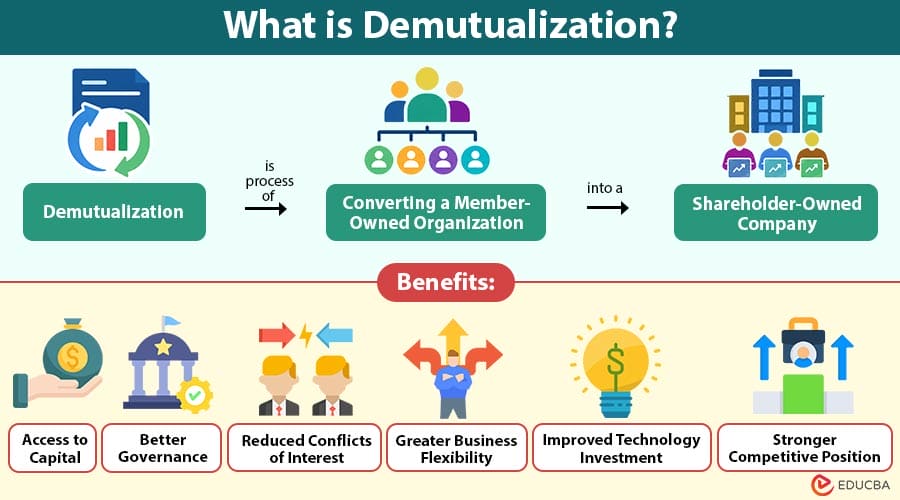
Demutualization is the process of converting a member-owned organization into a shareholder-owned company. It changes the ownership structure so that members receive shares or other financial interests in the newly structured company.
Mutual organizations are generally owned and controlled by their members, while corporations are owned by shareholders. Demutualization allows an organization to separate membership rights from ownership rights and may provide greater access to external capital.
For example, a stock exchange originally owned by its trading members may convert into a company owned by shareholders. Members may receive shares as part of the restructuring while the exchange continues operating its marketplace.
Table of Contents:
- Meaning
- Importance
- Working
- Types
- Example
- Benefits
- Challenges
- Difference
- Factors Affecting Demutualization
Key Takeaways:
- Demutualization changes an organization from member ownership to shareholder ownership.
- It separates ownership, membership, and management rights.
- Stock exchanges commonly use demutualization to modernize their ownership structures.
- Members may receive shares, cash, or other benefits during the conversion.
Importance of Demutualization
Demutualization can help organizations adapt their ownership and governance structures to changing business requirements. A member-owned model may work well when members are also the organization’s primary users. However, as the organization expands, separating ownership from operational participation can provide greater flexibility.
It can also strengthen corporate governance by clearly distinguishing management, ownership, and users. In regulated industries such as securities markets, this separation may reduce potential conflicts between commercial interests and member interests.
Demutualization can also help organizations attract outside investment, raise capital, introduce new technology, and expand into new markets.
How Does Demutualization Work?
The demutualization process generally involves several stages.
1. Evaluate the Existing Structure
The organization reviews its current ownership, membership rights, governance arrangements, assets, liabilities, and regulatory requirements.
2. Develop a New Structure
Management and advisors design a shareholder-based corporate structure. The organization determines how ownership rights will be distributed after conversion.
3. Obtain Approvals
Depending on the organization and jurisdiction, members, regulators, creditors, courts, or other authorities may need to approve the conversion.
4. Determine Member Entitlements
Existing members may receive shares, cash, or a combination of benefits based on their existing rights or interests in the organization.
5. Establish the New Company
The organization transfers relevant assets, liabilities, contracts, employees, and operations to the newly established corporate entity.
6. Issue Shares
Shares may be allocated to existing members or offered to other investors, depending on the demutualization structure.
7. Implement Corporate Governance
The organization establishes a board of directors, shareholder rights, reporting requirements, and other corporate governance mechanisms.
8. Continue Business Operations
After the conversion, the organization operates under its new shareholder-owned structure while maintaining its core products or services.
Types of Demutualization
Demutualization can take different forms depending on how ownership and financial interests are transferred.
1. Full Demutualization
Full demutualization completely separates membership from ownership. Members no longer own the organization simply by using its services. Instead, ownership is represented through shares.
2. Partial Demutualization
Partial demutualization changes the ownership structure while retaining certain member-based characteristics. Some membership rights may continue alongside shareholder ownership.
3. Hybrid Demutualization
A hybrid structure combines features of mutual and shareholder-owned organizations. Different groups may hold different rights relating to ownership, trading, voting, or participation.
Example of Demutualization
Suppose the ABC Stock Exchange is originally owned by 500 trading members. Each member has the voting rights and participates in exchange’s governance.
The exchange decides to demutualize. It establishes ABC Exchange Ltd. as a shareholder-owned company. Existing members receive shares based on the conversion plan, while trading rights become separate from ownership.
After the conversion, an individual or institution can potentially become a shareholder without becoming a trading member. Similarly, a trading participant can use the exchange’s services without necessarily owning part of the exchange.
This example shows how demutualization separates ownership from operational participation.
Benefits of Demutualization
Below are the key benefits of demutualization that can influence an organization’s growth, governance, flexibility, and competitive position.
1. Access to Capital
A shareholder-owned company can potentially raise capital from investors through equity issuance and other corporate financing methods.
2. Better Governance
Separating ownership from membership can create clearer responsibilities for directors, executives, shareholders, and users.
3. Reduced Conflicts of Interest
Demutualization can separate commercial ownership interests from the interests of organizations or individuals using the platform.
4. Greater Business Flexibility
The new corporate structure can make it easier to pursue acquisitions, partnerships, technology investments, and geographic expansion.
5. Improved Technology Investment
Additional capital and corporate flexibility can support investments in trading systems, digital platforms, cybersecurity, and other infrastructure.
6. Stronger Competitive Position
A demutualized organization may be better positioned to respond to competition and changing customer requirements.
Challenges of Demutualization
Below are the key challenges organizations may face when transitioning from a mutual ownership structure to a shareholder-based model.
1. Complex Restructuring
Changing ownership, governance, contracts, and legal arrangements can make the process complicated and time-consuming.
2. Regulatory Requirements
Organizations operating in regulated industries may require multiple approvals before completing the conversion.
3. Valuation Difficulties
Determining the organization’s value and deciding how much each member should receive can create disagreements.
4. Member Concerns
Members may have different expectations about shares, voting rights, compensation, or future participation.
5. Governance Changes
The organization must establish an effective shareholder-based governance system after conversion.
6. Implementation Costs
Legal advice, valuation, restructuring, technology changes, regulatory compliance, and communication can create substantial costs.
Difference Between Demutualization and Mutualization
The table below highlights the key differences between demutualization and mutualization:
| Basis | Demutualization | Mutualization |
| Ownership | Shareholders | Members |
| Main Structure | Corporate | Mutual |
| Ownership Rights | Represented through shares | Generally linked to membership |
| External Investment | Generally easier | More limited in traditional structures |
| Governance | Shareholder and board-based | Member-based |
| Capital Raising | Greater flexibility | Often more restricted |
| Example | Demutualized stock exchange | Member-owned mutual organization |
Factors Affecting Demutualization
Several factors can influence whether an organization considers demutualization:
1. Capital Requirements
Organizations that require substantial funding may consider a shareholder-based structure to access additional capital.
2. Regulation
Regulatory requirements can influence how an organization redesigns its ownership, governance, and operating structure.
3. Growth Strategy
Expansion plans may increase the need for a flexible corporate structure that supports investment and long-term growth.
4. Technology Investment
Significant technology investments may encourage organizations to seek external capital for modernization, infrastructure, and digital transformation.
5. Member Interests
Organizations must carefully consider existing members’ ownership, voting rights, financial benefits, and participation interests during the conversion process.
6. Competition
Increasing market competition may encourage organizations to adopt flexible structures that support faster decisions and strategic responses.
7. Governance
Organizations may seek clearer separation between ownership and operational participation to establish more defined responsibilities and decision-making processes.
Final Thoughts
Demutualization is a structural transformation that converts a member-owned organization into a shareholder-owned company. It separates ownership from membership and can provide greater flexibility in capital raising, governance, technology investment, and business expansion. However, the process involves complex legal, regulatory, financial, and operational considerations. Successful demutualization therefore requires careful planning, valuation, member communication, and governance restructuring.
Frequently Asked Questions (FAQS)
Q1. Why do organizations choose demutualization?
Answer: Organizations may choose demutualization to modernize their ownership structure, improve decision-making, attract investors, and respond more effectively to changing market conditions.
Q2. Can members lose their rights after demutualization?
Answer: Some membership rights may change or end after conversion, particularly rights connected to ownership or voting. The specific changes depend on the approved restructuring plan.
Q3. How are members compensated during demutualization?
Answer: Compensation can vary by structure and jurisdiction. Members may receive shares, cash payments, or a combination based on the terms of the conversion.
Q4. Does demutualization affect employees?
Answer: Employees may experience changes in reporting structures, employment arrangements, incentives, or governance processes, although the extent depends on the organization’s restructuring plan.
Recommended Articles
We hope that this EDUCBA information on “Demutualization” was beneficial to you. You can view EDUCBA’s recommended articles for more information.


