


Introduction to Customer Feedback for Business Growth
In the customer-driven marketplace, businesses that listen to their customers are the ones that grow. Whether improving products, enhancing customer service, or refining brand messaging, customer feedback for business growth has become a strategic asset. It is more than just listening—it is about leveraging insights to shape better experiences and build lasting relationships.
This article explores why customer feedback matters, how to gather it effectively, and the best tools to use in 2025 to harness its full potential.
Why Does Customer Feedback Matter?
Customer feedback is information users share about their experience with a product, service, or brand. This information is incredibly valuable for companies that want to boost performance and stay ahead of their competitors. It provides a clear picture of what customers like, dislike, or expect when used strategically.
Customer feedback is more than just opinions—it is a strategic asset that can shape better decisions, spark innovation, and drive lasting business success. When customers share their experiences with your product or service, they give you a direct look at what is working and what is not. Companies that use this input wisely gain a major advantage—and the data backs it up. In fact, 85% of businesses that prioritize feedback report significant revenue growth. Here is how that happens:
Understanding Your Customers Better
Feedback gives direct access to customer preferences, expectations, and pain points. When businesses understand their audience, they can tailor their offerings accordingly.
For instance, in the luxury fashion industry, brands that adapted their communication and branding strategies based on consumer input saw a surge in customer trust and purchase intent. They repositioned themselves for growth and relevance by paying attention to consumer insights.
This is a perfect example of how aligning your business decisions with real-time customer needs leads to better engagement and long-term growth.
Enhancing Products and Services
One of the most practical uses of feedback is improving products and services. Customers are often the first to notice when something is not working right.
Addressing these issues early prevents churn and boosts customer satisfaction. Feedback highlights hidden flaws that internal teams may miss, allowing companies to resolve problems before they escalate.
By actively using customer feedback for business growth, companies can innovate faster and more efficiently—based on real needs rather than assumptions.
Strengthening Your Reputation
Responding to feedback shows that the company listens and wants to improve. This transparency builds a trustworthy brand image.
In fact, companies that publicly respond to feedback—especially on review sites or social media—are seen as more authentic. This improves their reputation and attracts new customers while retaining existing ones.
Luxury brands that embraced customer-centric rebranding saw significant boosts in positive public perception, all thanks to their willingness to listen and act.
Building Long-Term Relationships
Listening to your customers is not just about solving problems—it is about building trust. When customers feel heard, they are more likely to become loyal advocates.
Brands that act on customer feedback create emotional connections with their audience. These connections translate into higher retention rates and greater customer lifetime value.
For example, SaaS companies that involve users in feature design improve functionality and foster brand loyalty. Over time, this approach becomes a sustainable way to drive revenue and retain customers.
How to Collect Customer Feedback Effectively?
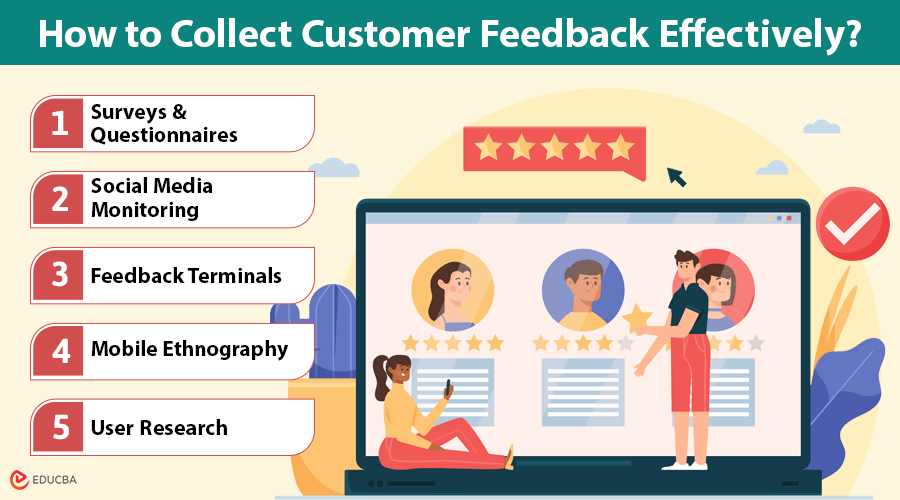
Businesses must have a structured collection strategy to make the most of customer feedback for business growth. Here are some of the most effective methods to gather meaningful feedback:
1. Surveys and Questionnaires
You can gather customer input directly by sending out surveys through:
- Company websites
- Mobile apps
- Cold calls
These tools help collect both quantitative (e.g., satisfaction scores) and qualitative (e.g., open-ended comments) data.
Use in-app popups, feedback widgets, and automated forms to gather real-time insights about specific interactions or product features.
2. Social Media Monitoring
Customers do not always share feedback through formal channels. Monitoring social media mentions, tags, and reviews can provide spontaneous and honest insights.
Tools like Hootsuite or Brandwatch allow companies to track brand sentiment and address concerns promptly. This improves reputation and keeps the brand in tune with customer expectations.
3. Feedback Terminals
Feedback kiosks can be used in physical locations such as retail stores or service centers. These terminals often include simple satisfaction tools like smiley buttons or quick rating systems.
They are useful for capturing instant impressions and work well in the hospitality, retail, and transportation industries.
4. Mobile Ethnography
This method uses smartphones to capture customer behavior in real-life settings. Participants record their interactions with a product or service, providing detailed and contextual feedback.
Mobile ethnography is especially useful for industries like consumer electronics, home appliances, and apps where hands-on usage matters.
5. User Research
User research dives deeper by observing or interviewing users directly. Common techniques include:
- One-on-one interviews
- Focus groups
- Usability testing
This approach offers in-depth insights into user needs and motivations. It is especially valuable for improving the user experience (UX) and refining new product features.
Deepening Insights Through Panel Discussions
In 2025, many companies will moderate a panel discussion to go beyond traditional feedback tools. These real-time conversations provide candid insights that surveys may miss. By moderating panels at conferences, webinars, or customer meetups, businesses create spaces for meaningful dialogue. These sessions often reveal industry-wide trends, pain points, and ideas for improvement.
Benefits of Moderating Customer Panels:
- Collects unfiltered, real-time feedback
- Identifies emerging customer needs
- Positions your brand as a thought leader
- Fosters collaboration between users and internal teams
For example, a SaaS provider might host a panel with long-term customers, product designers, and customer support staff. Such a session could uncover overlooked product flaws or reveal demand for new features, directly influencing product development.
Including panel discussions in your customer feedback for business growth strategy can diversify your insights and strengthen community bonds.
Top 5 Customer Feedback Tools for 2025
Using the right tools can streamline how feedback is collected, analyzed, and applied. Here are the five most effective feedback tools to use in 2025:
1. Hotjar
Best for: Hotjar gives you real-time insights into how visitors use your website through heat maps, session recordings, and quick on-site surveys.
Key Features:
- Heatmaps and click tracking
- Real-time surveys and polls
- Session recordings
- Easy integrations with tools like HubSpot and Google Analytics
2. Survicate
Best for: Multi-channel, targeted surveys
Survicate enables companies to deliver surveys through email, website widgets, and mobile apps.
Key Features:
- NPS, CSAT, and CES surveys
- CRM integrations (e.g., Salesforce, HubSpot)
- Real-time analytics and automation
- Personalization based on user behavior
3. Typeform
Best for: Engaging and interactive forms
Typeform makes surveys more human with a conversational interface.
Key Features:
- Beautiful, brand-aligned templates
- Logic jumps and conditional flows
- 500+ integrations (e.g., Zapier, Slack)
- Real-time response tracking
4. Qualtrics XM
Best for: Enterprise-level experience management
Qualtrics helps large businesses build scalable voice-of-customer (VoC) programs.
Key Features:
- AI-driven feedback analysis
- Predictive trends and reports
- Multi-channel input collection
- Powerful data segmentation
5. Feedier
Best for: Gamified feedback experiences
Feedier adds fun to feedback by offering incentives and using gamification.
Key Features:
- Reward-based survey experiences
- Sentiment analysis and dashboards
- Real-time reporting
- Persona-based segmentation
6. Qualaroo
Best for: In-context user insights on websites and apps
Qualaroo helps teams gather targeted customer feedback without disrupting the user experience.
Key Features:
- Nudges™ for on-site micro-surveys
- Behavior-based targeting
- AI-powered sentiment analysis
- Question branching & skip logic
Final Thoughts
In 2025 and beyond, customer feedback for business growth is not just a strategy but a necessity. It empowers businesses to understand customers’ wants, improve their offerings, and build lasting relationships.
There are countless ways to listen, from surveys to social media, from real-time kiosks to insightful panel discussions. However, the most successful businesses are those that do not just collect feedback—they act on it.
The right tools and methods can turn customer feedback into helpful ideas that improve your business and build customer loyalty.
Author Bio:

Ombir Sharma is the Managing Partner at Tecuy Media, where he drives business growth through innovative digital marketing strategies. He also leads LinksFrog, which specializes in high-quality SaaS backlinks and strategic link-building. With deep expertise in SEO, content strategy, and analytics, Ombir delivers measurable results by aligning creativity with data-driven decisions.
Recommended Articles
We hope this article helped you understand how to leverage customer feedback for business growth. Check out these recommended articles for more insights on customer experience strategies, feedback collection tools, and building lasting customer relationships.

