


How Custom Telemedicine Apps Are Transforming Virtual Care?
Telemedicine has reshaped how healthcare is delivered. Virtual consultations became widely accepted, improving access and convenience for patients. However, as adoption increased, many healthcare providers began to notice operational gaps. Most platforms solved the problem of access but struggled with workflow efficiency, system integration, and scalability. Video calls alone were not enough. Clinicians needed tools aligned with real clinical processes, and patients expected connected, continuous care. This is where a custom telemedicine app makes a difference. Built around real care models, custom platforms help healthcare organizations deliver consistent virtual care while supporting long-term growth.
Table of Contents
- Introduction
- Why Many Telemedicine Platforms Fall Short?
- What Custom Telemedicine App Development Really Means?
- How Custom Telemedicine Apps Improve Virtual Care Delivery?
- Core Features Modern Telemedicine Apps Need
- Understanding Security and Compliance Factors
- Who Benefits Most from Custom Telemedicine Apps?
- When Custom Telemedicine Development Becomes the Right Choice?
- Choosing the Right Telemedicine App Development Partner
- Relinns: Telemedicine Built for How Care Actually Works
Why Many Telemedicine Platforms Fall Short?
Most telemedicine apps seem effective at first. Over time, real-world applications expose gaps. What works for basic virtual visits often struggles to support daily operations, complex care delivery, and sustainable growth. This gap becomes clear when compared with custom-built solutions:
| Area | Standard Telemedicine Platforms | Custom Telemedicine App |
| Flexibility | Fixed workflows | Adapts to real clinical workflows |
| Integration | Limited or fragmented | Seamless EHR, billing, and pharmacy integration |
| Scalability | Struggles as usage grows | Scales across teams, locations, specialties |
1. Limited Workflow Flexibility: Standard telemedicine platforms rely on rigid setups. Real care is more complex. Clinics, hospitals, and specialties all operate differently. When tools cannot adapt, clinicians must change how they work. Teams end up needing workarounds and manual efforts. Over time, this increases errors and slows down care delivery.
2. Poor EHR, Billing, and Pharmacy Integration: Virtual care cannot function in isolation. Yet many platforms struggle to link with EHR systems, billing software, and pharmacy tools effectively. Because data sits in silos, clinicians must re-enter information or switch systems. This hinders continuity of care and adds to the staff’s administrative load.
3. Scaling Issues Across Teams and Locations: What works for a small team would not always work for a large one. As patient volume grows, the platform reaches its limit. Adding features, locations, services, or specialities becomes difficult and expensive. Performance gaps, access controls, and reporting issues appear. This is where custom telemedicine software solutions providers prove helpful. They integrate smoothly with pharmacies, EHRs, and billing systems, breaking down data silos and aligning with real clinical workflows.
What Custom Telemedicine App Development Really Means?
Custom telemedicine app development is often mistaken for complex systems. In reality, it focuses on building software that fits how teams plan, manage, and deliver care.
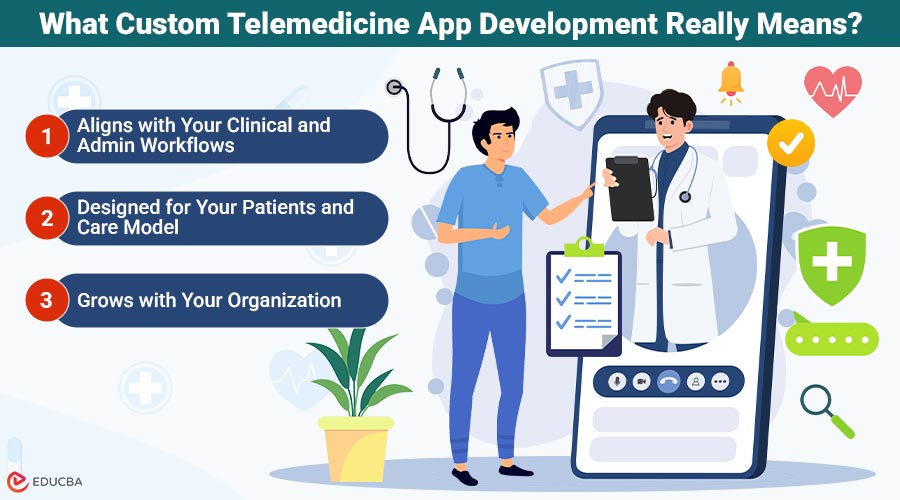
- Aligns with Your Clinical and Admin Workflows: Care rarely follows a single template. Teams build custom telemedicine software solutions that align with real clinical and administrative workflows. Scheduling, reporting, documentation, and care coordination match how teams already work. This reduces manual efforts, delays, and unnecessary handoffs.
- Designed for Your Patients and Care Model: Patient expectations vary across specialties and care settings. When teams develop custom telemedicine software, they shape the experience around your care model. Telemedicine app features support follow-ups, ongoing care, and virtual visits instead of disconnected interactions.
- Grows with Your Organization: Healthcare platforms should support long-term growth. A custom telemedicine app development solution enables you to expand features and services and scale across locations without limits.
How Custom Telemedicine Apps Improve Virtual Care Delivery?
Virtual care should be more than a video call. Custom platforms improve both care quality and operational efficiency.
1. Better Care, Not Just More Visits
Custom tools help you move beyond one-off visits.
- Prioritizes ongoing care
- Makes follow-ups seamless
- Let’s different providers collaborate
2. Faster, Streamlined Operations
When platforms match real workflows, friction fades, and work moves faster:
- Automates repetitive tasks
- Gives clinicians a unified view to avoid tab-switching
- Handles scheduling, reporting, and documentation in one spot
This lets teams focus less on managing systems and more on patient care.
3. Consistent Patient Experience
A custom design offers consistency that builds trust in virtual care:
- Creates simple interfaces across devices
- Builds accessible multi-lingual design for wider reach
- Ensures clear communication across visits
Patients experience care that feels seamless, familiar, and reliable.
Core Features Modern Telemedicine Apps Need
A custom app needs tools that handle the heavy lifting of healthcare. Here are features that make the shift possible:
- Secure Video and Chat Consultations: Trust is the foundation of care. Patients need to know their private conversations stay private. High-quality video ensures the visit feels personal, while encrypted chat allows for secure follow-ups.
- E-prescriptions and Pharmacy Workflows: Integrated e-prescriptions allow providers to send medication orders directly to the pharmacy. This reduces prescription errors and helps patients receive medication faster.
- EHR/EMR and FHIR-based Data Exchange: The app must automatically pull in the complete patient history. Using standards like FHIR, a custom system connects smoothly with existing medical records.
- Remote Patient Monitoring Support: Modern apps should connect with wearables to track vital signs such as blood pressure and glucose levels. Continuous data helps clinicians notice early changes and act sooner.
- Billing and Insurance Automation: Automated tools check insurance coverage and handle payments. This reduces claim rejections and removes friction around costs.
Understanding Security and Compliance Factors
A telemedicine app must protect patient data at every step. Security and compliance need to be part of the foundation from day one.
- HIPAA and GDPR-ready Systems: Building HIPAA and GDPR standards into the foundation ensures you do not have gaps later. Teams design custom telemedicine apps from the start to meet these requirements. This includes patient consent, proper data handling, and clear access rules.
- Encrypted Communication and Secure APIs: Video calls, messages, and data transfers are protected by encryption to prevent unauthorized access. Secure APIs ensure integrations do not expose sensitive data.
- Role-Based Access and Audit Trails: Role-based controls limit data visibility by role. Audit trails record every action and help maintain accountability.
- Cloud Infrastructure Built for Healthcare: Secure cloud systems support data backups, uptime, and controlled scaling. Platforms remain stable and ready as demand grows.
Who Benefits Most from Custom Telemedicine Apps?
Healthcare is not one-size-fits-all, and telemedicine should not be either. Here are the types of organizations that gain the most from custom telemedicine apps:
1. Specialty Clinics and Private Practices
Custom apps enable care teams to work the way they need to. They offer:
- Workflows designed to match your specialty
- Support for specific needs
- Software that reflects how you treat patients
2. Large Hospitals and Health Systems
Custom platforms help bring order to scale. These:
- Connect departments
- Create a unified view of patient data.
- Integrate smoothly with existing systems.
3. HealthTech Startups
Innovation needs control. Custom development gives startups flexibility and ownership. This includes:
- Full ownership of the product
- Ability to build differentiated features
- Technology that grows with the business
When Custom Telemedicine Development Becomes the Right Choice?
Not every telemedicine app requires tailoring. Custom telemedicine app development becomes the ideal choice when platforms need to support growth, long-term control, and real care delivery.
Signs You are Outgrowing Ready-Made Platforms:
- Your workflows do not fit traditional platforms.
- You plan to scale specialties or services.
- Compliance and data control are priorities.
- You want long-term platform ownership.
Over time, these patterns become easier to recognize. And when multiple signs show up, custom development helps teams move forward without being held back by platform constraints.
Choosing the Right Telemedicine App Development Partner
A telemedicine platform works when teams build it with purpose. An ideal partner:
- Understands Healthcare Workflows: Healthcare workflows are complex and interconnected. A capable partner designs systems that support daily operations.
- Supports Integrations and Scalability: Telemedicine depends on connected systems. A reliable partner ensures smooth integration and plans for growth.
- Builds with Compliance in Mind: The right partner builds telemedicine apps with healthcare regulations in mind from the start.
- Offers Ongoing Technical Support: Telemedicine platforms evolve as care models change. Long-term support keeps systems stable and secure.
- Thinks Beyond the First Release: New features, integrations, and care models will come over time. The right partner helps teams plan for what comes next.
Partnering with the right telemedicine app development teams, like Relinns Technologies, can make a difference between a working product and a sustainable platform.
Relinns: Telemedicine Built for How Care Actually Works
Relinns Technologies builds custom telemedicine platforms for healthcare teams that have outgrown generic tools. Teams design platforms to match real clinical and operational workflows, using HIPAA-ready architecture and cloud infrastructure that supports disruption-free expansion. The idea for development is straightforward: let technology stay in the background while care stays front and centre.
Final Thoughts
Telemedicine has moved past experimentation. It is part of everyday care. Custom telemedicine apps give teams control over data, workflows, growth, and experience. When technology aligns with real care workflows, clinicians spend less time managing systems and more time treating people. Patients feel the difference. The future of virtual care is not louder software. It is quieter systems working reliably in the background.
Frequently Asked Questions (FAQs)
Q1. What is custom telemedicine development?
Answer: Building telemedicine software tailored to clinical workflows, integrations, and compliance needs
Q2. How is it different from ready-made platforms?
Answer: Custom apps fit real care processes and scale better.
Q3. Who should use custom telemedicine software?
Answer: Hospitals, clinics, pharmacies, and digital health startups
Q4. Is custom telemedicine software secure?
Answer: Yes, with encryption, access controls, and HIPAA-ready architecture
Recommended Articles
We hope this guide to custom telemedicine apps helps you optimize virtual care delivery. Check out these recommended articles for more insights and strategies.

