


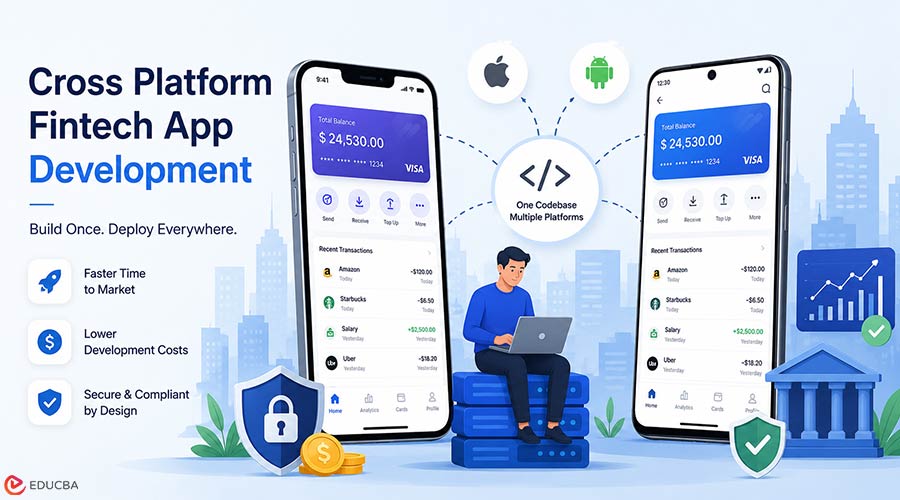
Building a fintech app has always come with a brutal trade-off: move fast enough to grow, but carefully enough to survive compliance and security reviews and maintain user trust. The moment your app experience starts falling apart across iOS and Android, growth slows, support tickets rise, and the roadmap slips quietly into the background. For years, fintech teams solved that problem by building two separate native apps with two separate teams, which usually led to higher costs, slower releases, and persistent feature gaps between platforms. This shift is driving the rise of cross-platform fintech app development across the industry.
Nearly 60% of new fintech apps launching in 2026 are now built with cross-platform frameworks such as Flutter and React Native. The reason is simple: teams are getting to market up to 50% faster while significantly reducing development costs and maintaining far better feature consistency across devices. In fintech, going to market even a few months sooner can determine whether a company leads the industry or falls behind a competitor.
How is Cross-Platform Fintech App Development Changing the Way Fintech Actually Ships?
Fintech mobile development used to carry a hidden tax; every feature got specced, built, and tested twice, and any platform that fell behind became a compounding source of support pain. An experienced cross-platform app development company flips that math because one codebase drives iOS and Android together, the team specs once and ships once, and platform parity becomes a default, not a milestone.
- Real-time transaction screens that look identical on both platforms, cutting UI-inconsistency tickets by 40 to 60% and removing one of the quietest sources of trust erosion in fintech
- Single-codebase compliance updates are rolling out across iOS and Android on the same day, which matters when regulators push deadline shifts mid-quarter
- Onboarding flows share components across web, mobile, and partner-embedded surfaces, letting growth teams test acquisition funnels faster than twin-native can match.
- Unified analytics provide the same behavioral insights across platforms, giving product teams clean data without needing dedicated engineering support to reconcile it.
Why Partnering with a Fintech Mobile App Development Company Changes the Build Entirely?
The first time a founder works with a focused fintech mobile app development company instead of a generalist agency, the difference shows up in the kickoff meeting. Generalist teams ask about features and timelines, while a specialist fintech team asks about KYC providers, PCI scope, audit logging, encryption at rest, and which compliance officer signs off. Only one of those teams is building with an honest picture of what breaks in year two.
The cost of a missed assumption in fintech does not show up in the next sprint; it shows up two years later, when a regulator asks a question the codebase cannot answer, and a team that has shipped fintech apps before knows where the landmines sit.
What Most Fintech Founders are Quietly Getting Wrong with their Mobile Strategy?
While many founders treat mobile as the actual product, plenty still treat it as a thinner version of the web app, and the gap is wider than screenshots suggest. The biggest mistake is mirroring the desktop flow, the same dense forms and multi-step verification that felt fine on a laptop and now feel hostile on a four-inch surface. Users notice in the first session. Conversion notices in the first month.
The second mistake is underinvesting in what mobile fintech depends on: real-time push notifications, frictionless biometric auth, offline grace handling, and clean error states when payments fail mid-flow. The third is treating cross-platform development as a code choice instead of a product decision, choosing a framework for its popularity rather than its fit for the use case.
Must-Know Use Cases for Cross-Platform Fintech Apps
The proof is in the launched products quietly beating twin-native competitors. Neobanks shipping cross-platform report 25 to 35% lower per-feature engineering costs while shipping releases twice as often, a real lead by year two. Users barely notice the framework. They notice the pace of feature releases.
In payments and remittances, cross-platform builds see regional rollouts up to 50% faster because localization is not split across two codebases, and more countries can decide whether the next round closes. In lending, cross-platform lets tiny teams maintain feature parity across iOS, Android, and partner SDK surfaces through shared logic.
Why Does the Cross-Platform App Development Company You Choose Matter Most?
The frameworks themselves, React Native, Flutter, Kotlin Multiplatform, and the rest, have matured to where they are no longer the real differentiator, which is why the cross-platform app development company you partner with has become the deciding variable in whether a fintech product succeeds or stalls. The gap between a prototype and a production fintech app largely comes down to early architectural decisions, including data flows, audit logging, and compliance design.
A team that has built fintech cross-platform apps at scale knows where the framework trips them up. A team that hasn’t built products for 30,000 users and faced the challenges of scale and regulation. Frameworks do not lose products; partners do.
What Every Serious Fintech Mobile App Development Company is Preparing for Next?
Which raises the obvious next question: what is coming in the next twelve months that fintech founders should be planning for? Any fintech mobile app development company worth working with in 2026 is already wiring these into roadmaps before clients know to ask.
- Embedded AI personalization that adapts the dashboard, alerts, and savings nudges to each user in real time, at a level legacy banking apps cannot match.
- Real-time fraud detection running partly on-device, reducing latency and regulatory exposure from sending every transaction to the cloud.
- Cross-platform integration with open banking APIs that lets fintechs spin up aggregation, payment initiation, and credit-decisioning flows in weeks rather than quarters
- On-device biometric and behavioral authentication is replacing SMS OTPs for high-value transactions, reducing both friction and fraud.
Final Thoughts
The window for fintech to use cross-platform apps as the primary lever for fast, capital-efficient growth is still open—but not forever. In 2026, cross-platform fintech app development is becoming less of a competitive advantage and more of a baseline expectation for serious fintech players. The fintechs moving with conviction will write the case studies everyone else cites later, and the deciding factor is rarely the idea or the funding; it is who is on the build side during the first critical sprints. AppZoro Technologies has built enough cross-platform fintech apps to know the pitfalls and create scalable products.
Recommended Articles
We hope this comprehensive guide to cross-platform fintech app development helps you understand how fintech apps are transforming in 2026. Check out these recommended articles for more insights and strategies to build faster, scalable, and secure fintech solutions.


