


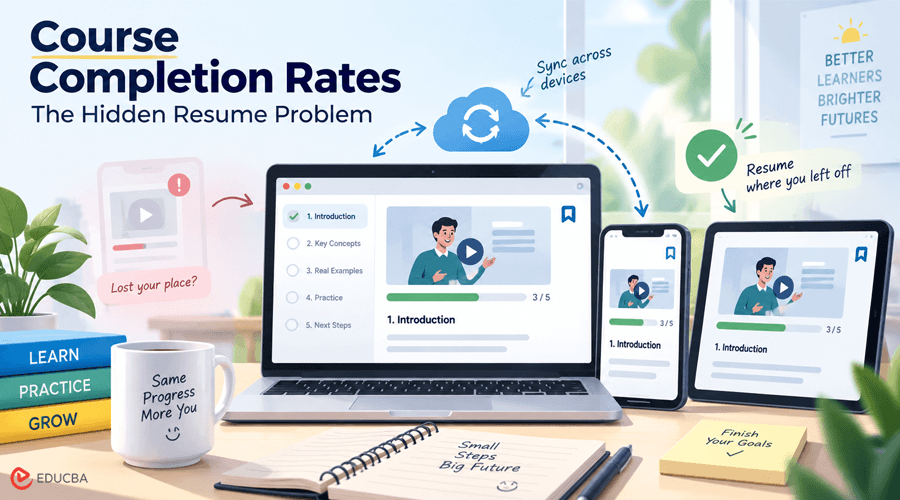
Every course platform shows a progress bar. Almost none of them reliably remember where a learner left off when that learner switches devices. A student starts a lesson on a laptop and picks it back up on their phone that evening. What they get is an inaccurate resume point, sometimes no resume point at all. Course teams keep adding new lessons to fix a completion problem that this one bit of friction causes on its own. The platforms that moved Course Completion Rates in 2026 did not add lessons. They rebuilt how resume state gets stored.
Course Completion Rates Have Been Stuck for Years
Online course completion is not a new problem, and it has not meaningfully improved despite a decade of platform investment. Platforms have tried gamification, reminder emails, and cohort-based structures. The number barely moved.
Where Course Completion Rates sit:
- The median massive open online course (MOOC) completion rate sits at 12 to 15 percent, per Class Central’s tracking, roughly steady for years.
- The HarvardX-MITx Person-Course dataset, one of the largest de-identified records of MOOC behavior ever released, shows the same pattern at the individual course level.
- Drop-off happens in small increments across many sessions, not in one dramatic exit.
Small frictions add up. Session resumption rarely gets measured directly, but it is sitting right there at the exact point where a learner either keeps going or closes the tab. Improving this experience can therefore become an important consideration when platforms evaluate Course Completion Rates.
Why Device Switching Breaks the Resume Point?
Most course platforms built their resume-position tracking on localStorage. It is a browser storage API and has been a part of the web platform since 2018. It is scoped tightly to a single browser on a single device, it was never designed to sync anywhere. Take a learner switching from a work computer to a tablet at home. localStorage on the tablet has no idea the work computer’s session ever existed, since each browser instance keeps its own separate storage bucket with nothing shared between them.
The resume point either does not transfer at all, or the platform falls back to a rough approximation. “Last completed module” instead of the exact timestamp. The exact scroll position, gone. Nielsen Norman Group’s research on cross-channel experience identifies this exact failure mode as a loss of continuity when a user moves between devices. Apple’s device Handoff avoids this by keeping state on Apple’s servers rather than on either device.
Netflix’s “continue watching” row does the same thing, storing playback position centrally so it is there no matter which screen a viewer opens next. A course platform that stores progress only in the browser cannot offer the same continuity. For platforms focused on improving Course Completion Rates, this cross-device continuity is particularly important because learners increasingly move between devices during the same course.
A Broken Resume Point Costs Completions
This is where the account-vs-device split becomes a business problem, not just a technical one. Learning happens across more than one device, and that share keeps growing across the most widely used e-learning platforms today.
The scale involved:
- Coursera and Udemy, which merged in 2026, now share one platform and have a combined base of about 290 million registered learners, according to their public filings.
- Mobile access has grown steadily as a share of total sessions industry-wide for years.
- Every mobile session is a potential point of device switching relative to whatever device a learner used before.
That scale means the broken resume point is not a rare edge case. It is a routine moment in a normal learner’s week. Each time it happens, it costs something specific: rebuilding context from scratch, which behavioral research on task interruption identifies as the real price of any interruption. Most of what it costs a person to pick a task back up is figuring out where they left off and what they were about to do next.
A broken resume point makes a learner do that figuring-out by hand. Because that cost repeats at scale, fixing it well takes more than an engineering afterthought. Platforms working through a resumption-first redesign often start by reviewing top educational website designs built around this kind of continuity, before committing to a specific technical approach.
Content Fixes Cannot Touch the Resume Problem
When Course Completion Rates stall, most platforms look at the content. Shorter lessons. Better video production. More interactive quizzes. That work does not touch session resumption specifically. That friction lies below the content layer. It is shell-state architecture. That part of the platform tracks where a learner is, independent of what they are learning.
The real fix looks like a data-modeling change. Resume position needs to live server-side, tied to the account rather than the browser, and updated frequently enough that a mid-video interruption resolves within a second of when a learner stopped.
Why it is easier to fix now than in 2013:
- IndexedDB and the Storage Manager API can store structured data locally and sync it in the background.
- localStorage never could, as it only handles simple key-value pairs, and it has no built-in sync.
- Structured server sync patterns are standard practice for most modern web applications.
- Platforms rebuilding their resumption layer today are not fighting the technical constraints an early MOOC platform faced.
A server-side approach can make progress more consistent across devices, removing one small but repeated source of friction that can affect Course Completion Rates.
The Bigger Lever Was Never the Lessons
The platforms that saw completion move focused on one lever: resume-state tracking. They moved it off the browser and onto the account, then synced it across devices in near real time. They also tested it specifically against the device-switch scenario, rather than assuming a single-device user in QA. That is a front-end and infrastructure problem as much as an instructional design one. It is why platforms tackling it seriously bring in dedicated design and engineering support to lead the rebuild, the same kind of investment that separates the best online learning platforms from the rest.
Progress bars solve a narrow problem, telling a learner how far they have come. Getting a learner back to exactly where they were, on whatever device they happen to be using, needs a different fix entirely. Course consumption keeps splitting across laptops, phones, and tablets within a single learner’s week. That second problem is becoming a bigger lever on Course Completion Rates, in some cases bigger than anything a platform could do to the lessons themselves.
Recommended Articles
We hope this guide helps you understand Course Completion Rates, session resumption, and the role of cross-device learning experiences. Explore our recommended articles for more insights on e-learning platforms, learning experience design, course engagement, educational technology, and online learning strategies.


