


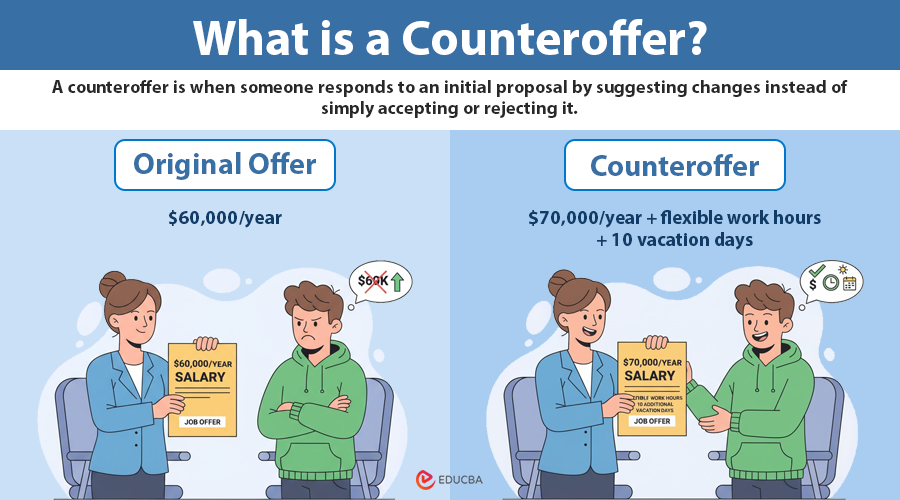
What is a Counteroffer?
A counteroffer is a response to an initial proposal in which the recipient suggests modifications to the original terms rather than outright rejecting or accepting them. Counteroffers are prevalent in job offers, business transactions, contracts, real estate deals, and legal settlements.
Counteroffers serve two main purposes:
- Negotiation: They allow both parties to find common ground without ending discussions.
- Protection of Interests: The responding party can adjust the terms better to meet their financial, personal, or strategic goals.
For instance, if a company offers a salary lower than a candidate’s expectation, the candidate may submit a counteroffer requesting a higher salary and additional benefits. Similarly, in business deals, a supplier may propose a price revision based on order volume or delivery conditions.
A counteroffer is not a rejection but a negotiation tool, indicating that the responder is interested but has conditions to meet before reaching an agreement.
Table of Contents
Features of a Counteroffer
- Modification of original terms: It always alters some part of the original offer, whether price, timelines, or conditions.
- Legal binding potential: Once accepted, it forms a binding agreement under contract law.
- Temporary validity: They are usually time-sensitive; delaying a response can result in losing the opportunity.
- Initiates dialogue: It is an entry point for further negotiation, aiming for a win-win solution.
- Reflects value assessment: The responder communicates their perceived value or expectations compared to the original offer.
Example: A freelance graphic designer offered $500 for a project may counter with $650 if they believe the workload and creative input justify the increase.
Types of Counteroffers
Counteroffers vary based on context and purpose. The major types include:
1. Job Offer Counteroffers
Common for a candidate to receive a job offer but wish to improve compensation, benefits, or work arrangements.
- Example: A candidate offered $60,000 annually may request $70,000, flexible working hours, and additional leave days.
- Tip: Focus on adding value by highlighting skills or experience that justify the requested adjustment.
2. Business Contract Counteroffers
Used in commercial negotiations to adjust pricing, timelines, or service terms.
- Example: A supplier quotes $10 per unit for 1,000 units. The buyer counters at $9.50 per unit for bulk purchase and faster payment terms.
- Tip: Always back your counteroffer with data or market research to appear reasonable and professional.
3. Real Estate Counteroffers
Widely applied in property transactions where buyers and sellers negotiate price, possession dates, or property condition.
- Example: A home listed at $300,000 receives a buyer’s offer of $280,000; the seller counters with a $295,000 offer, including minor repairs.
- Tip: Understand market trends, neighborhood pricing, and comparable sales before countering.
4. Legal Counteroffers
Used in settlements, disputes, or contract renegotiations.
- Example: In a lawsuit, Party A offers $50,000 to settle. Party B counters at $70,000, citing damages or additional claims.
- Tip: Seek legal advice to ensure counteroffers do not unintentionally create liability.
How Does a Counteroffer Work?
The counteroffer process is methodical, requiring strategy and timing:
- Receive initial offer: Carefully review all terms, including benefits, obligations, timelines, and fine print.
- Assess needs: Identify areas needing improvement, such as salary, price, service quality, or deadlines.
- Draft the counteroffer: Be specific, professional, and realistic. Avoid ambiguous or extreme requests.
- Present to the other party: Use formal channels, such as email, negotiation meetings, or official documents.
- Negotiate further: Expect back-and-forth discussions. Both parties may make multiple counteroffers before a final agreement.
- Finalize agreement: Once both parties agree on the terms, they should formalize the agreement to make it legally valid.
Examples of Counteroffers
Counteroffers can occur in various situations, such as jobs, business deals, real estate, and legal settlements. Here are some practical examples:
| Scenario | Original Offer | Counteroffer | Explanation |
| Job Offer | $60,000/year | $70,000/year + flexible work hours + 10 vacation days | Candidate negotiates higher salary and additional benefits based on experience and skills. |
| Real Estate | $300,000 for a house | $295,000 with closing in 30 days and minor repairs by seller | Buyer requests a slightly lower price and property in good condition, creating a compromise. |
| Business Deal | Supplier quotes $10/unit for 1,000 units | $9.50/unit with free shipping for bulk order | Buyer aims to reduce cost while maintaining order, supplier may accept to secure the deal. |
| Legal Settlement | $50,000 to settle a dispute | $70,000 citing additional damages and legal costs | Reflects responder’s assessment of claim value and encourages a fair settlement. |
Benefits of Counteroffers
- Negotiation power: Provides leverage to secure better terms, pricing, or benefits.
- Flexibility and creativity: Opens the door for tailored solutions that satisfy both sides.
- Increased satisfaction: Achieves win-win outcomes where both parties feel valued.
- Demonstrates confidence: Shows professionalism, strategic thinking, and negotiation skills.
- Relationship building: Encourages collaboration when handled respectfully.
Risks of Counteroffers
- Offer withdrawal: The original offeror may reject your counter and withdraw entirely.
- Damaged relationships: Aggressive or unreasonable counteroffers can create tension or mistrust.
- Legal implications: In contracts or settlements, poorly worded counteroffers may inadvertently create obligations.
- Perceived arrogance: Overestimating value or asking for unrealistic terms can harm reputation.
- Lost opportunities: Delays in submitting a counteroffer may result in missed deals.
Tips for Making an Effective Counteroffer
- Be clear and specific: Avoid vague terms or open-ended requests.
- Maintain professionalism: Keep tone polite, constructive, and respectful.
- Justify your proposal: Provide logical reasoning, data, or examples to support your terms.
- Know your minimum: Identify the lowest acceptable terms beforehand.
- Time your response: Prompt counteroffers demonstrate interest and seriousness.
- Be flexible: Prepare to compromise, as rigidity reduces chances of acceptance.
- Focus on value addition: Emphasize what you bring to the table rather than just what you want.
Counteroffer vs. Negotiation
| Aspect | Counteroffer | Negotiation |
| Definition | A specific response that changes some terms of the original offer. | A broader process of discussing, bargaining, and reaching a mutually acceptable agreement. |
| Purpose | To modify or improve the original offer. | To find common ground and achieve a win-win outcome. |
| Scope | Narrow and focused on a single offer. | Broad, can involve multiple offers, counteroffers, and compromises. |
| Timing | Happens after an initial offer is made. | Can occur throughout the discussion process, even before formal offers. |
| Outcome | Becomes a legally binding agreement if accepted. | May result in multiple iterations before reaching a final agreement. |
| Example | Employee requests a higher salary than initially offered. | Employer and employee discuss salary, benefits, work hours, and other terms until both agree. |
Final Thoughts
Counteroffers are powerful tools for achieving favorable terms in jobs, business deals, contracts, real estate, and legal settlements. By carefully assessing the initial offer, articulating clear and justified terms, and maintaining professionalism, it can lead to mutually beneficial agreements. However, it is crucial to manage risks, avoid overreach, and be ready for compromise to ensure long-term success.
Frequently Asked Questions (FAQs)
Q1. Can I make multiple counteroffers?
Answer: Yes, you can make multiple counteroffers during negotiations. However, making too many can frustrate the other party and increase the risk of losing the deal. It is best to be strategic and realistic.
Q2. How do I politely decline a counteroffer?
Answer: You can decline a counteroffer politely by thanking the other party for their time and effort, acknowledging their proposal, and explaining why you cannot accept the terms. Always remain professional to preserve relationships.
Q3. What is the risk of making an aggressive counteroffer?
Answer: An aggressive counteroffer may be perceived as unrealistic or disrespectful, leading the other party to withdraw from negotiations. It is important to find the right balance between being firm and being flexible.
Q4. Do employers get offended by counteroffers?
Answer: Most employers expect some level of negotiation. However, an unreasonable or poorly justified counteroffer can damage your chances. Always provide a clear rationale backed by skills, experience, or market data.
Q5. Can a counteroffer expire?
Answer: Yes. Many counteroffers have deadlines or validity periods, especially in contracts and real estate deals. If not accepted within the timeframe, the counteroffer automatically lapses.
Recommended Articles
We hope this guide on counteroffers helped you understand negotiation strategies. Explore our related articles on:

