


How to Further Your Education as a Business Professional?
In the fast-paced business environment, the skills and knowledge you acquired during formal education can quickly become irrelevant. Technologies evolve at lightning speed, market dynamics shift due to global events, and innovative practices rapidly become standard expectations. For business professionals, the question is no longer whether to continue learning but how to engage in continuing education for business professionals strategically. Those who commit to lifelong learning not only maintain their relevance but also gain a competitive edge, positioning themselves as leaders in their industries. Continuing education is not just a defensive strategy to avoid falling behind it is an investment in your professional growth.
Each new skill acquired, every framework mastered, and all knowledge gained compound with what you already know, creating a unique professional value that no credential alone can provide. This guide will show you how to approach professional development not as an occasional obligation, but as a sustainable practice woven into your career trajectory. Whether you are navigating your first professional role or leading teams toward ambitious goals, the principles of strategic, ongoing education remain the same: intentionality in what you learn, discipline in how you learn it, and wisdom in applying that knowledge to create measurable impact. Your education did not end when you received a diploma. In many ways, it had only just begun.
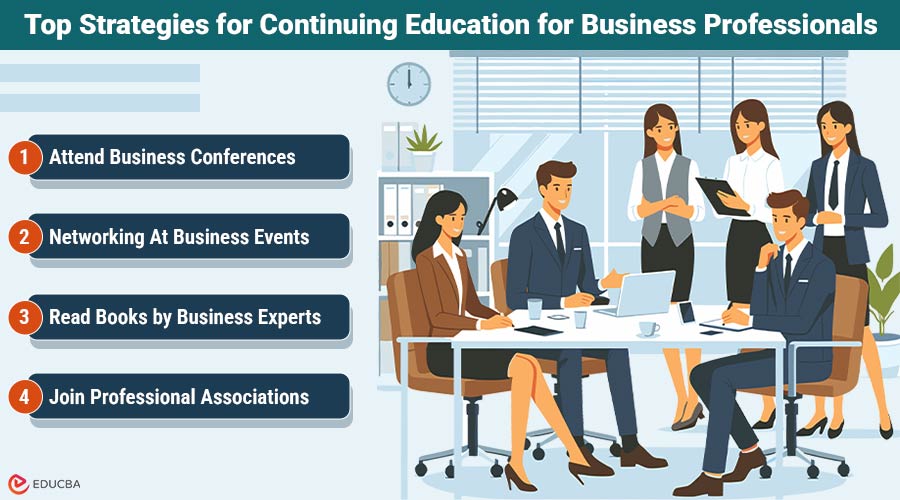
Top Strategies for Continuing Education for Business Professionals
Engaging in continuing education for business professionals requires intentionality, discipline, and practical application. There are several highly effective ways to integrate ongoing learning into your professional life:
1. Attend Business Conferences
Industry conferences are among the most concentrated sources of current knowledge available to business professionals. Unlike textbooks or recorded courses, which may take months or years to develop and publish, conferences deliver insights unfolding in real time. The expert business guest speakers standing before you are not teaching from outdated case studies they are sharing strategies they implemented last quarter, discussing challenges they are navigating right now, and forecasting trends based on data they analyzed last week. This immediacy makes conferences invaluable for professionals who need to stay ahead of the curve rather than catch up.
The true value of these events extends far beyond the keynote sessions. When industry leaders take the stage, they distill years of leadership experience into actionable frameworks, reveal what is working in their organizations, and often candidly discuss what is not. They provide context that no article or webinar can fully capture the nuances of implementation, the unexpected obstacles, the adjustments required when theory meets reality. You gain not just information, but a perspective shaped by practical application.
2. Networking At Business Events
Equally important is the networking that happens in the margins of these events. The conversations during coffee breaks, the discussions over lunch, the questions exchanged after panel sessions this is where insider knowledge circulates. Your peers are facing similar challenges, experimenting with new approaches, and discovering solutions that have not yet made it into formal publications. They understand the unwritten rules of your industry, know which vendors deliver on their promises, and can offer candid assessments of emerging tools and methodologies. These informal exchanges often prove more valuable than the formal programming, providing the kind of practical intelligence that can only come from practitioners in the trenches.
Industry events also expose you to perspectives outside your immediate organizational bubble. You might assume your company’s approach is standard until you see three different methods succeeding elsewhere. Conferences break down these silos, allowing you to benchmark your knowledge, identify gaps in your expertise, and return to your organization with fresh ideas backed by evidence from across your sector. Make attending relevant conferences a regular investment in your professional development. The knowledge you gain will be current, the connections you make will be genuine, and the insights you bring back will position you as someone who understands not just where your industry has been, but where it is heading.
3. Read Books by Business Experts
After formal education ends, many professionals unknowingly abandon deep learning habits. Without assignments or deadlines, reading often shifts from structured study to surface-level consumption leading to intellectual stagnation. Reading books by industry experts is a highly effective, yet often underutilized, method of continuing education for business professionals. These books are authored by leaders actively shaping industries, navigating disruption, and building scalable strategies. Unlike short-form content, business books allow authors to explore complexity by presenting detailed case studies, long-term frameworks, and strategic principles.
Whether reading classic thinkers like Peter Drucker and Clayton Christensen or modern voices in digital transformation and leadership, professionals gain mental models that enhance decision-making across diverse scenarios. Many industry trends surface quietly before becoming mainstream. Business authors often recognize these early signals and translate them into actionable insights long before they reach popular discourse. By the time a trend becomes common knowledge, informed professionals have already prepared for it. To maximize impact, establish a consistent reading routine such as one book per month, daily focused reading sessions, or audiobooks during commutes. Diversify across leadership, strategy, finance, marketing, and organizational behavior to support well-rounded professional growth.
4. Join Professional Associations
Professional associations provide structured environments where continuing education intersects with peer collaboration. These organizations foster learning through shared experience rather than solely through formal instruction. Membership grants access to collective intelligence knowledge built from real challenges, tested solutions, and ongoing industry evolution. More importantly, professional growth within associations thrives on reciprocity. By contributing insights from your work, sharing lessons learned, or participating in discussions, you establish credibility and trust. This active engagement encourages experienced professionals to share candid advice, best practices, and insider perspectives.
Associations also facilitate learning through forums, special interest groups, mentorship programs, and collaborative initiatives. These platforms offer proven approaches to regulatory change, technology adoption, team structure, and strategic pivots supported by peers who can provide context and guidance. The relationships built within professional associations often become long-term career assets. What begins as peer interaction can evolve into partnerships, referrals, or leadership opportunities rooted in genuine professional respect. Active participation through volunteering, publishing, or committee involvement unlocks the greatest value. Those who treat associations as communities to contribute to, rather than services to consume, gain the most from collective professional knowledge.
Final Thoughts
In a rapidly changing business environment, isolation is a liability. Continuing education for business professionals ensures you evolve alongside your industry rather than attempting to decode it alone. Learning from peers, industry leaders, and trusted networks builds adaptability, foresight, and influence. When approached intentionally, ongoing education does not merely protect your career it accelerates it. Your formal education may have ended with a diploma, but your professional education has only just begun.
Recommended Articles
We hope this guide to continuing education for business professionals helps you advance your career. Check out these recommended articles for more insights and strategies to enhance your professional growth.

