
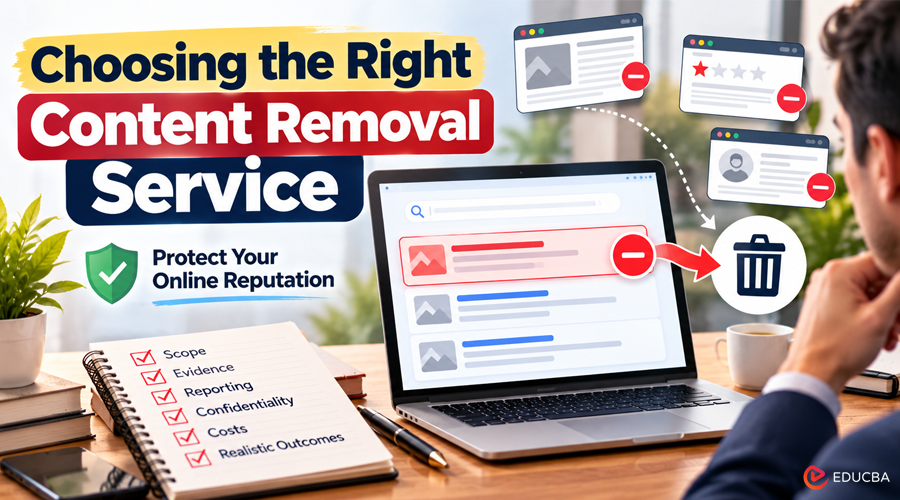
A negative search result, a questionable review, or a copied business asset can demand attention. Yet content removal can have several outcomes, and a Content Removal Provider’s promise matters only if it matches the problem. Businesses, founders, and professionals should start by identifying the specific URL, the desired result, and how to verify what has changed.
Define the Outcome Before Comparing Providers
Start by identifying where the material appears and what needs to happen to it. Source removal means the material is taken down from the website or account hosting it. Search delisting removes a result from a search service while the original page may remain accessible. Suppression makes unwanted material less prominent by developing or promoting other content; it does not remove the original. These are different services, not interchangeable descriptions of success.
The distinction matters when a harmful page is accessible through several routes. Delisting from one search service may reduce discovery there, but it does not resolve a live page that people can reach directly or through another service. Source removal may address the original URL while leaving copies elsewhere. Suppression may be relevant when removal is not viable, but its visibility outcomes should not be treated as guaranteed.
Ask each provider to map its proposal to the URLs and platforms involved. For example, ContentRemoval’s content removal services distinguish work at the source from search delisting and suppression. That distinction gives a buyer a starting point for asking which outcome each item addresses, what falls outside the assignment, and what counts as completion. A broad offer to “fix online reputation” is harder to assess than a defined scope tied to the material causing concern.
Ask the Content Removal Provider About Its Assessment and Evidence
A credible assessment explains why action may be possible for the particular material. The proposed route might depend on a platform’s rules, ownership of a copied asset, a privacy concern, or another applicable basis. The Content Removal Provider should identify the route it intends to pursue and the evidence it needs, rather than treating every unfavorable mention as removable. A screenshot may help document what appeared at a given time, but the live URL, account location, and surrounding context can also matter when assessing a request.
Businesses should separate material that may breach a rule or infringe a right from legitimate criticism and journalism. An uncomfortable article, fair review, or accurate account of a dispute is not automatically a candidate for takedown. A provider that promises to eliminate all negative coverage is offering a poor basis for a purchasing decision. Ask what happens if a request is rejected or if the host determines the material can remain: a useful answer describes the next permitted option and its limits, not a guaranteed workaround.
The assessment should also distinguish evidence gathering from submitting a request. Who will prepare the supporting material, who will review its accuracy, and will the business approve claims made on its behalf? This is especially important when the material concerns several people or combines genuine information with disputed statements. A reasoned proposal lets decision-makers weigh the likely value of each step without mistaking an attempted removal for a completed one.
A professional Content Removal Provider should also explain which documents or details are necessary before work begins. Businesses can then prepare relevant evidence, clarify disputed information, and avoid sharing unnecessary personal or commercial details. Clear assessment criteria help both parties understand the basis for the proposed action.
Compare Deliverables, Verification, and Follow-Up
Before comparing fees, compare what the business will receive. “Removal attempted” and “content unavailable” describe different deliverables. A written proposal from a Content Removal Provider can assign a target outcome to each URL and explain how the provider will check it. It should also say whether the work covers only the identified page, a set of known copies, or further instances discovered during the engagement.
A useful reporting plan records the following for each item:
- Target and outcome: the exact URL or account, the requested action, and the result that would count as complete.
- Action taken: the route pursued and whether a request was submitted, accepted, declined, or remains pending.
- Verification: how the result will be checked and documented, including whether the original page remains accessible.
- Follow-up: what happens if a copy appears, a result returns, or a platform reverses its decision.
This record makes two offers easier to compare even when they use different language. It also prevents a change in search visibility from being reported as though the underlying page had disappeared. Ask how often the provider will update the business, who receives those updates, and what the final report will contain. Where a case involves several URLs, reporting at the individual-item level helps a decision-maker see which parts of the assignment succeeded and which still require attention. Follow-up should have a stated boundary: monitoring, new submissions, and work on newly discovered copies need not be included in the original fee.
Review Confidentiality, Access, and Commercial Terms
A business may need to share sensitive context to obtain an assessment, but it can establish handling rules before sending a full file. Ask the Content Removal Provider who can access case material, whether subcontractors may be involved, how documents are stored, and when they are deleted or returned. Written confidentiality commitments are more useful than a general assurance of discretion. Limit the initial submission to what the provider needs to assess the work, and identify an internal contact authorized to approve any additional disclosure.
Commercial terms deserve the same attention as the proposed removal route. Determine whether the price covers assessment, preparation, submissions, reporting, and follow-up, or whether these are separate charges. If a fee depends on an outcome, the agreement should define that outcome precisely: removal of a source page, delisting of a specified result, and suppression are not equivalent. Ask what is payable when a request is declined, how extra URLs are priced, and whether an ongoing service can be ended without disrupting access to the business’s records.
Don’t assume speed or a higher fee changes a platform’s decision. The useful comparison is between a clearly bounded engagement and its potential business value. A proposal that states exclusions and unsuccessful-outcome terms plainly may be easier to manage than one built around an impressive but undefined promise. Procurement, communications, and other relevant internal teams can then review the same scope before anyone commits funds or shares further information.
A trustworthy Content Removal Provider should explain its data-handling practices and pricing structure before the business signs an agreement. Confirm whether the contract identifies the services included, additional charges, expected communication frequency, cancellation conditions, and responsibility for maintaining case records. Reviewing these details in advance can help prevent unexpected costs and reduce uncertainty throughout the engagement.
Build a Practical Shortlist Before Signing
Bring competing proposals into a common format. Prepare an inventory of relevant URLs, note which items are most urgent, and record the outcome sought for each. Keep the description factual; an internal assessment is not a reason to label all unfavorable coverage false. Then give shortlisted Content Removal Providers the same limited set of materials and compare their answers against consistent questions:
- Which specific items can the provider assess, and which outcome does it propose for each?
- What basis supports the proposed action, and what evidence must the business supply?
- How will progress and results be verified, reported, and handled if material reappears?
- Who can see the case material, and what are the fees, exclusions, and exit terms?
Look for answers that identify uncertainties without turning them into vague promises. One Content Removal Provider may propose action at the source; another may focus on a search result or offer suppression when a takedown route is weak. Comparing them by the same desired outcome makes that difference visible. It also helps prevent a buyer from paying for a service that addresses discoverability while leaving the main operational problem untouched.
When comparing proposals, consider the provider’s experience with the relevant content type, the clarity of its assessment, the quality of its reporting, and the transparency of its commercial terms. Do not rely on broad claims about success rates without understanding how the provider defines success and whether the figures apply to cases like yours.
Choose a Content Removal Provider only when the proposed route, definition of completion, evidence requirements, confidentiality terms, and total scope are clear in writing. That discipline turns a stressful reputation issue into a decision the business can assess, approve, and review afterward, without assuming every piece of unwanted content can or should be removed.
Disclaimer: This article is promotional content created in collaboration with ContentRemoval. It discusses content removal services to help businesses understand their options when addressing unwanted online content and evaluating potential service providers.
Recommended Articles
We hope this guide helps you understand how to evaluate a Content Removal Provider by comparing services, evidence requirements, reporting practices, confidentiality, and pricing. Explore our recommended articles for more insights on online reputation management, content removal strategies, digital privacy, brand protection, and business reputation management.