



A Commercial Christmas Decoration proposal can look complete while leaving major costs and responsibilities unresolved. A shopping center may receive three attractive concepts, each with a large tree and several illuminated features, yet the quotations may cover very different work. One includes packaging and assembly drawings. Another assumes a local contractor will supply the supporting structure; a third leaves removal and storage entirely out of the discussion.
For property managers, procurement teams and project coordinators, the useful comparison begins before the final price. The task is to make the proposals comparable: the same venue information, the same display objectives, the same delivery assumptions, and a clear explanation of what each party will provide. This approach applies to malls, hotels, commercial streets and other public-facing seasonal projects.
1. Give Every Supplier the Same Commercial Christmas Decoration Brief
Start with a short brief that identifies the property, the intended operating period and the role of the display. Is the priority a recognisable arrival feature, a central Christmas landmark, a connection between retail zones or a coordinated treatment along a commercial street? Several purposes may coexist, but state them before comparing quantities and product forms.
Share current site photographs, available drawings, approximate dimensions and known access restrictions. Identify which dimensions are preliminary and which have been checked. Include the intended opening date as a planning requirement, not as evidence that every supplier can meet it.
Distribute the same revision to all bidders. If one receives new information about a loading entrance or a revised installation window, circulate that update to the others. Otherwise, a price difference may reflect unequal information rather than better value.

Illuminated cone-frame Christmas tree in a crowded outdoor plaza at night. A large illuminated tree serves as a visible landmark in a public plaza. Photograph supplied by HYCLight; the image does not establish the scope or results of a proposed project.
2. Compare Display Functions in a Commercial Christmas Decoration Project
A tree, an arch and a light sculpture are different formats, but a useful brief also explains the job each feature must perform. A focal element needs to work from the intended viewing positions. An entrance feature needs to relate to the existing arrival route. Repeated decorations need to support a coherent visual scheme across the agreed area.
Ask suppliers to map their proposed items to those functions. This makes it easier to spot an impressive feature that does not address the brief, or a lower-cost proposal that omits an important part of the scheme.
For example, to see how product families can be organized around a venue brief, buyers can review HYCLight’s commercial Christmas decoration solutions. The useful next step is to connect that broad direction to the actual property and request a project-specific scope, rather than treating a general website description as a complete quotation.
3. Separate Product Price from the Cost of Delivery and Use
The product subtotal is only one part of a Commercial Christmas Decoration project. Ask for a breakdown that identifies the decoration supply, agreed customization, packaging, transport arrangements, installation support, and any other included services. Record exclusions beside the corresponding item rather than placing them in an unstructured note at the end.
The buyer’s own costs also matter. Depending on the project, these may include unloading equipment, local contractors, electrical work, access equipment, storage, inspections and seasonal maintenance. These are planning categories, not a claim that every project requires the same services.
A practical comparison sheet can use five columns: item or activity, supplier inclusion, buyer responsibility, price basis, and open question. Where a cost is not yet known, mark it as unresolved. Entering zero for an unknown item creates a misleading total.
4. Ask What Must Be Approved Before Production
Custom work needs an approval sequence that both parties understand. Ask which drawings, dimensions, visual details, materials, and connection information require confirmation before manufacturing begins. The proposal should also explain how you will document and review later changes.
For example, changing an entrance feature after the site team revises the usable opening may affect more than appearance. It could require a drawing revision, different modules, or a new packing arrangement. The point is to identify these dependencies before a change becomes urgent.
Keep approval records tied to a specific drawing or file version. A message saying that a design looks good is less useful than a clear confirmation of the agreed revision and any remaining questions.
5. Make the Commercial Christmas Decoration Installation Handoff Specific
“Installation support included” is too broad to compare without explanation. One supplier may mean written instructions and remote guidance. Another may propose technician assistance under separately agreed travel and service costs. Neither description automatically assigns local electrical work, foundations, lifting equipment or venue approval to the supplier.
Ask what the receiving team will actually receive: component labels, packing lists, assembly drawings, installation videos or photographs from an agreed pre-assembly check. Confirm the language, format and timing of those materials so the local team can use them.
If factory pre-assembly is proposed, record what will be assembled and what the buyer is expected to review. A workshop photograph can document visible preparation, but it does not replace destination-specific structural, electrical, or site review.
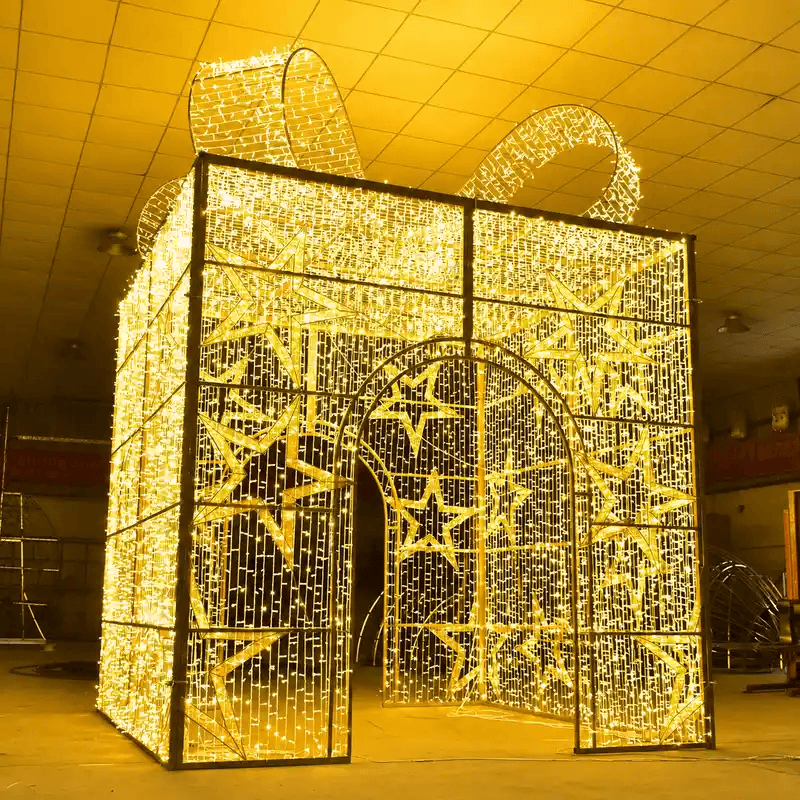
A workshop photograph shows the form and illuminated appearance of a gift-box-shaped arch photograph supplied by HYCLight.
6. Check the Commercial Christmas Decoration Schedule as a Chain of Dependencies
A promised delivery date is more useful when the assumptions behind it are visible. Work backward from opening and identify the planned installation period, delivery arrangements, production milestones and buyer approvals. Ask what happens if a required site measurement or design decision arrives late.
Keep transport and site access assumptions explicit. The receiving property should know who arranges unloading, where goods can be held, and whether work is restricted to particular hours. International projects also require clarity on the agreed shipping terms and which party handles destination procedures.
A schedule should show decisions, not just activities. An unresolved approval can delay several later steps even when the manufacturing work itself is straightforward.
7. Include Maintenance, Removal and Storage in the Comparison
The installation must remain manageable after opening. Ask how a fault should be reported, which information the support team needs, and what replacement components or documentation are included in the agreed scope. Avoid assuming that all spare parts or on-site repairs are automatically covered.
Consider the end of the season at the same time. Identify who will dismantle the display, how components will be labeled, and how you will record the condition of returned items. If reuse is part of the business plan, confirm available storage and the process for reviewing condition before another installation.
A proposal that explains these stages gives the operator more information for budgeting. It still needs to be tested against the venue’s staff, facilities, and intended use.
8. Resolve Important Unknowns Before Selecting the Lowest Total
Use a final clarification round to address differences that could change the buying decision. Ask each supplier to confirm the agreed items, exclusions, responsibilities, milestones, and remaining dependencies in writing.
The preferred Commercial Christmas Decoration proposal should clearly link the display objective to the work being purchased. Price remains important, but it is meaningful only when the buyer understands what the number includes. A well-prepared comparison helps the team choose a supplier with a defined scope and a workable handoff, while keeping unresolved site and operating decisions visible.
Common Buyer Questions
Q1. Should the lowest product quotation win?
Answer: Only after the proposals cover a comparable scope, review the buyer’s additional costs and unresolved responsibilities before interpreting the lowest subtotal as the lowest project cost.
Q2. What should be clarified before approving a custom design?
Answer: Confirm the relevant drawing revision, dimensions, agreed appearance, included components, approval responsibilities, and the process for handling later changes.
Q3. Can photographs prove that a display is suitable for a specific venue?
Answer: No. Photographs help buyers understand appearance and visible preparation. Suitability depends on the exact product, site conditions, intended use, and the reviews required for that project.
Final Thoughts
Comparing Commercial Christmas Decoration proposals isn’t just about finding the lowest quoted price. A reliable evaluation considers the complete scope, supplier and buyer responsibilities, design approvals, delivery schedule, installation requirements, maintenance, removal, and storage. Reviewing these details side by side helps project teams spot hidden costs and unresolved responsibilities before committing.
A clear comparison process also builds a stronger project foundation. When suppliers receive the same brief and explain their inclusions, exclusions, and dependencies, buyers can make decisions based on comparable information. This helps property managers and procurement teams select a proposal that fits the venue, budget, and operating requirements while reducing avoidable issues during installation and throughout the seasonal display period.
Recommended Articles
We hope this guide helps you compare Commercial Christmas Decoration proposals and evaluate supplier pricing, project scope, installation requirements, and responsibilities more effectively. Explore our recommended articles to learn more about commercial projects, procurement planning, supplier evaluation, project management, and cost management.

