


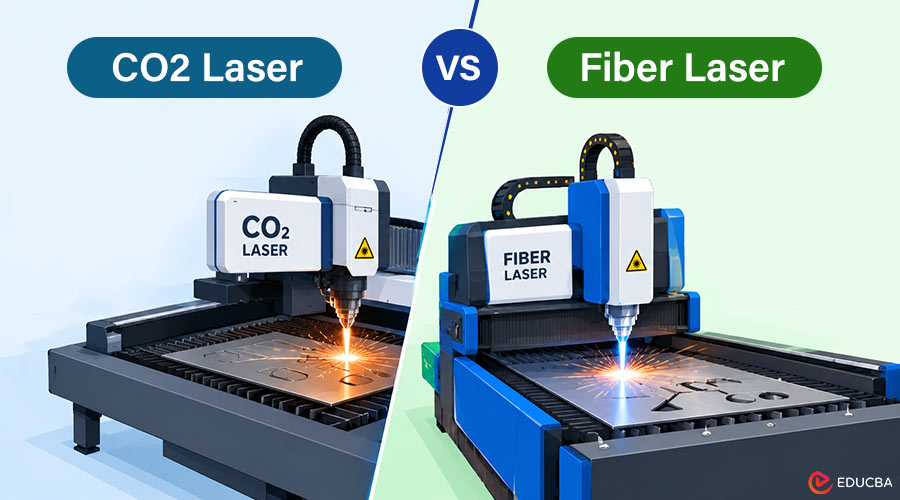
Ask ten people whether a fiber laser is “better” than a CO2 laser and you will get ten confident, mostly wrong answers. The truth is less satisfying but more useful: these are two different technologies built around different wavelengths, and each one is genuinely good at things the other one is not. The key differences between CO2 vs fiber laser systems lie in their wavelengths, material compatibility, applications, and operating requirements.
A CO2 system optimized for wood and acrylic is not a worse fiber laser; it is a different tool solving a different problem. The right starting point is not the brand or the wattage on the spec sheet. It is the material you are working with, the operation you need cutting, engraving, or marking and the output that operation must produce. Everything else follows from there.
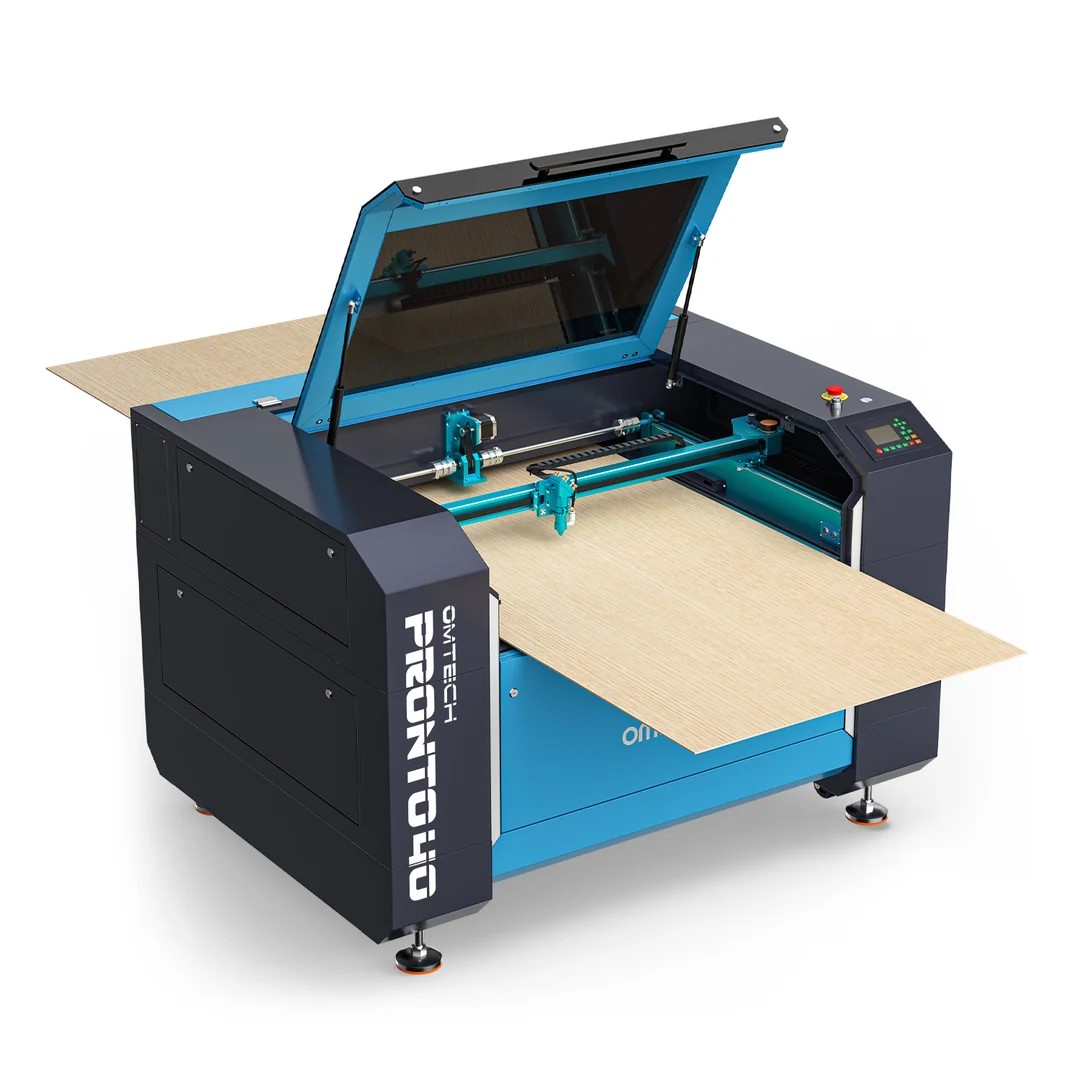
Image Source: OMTech
CO2 vs Fiber Laser at a Glance
| Feature | CO2 | Fiber Marking/Engraving | Industrial Fiber Cutting |
| Laser Medium | Gas (CO2) | Solid-state fiber | Solid-state fiber |
| Typical Wavelength | ~10.6 µm | ~1.06–1.07 µm | ~1.06–1.07 µm |
| Typical Operation | Cutting and engraving | Marking and engraving | Sheet-metal cutting |
| Best-suited Materials | Wood, acrylic, leather, paper, some glass and rubber | Stainless steel, aluminum, brass, coated metals | Stainless steel, aluminum, carbon steel sheet |
| Common Power Class | Roughly 40W–150W (workshop/desktop class) | Roughly 20W–100W | 1kW and up |
| Beam Delivery | Mirrors, in most traditional tube systems | Fiber-optic cable | Fiber-optic cable |
| Typical Buyer | Makers, sign shops, small manufacturers, schools | Manufacturers needing part ID, branding, traceability | Metal fabrication shops, industrial production |
| Cost Class | Entry to mid-range capital equipment | Mid-range capital equipment | Major industrial capital investment |
That table alone resolves most of the confusion. The material and the operation point you to a category before power or price enters the conversation.
How CO2 and Fiber Lasers Work Differently?
A CO2 laser generates its beam by exciting a gas mixture, producing a wavelength around 10.6 micrometers. In traditional tube-based systems, that beam travels through a series of mirrors to the cutting head. A fiber laser instead generates its beam within a solid-state fiber medium and delivers it through fiber-optic cable at a much shorter wavelength, roughly 1.06 to 1.07 micrometers.
That wavelength gap explains why these two lasers behave so differently on the same material. Organic materials like wood, leather, and acrylic tend to absorb the longer CO2 wavelength efficiently, which is why CO2 systems handle those materials well. Metals reflect much of that longer wavelength but absorb the shorter fiber wavelength far more efficiently, which is why fiber systems dominate metal marking and engraving. Power rating matters too, but it is downstream of this more basic physics: wavelength decides what a laser can interact with before power decides how well it does it.
Materials: Where CO2 Lasers Have the Advantage?
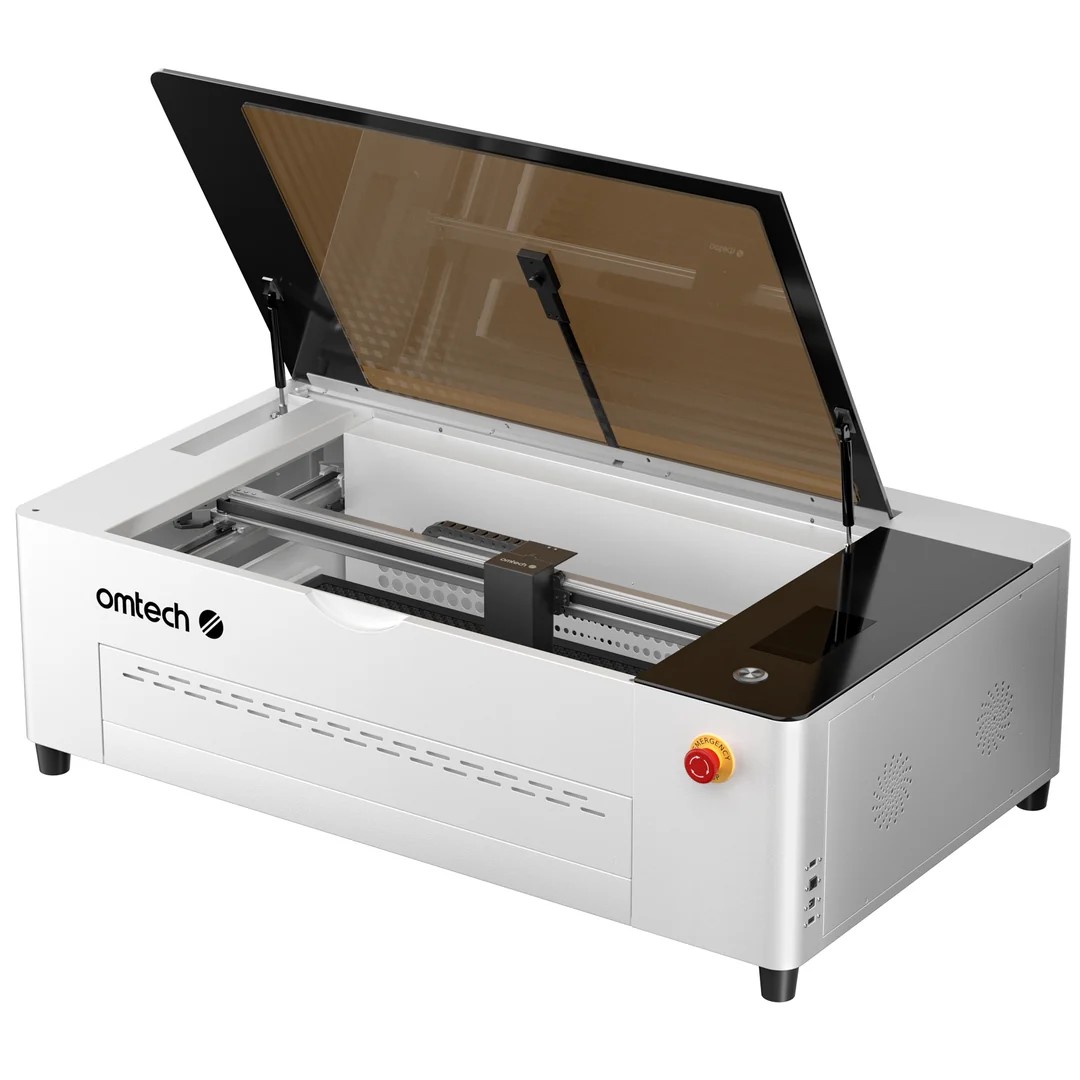
Image Source: OMTech
For non-metal materials, CO2 remains the workhorse. Wood, acrylic, leather, paper and cardboard, and select glass and rubber applications are all squarely in CO2 territory, which is why sign businesses, personalization shops, schools, and small design studios have built entire workflows around it. A single CO2 laser machine can typically both cut and engrave these materials on the same bed, which is part of the appeal for shops that do not want two separate machines for two separate operations.
None of this means every non-metal material is automatically safe to process. Composition matters; some plastics and coated materials release harmful fumes when laser-processed, so check manufacturer safety data before running an unfamiliar material through any laser system, and ensure proper ventilation and extraction.
That material flexibility shows up in how owners actually use these machines. One OMTech owner running a 150W hybrid CO2 system reported using it across wood, acrylic, and fabric rather than buying it for a single product category. For a shop whose work moves between signage, cut parts, and other non-metal projects, that mixed-material workflow is one practical reason a CO2 platform can make more sense than a metal-focused fiber marker. The value is not just what it cuts, but how many different things it cuts.
Materials: Where Fiber Lasers Make More Sense?
This is where the terminology gets sloppy, and precision matters. “Fiber laser” is not one machine it covers at least two categories that do fundamentally different jobs.
Fiber Marking and Engraving Systems
Typically built around Galvo or MOPA architecture, these are designed for direct work on metal surfaces: stainless steel, aluminum, brass, and various coated metals. These machines produce serial numbers, logos, barcodes, QR codes, and industrial identification markings. MOPA variants add the ability to produce a range of colors and finer control over engraving depth, which matters for jewelry work and detailed branding.
Another OMTech owner described getting a 50W autofocus Galvo system running with little difficulty and using it for 3D depth-map coin work a very different workload from cutting acrylic signs or engraving wooden panels on a CO2 machine. It is a useful reminder to evaluate a fiber engraver around the specific metal-marking or engraving task it needs to perform, not compare it to a CO2 cutter simply because both machines happen to be rated in watts.
High-Power Fiber Cutting Systems
These are an entirely separate equipment class, built for cutting sheet metal rather than marking its surface. These machines run at dramatically higher power than a marking system often into the multiple kilowatts and are sized and engineered for industrial sheet-metal fabrication rather than a desktop or benchtop workflow. A shop researching fiber laser systems for metal identification work is looking at a completely different machine than one shopping for industrial sheet-metal cutting capacity, even though both get called “fiber laser” in casual conversation.
Power: Why Wattage Alone Does Not Tell You Which Laser Is Stronger
A 60W CO2 engraver, a 60W MOPA fiber marker, and a 1,500W fiber cutter are not three points on the same scale. They are three different tools that happen to share a unit of measurement. Wattage only means something in context, architecture, wavelength, whether the laser runs continuous-wave or pulsed, the material being processed, and how the optics focus and deliver that power.
A 60W CO2 laser cutting plywood and a 60W MOPA fiber laser marking stainless steel are not competing for the same job, so comparing their wattage tells you almost nothing useful. The same logic applies at the high end: a 60W fiber marker and a 1,500W fiber cutter share a laser type and a rough wavelength, but they are not the same class of equipment and were never meant to compete. If you take one thing from this article, make it this: ask what job the wattage is doing, not just what the number is.
Cost: Purchase Price vs. Total Cost of Ownership
Laser system pricing can vary by an order of magnitude or more depending on power, working area, automation, and machine architecture, so broad statements like “fiber costs more than CO2” or vice versa do not hold up. A desktop CO2 engraver and a multi-kilowatt industrial fiber cutter are not in the same budget conversation at all comparing their sticker prices as if they are competing products is misleading either way.
A more useful way to think about cost breaks into three layers:
1. Purchase Cost
Purchase cost depends on power, working area, automation level, laser source, and included accessories. This is the number most buyers fixate on, and the one that least reflects what the machine actually costs to own.
2. Operating Cost
Operating cost includes electricity, cooling, consumables, optics maintenance, extraction, and for cutting systems assist gas. CO2 tube-based systems and fiber sources have different maintenance profiles and different consumable costs, and both scale with how heavily the machine runs.
3. Total Cost of Ownership
Total cost of ownership stacks purchase price against installation, accessories, maintenance, training, and downtime, weighed against the throughput the business actually needs. A cheaper machine that cannot keep up with order volume is not cheaper once you account for missed production. There is no universal ROI figure that applies across machine types, materials, and production volumes; anyone quoting one is oversimplifying.
CO2 vs Fiber Laser Applications
CO2 systems most often show up in custom wood products, acrylic signage, leather goods, packaging prototypes, classroom and makerspace projects, and general non-metal personalization work. Fiber marking and engraving systems handle metal serial numbers, machine part identification, tool marking, jewelry work, industrial traceability, QR and barcode marking, and logo engraving on metal surfaces.
Industrial fiber cutting systems are built for sheet-metal fabrication, stainless steel parts, aluminum components, and metal production runs where a CO2 or fiber marking system simply is not in the right power or design class for the job.
Which Laser Should You Choose?
Start with material and operation, not brand preference. A CO2 system fits when most of the work is non-metal, wood, acrylic, leather, and the business needs both cutting and engraving on the same platform, with workpieces that fit typical CO2 bed sizes. A fiber marking or engraving system fits when the primary task is direct metal marking or engraving, especially where fine detail, speed, and traceability matter more than raw cutting capability.
An industrial fiber cutter fits when the primary task is cutting metal sheet at a volume that justifies industrial-grade equipment and the facility can support it. None of these is a universal upgrade over the others. The right answer depends entirely on what the business is actually trying to produce.
Can One Laser Replace the Other?
Generally, no not across the full range of applications each is built for. A CO2 system cannot engrave bare metal as effectively as a fiber system, and a fiber marking system cannot cut wood or acrylic sheets as effectively as a CO2 system. However, both technologies can process certain plastics and coated materials, depending on their composition and the machine settings. This limited overlap does not make the two technologies interchangeable.
Buyers who choose based on the material and operation they actually need rarely end up disappointed by “the wrong laser.” Buyers who choose based on which technology sounds newer or more powerful sometimes do. One OMTech owner illustrates that distinction well. After using a 60W OMTech CO2 laser for roughly three years, they added a 30W Galvo fiber laser when they wanted to move into metal engraving. The CO2 machine had already become familiar territory; the fiber system introduced a new learning curve rather than replacing it.
That experience reflects the practical difference between the two technologies: adding fiber made sense because the material and application changed, not because the CO2 laser had somehow become obsolete. Material first, process second, power and configuration third, economics last. That order rarely leads anyone astray, no matter which side of the CO2 vs fiber laser question they land on.
Recommended Articles
We hope this comprehensive guide to CO2 vs fiber Laser helps you understand the differences in materials, power, cost, and applications. Check out these recommended articles for more insights into laser technology, engraving techniques, and equipment selection.

