



What is Circle Sort?
Circle Sort is a recursive sorting algorithm that compares and swaps elements in a circular pattern until the array is sorted.
Circle Sort is a unique and educational sorting algorithm that applies a divide-and-conquer strategy to organize elements in an array. It compares elements circularly—starting with the first and last elements, then moving toward the center—swapping pairs that are out of order. The algorithm recursively repeats this process on smaller subarrays until it fully sorts the list.
Imagine people standing in a circle and swapping seats if the taller person is in front of a shorter one — they keep doing this until the circle is in order from shortest to tallest. While not commonly used in practical applications, it provides a unique approach to understanding recursion and sorting concepts, making it a valuable tool for developing algorithmic thinking.
Table of Contents
- What is Circle Sort?
- How Circle Sort Works?
- Example
- Circle Sort in Python
- When to Use Circle Sort?
- How is Circle Sort Different from Other Sorts?
- Pros and Cons
How Circle Sort Works?
Circle Sort compares elements at symmetric positions in the array (first with last, second with second last, etc.) and swaps them if they are out of order. Then, it recursively applies the same process to the subarrays.
Steps to follow:
- Compare the outermost pair of elements.
- Swap them if the first is greater than the last.
- Repeat for the next inner pair.
- Recursively call the function on the left and right halves of the array.
- Continue until the entire array is sorted.
Fun Fact:
Circle Sort was introduced in 2005 by Hans Bezemer and Olufem as a simple conceptual algorithm for exploring recursive divide-and-conquer sorting strategies using symmetric circular comparisons.
Example
Consider the array: [20, 50, 10, 40]
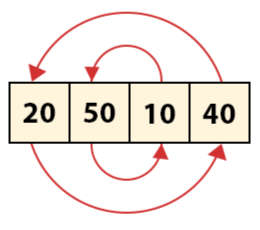
- Compare array[0] and array[3]: 20 vs 40 → No swap
- Compare array[1] and array[2]: 50 vs 10 → Swap
Result:
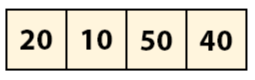
Now recurse:
- Left half: [20, 10] changes to [10, 20]
- Right half: [50, 40] changes to [40, 50]
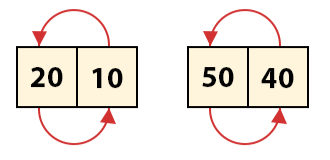
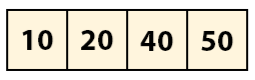
After full recursion and sorting
Final sorted array:
Circle Sort in Python
Here is a simple and readable Python version of Circle Sort:
Sort this array: [10, 3, 15, 7, 8, 23, 98, 29]
Code:
def circle_sort(arr, start, end):
    if start >= end:
        return False

    swapped = False
    low = start
    high = end

    while low < high: if arr[low] > arr[high]:
            arr[low], arr[high] = arr[high], arr[low]
            swapped = True
        low += 1
        high -= 1

    if low == high:
        # Handle the middle element in an odd-length segment
        if arr[low] > arr[low + 1]:
            arr[low], arr[low + 1] = arr[low + 1], arr[low]
            swapped = True

    mid = (start + end) // 2
    left_swapped = circle_sort(arr, start, mid)
    right_swapped = circle_sort(arr, mid + 1, end)

    return swapped or left_swapped or right_swapped

def circle_sort_main(arr):
    while circle_sort(arr, 0, len(arr) - 1):
        pass
    return arr

# Example usage
arr = [10, 3, 15, 7, 8, 23, 98, 29]
print("Original array:", arr)
sorted_arr = circle_sort_main(arr)
print("Sorted array:", sorted_arr)
Output:

When to Use Circle Sort?
Circle Sort is mainly used for educational purposes or to demonstrate recursive divide-and-conquer approaches. It is not suitable for performance-critical applications.
Use it if you want to:
-
- Understand recursive sorting better
- Explore alternate versions of Bubble Sort
- Learn symmetric comparison techniques
Avoid it for:
- Large datasets
- Real-time applications
- Systems requiring performance or stability
How is Circle Sort Different from Other Sorts?
| Feature | Circle Sort | Quick Sort | Bubble Sort |
| Type | In-place, recursive | Divide & conquer | In-place, iterative |
| Best Time | O(n log n) approx. | O(n log n) | O(n) |
| Worst Time | O(n²) | O(n²) | O(n²) |
| Average Time | O(n log n) approx. | O(n log n) | O(n²) |
| Stable? | ❌ | ❌ | ✅ |
| Commonly used? | ❌ | ✅ | ✅ (basic cases) |
Pros and Cons
Below are the pros and cons to help you understand where it excels and where it falls short.
Pros
- Simple Recursive Logic: Circle Sort’s recursive approach is straightforward to understand once you grasp the concept of circular comparison.
- Good for Nearly Sorted Arrays: Circle Sort tends to perform better on nearly sorted or partially sorted data, reducing the number of swaps needed.
- In-Place Sorting: It sorts the array without requiring extra significant memory (space complexity is O(log n) due to recursion stack).
- Educational Value: It is great for learning recursion, algorithm design, and alternative sorting methods.
Cons
- Worst-Case Time Complexity O(n²): In the worst case, particularly with certain data arrangements, the algorithm can degrade to quadratic time, rendering it inefficient for large datasets.
- Less Popular / Less Optimized: Developers rarely use it in practical applications, so it lacks the optimizations and community support that more popular algorithms, such as QuickSort or MergeSort, benefit from.
- Recursive Overhead: Like other recursive algorithms, Circle Sort can suffer from stack overhead and risk stack overflow for very large arrays.
- Limited Practical Use: Due to the above limitations, it is mostly useful as an academic or educational tool rather than for production-grade sorting needs.
Final Thoughts
Circle Sort is more conceptual than practical. It offers valuable lessons in recursion, symmetry, and sorting mechanisms. Although not commonly used in professional software development, it is a fantastic algorithm to experiment with for educational purposes. If you are diving into algorithms and want to understand recursive patterns better, give circle sort a try.
Recommended Articles
We hope this detailed guide on circle sort helps you grasp its unique approach to sorting through recursion and comparisons. Explore these recommended articles to discover more sorting algorithms and enhance your algorithmic thinking.

