


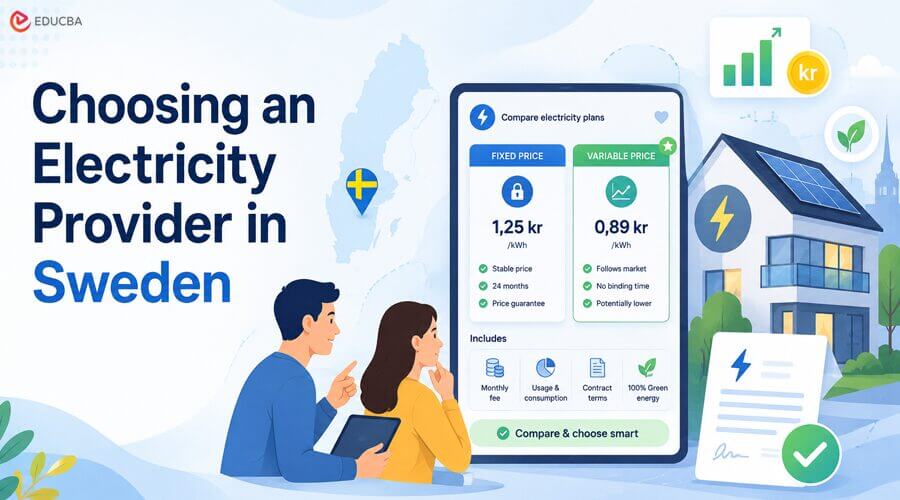
Choosing an electricity provider in Sweden may seem straightforward, but the cheapest-looking offer is not always the most economical choice over time. Contract type, electricity usage, location, monthly fees, price structure, and even the time of day you use electricity can all affect the final cost.
For households that want an easier way to understand the market, an electricity providers App for Sweden can be useful for comparing providers and getting an overview of available electricity companies before examining individual contract terms.
The key is not simply finding a low electricity price. A better approach is to understand how the Swedish electricity market works, identify your household’s consumption pattern, and then compare contracts on a level playing field.
How Electricity Providers in Sweden Work?
One important detail for newcomers to Sweden is that the electricity supplier and the electricity grid operator are not necessarily the same company.
The electricity supplier, or electricity trading company, sells the electricity you consume. Consumers can choose between competing electricity suppliers.
The grid operator owns and maintains the electricity network in the area where you live. Consumers normally cannot choose another grid operator because electricity distribution is organized geographically.
This means a household can have a contract with one company for electricity supply and another relationship with the local grid company for distribution. Sweden’s retail electricity market is competitive, while electricity distribution is a regulated local monopoly.
This distinction matters when comparing bills. Changing electricity suppliers does not change the physical electricity cables or the local grid operator.
When choosing an electricity provider in Sweden, it is important to understand which part of your electricity bill relates to the supplier and which part relates to the local grid.
1. Start With Your Actual Electricity Consumption
Before comparing electricity providers, check how much electricity the household actually uses.
Electricity consumption can vary considerably by home type. An apartment where heating is included in the rent may use relatively little electricity. In contrast, a detached house with electric heating, an electric vehicle, and several family members can consume considerably more.
Look at previous electricity bills and identify your annual consumption in kilowatt-hours (kWh).
Ideally, examine at least 12 months because electricity use is often seasonal. Swedish winters can create very different consumption patterns from summer months.
Once you know your approximate annual consumption, comparing offers becomes much easier. Your consumption level should also matter when choosing an electricity provider in Sweden, because a contract that works well for a low-consumption household may not suit a high-consumption home.
2. Compare the Total Cost, Not Just the Price per kWh
A common mistake is comparing electricity contracts based only on the advertised price per kWh.
The total cost may include several components, such as:
- Electricity price per kWh
- Supplier markup
- Monthly administration fee
- Fixed subscription charges
- Additional services
- Taxes and VAT
- Grid-related charges
Some providers may offer a competitive electricity price but charge a relatively high monthly fee. For a household with low consumption, that fixed fee can represent a meaningful percentage of the annual electricity cost.
Consider a simple example.
Household A uses relatively little electricity in a small apartment. A SEK 49 monthly fee would equal SEK 588 per year before the household has consumed a single kilowatt-hour.
Household B lives in a large electrically heated house. The same SEK 588 annual fee represents a much smaller proportion of its total electricity expenditure.
The best contract can therefore differ between households even when both are offered the same electricity price.
When choosing an electricity provider in Sweden, always look at the estimated overall cost rather than choosing a provider based solely on the advertised price per kWh.
3. Understand Fixed and Variable Electricity Contracts
Swedish electricity providers offer different contract structures. Two of the most familiar categories are fixed-price and variable-price agreements.
Fixed-Price Contracts
With a fixed contract, the electricity price is generally agreed for a specified period.
The main advantage is predictability. Households know more about what they will pay per unit of electricity and are less exposed to sudden changes in market prices during the contract period.
However, predictability does not necessarily mean that the contract will ultimately be cheaper.
A fixed price normally reflects expectations about future electricity prices, and customers may also face contractual conditions related to the agreement’s duration.
Variable-Price Contracts
Variable contracts allow the electricity price to change according to market conditions and the supplier’s pricing model.
These contracts offer less month-to-month certainty but may appeal to consumers comfortable with fluctuations who do not want to lock in a price for a longer period.
Neither option is automatically superior.
A household should instead ask whether price stability or flexibility matters more for its budget.
4. Look at Hourly and More Dynamic Pricing
Smart meters and digital energy tools have made electricity consumption increasingly transparent.
Some contracts allow electricity prices to follow shorter market intervals. This allows consumers to shift significant electricity use away from expensive periods.
For example, flexible households may be able to change when they:
- Charge an electric vehicle
- Run the dishwasher
- Use the washing machine
- Run a tumble dryer
- Heat water
- Operate certain heating systems.
This type of contract is not necessarily useful for everyone.
If most electricity consumption must occur during the same periods regardless of price, the potential advantage is smaller. Dynamic pricing becomes more interesting when a household has both substantial electricity consumption and the ability to control when that consumption occurs.
5. Know Your Swedish Electricity Price Area
Location is another factor that can affect electricity prices in Sweden.
Sweden is divided into four electricity bidding areas:
- SE1 – Northern Sweden
- SE2 – Northern-central Sweden
- SE3 – Southern-central Sweden
- SE4 – Southern Sweden
Market prices can differ between these areas because electricity generation, consumption, and transmission capacity are not evenly distributed across the country.
As a result, a friend living elsewhere in Sweden may pay a different electricity price even with a similar contract.
When comparing electricity providers, always make sure the prices and offers shown apply to your actual address or electricity area.
6. Check Contract Length and Cancellation Conditions
Price attracts attention, but contract conditions can matter just as much.
Before switching provider, check:
- Contract duration
- Notice period
- Automatic renewal conditions
- Cancellation charges
- Requirements for promotional prices
- When the new contract becomes active.
A temporary discount can make an offer look attractive during the first few months while providing less value after the promotional period ends.
Try calculating the cost over a full year rather than focusing exclusively on the introductory price.
It is also useful to set a calendar reminder before a fixed contract or introductory offer expires. This gives you time to compare the market again instead of automatically continuing with an agreement you have not reviewed.
When choosing an electricity provider in Sweden, reviewing these conditions can help you avoid unexpected costs or being locked into an unsuitable agreement.
7. Be Careful With Unassigned or Default Contracts
When moving into a new property, arrange electricity early.
Consumers who do not actively select an electricity agreement may end up under arrangements that are not necessarily the most competitive available to them.
Swedish authorities encourage consumers to compare electricity contracts rather than remain passive. The Swedish Energy Markets Inspectorate also operates the comparison service Elpriskollen for this purpose.
Therefore, moving home is a good opportunity to review electricity contracts rather than simply accepting whatever arrangement initially applies.
8. Compare Providers Using the Same Assumptions
A useful comparison requires consistency.
If Provider A shows a variable price based on one month while Provider B highlights a promotional fixed rate, putting those figures side by side may create a misleading comparison.
Use the same information for every provider:
- Your postcode or electricity area: Prices can vary geographically.
- Annual consumption: Use the same kWh figure for all calculations.
- Contract type: Compare fixed with fixed and variable with variable where possible.
- Time period: Calculate expected costs over the same number of months.
- All supplier fees: Include monthly charges and markups, not just the basic electricity price.
This makes it easier to identify genuine differences between offers.
9. Consider Your Lifestyle Before Choosing a Contract
The cheapest theoretical contract is not necessarily the best practical contract.
Someone working from home may use electricity throughout the day. A commuter may use most electricity early in the morning and evening. An EV owner may have a large but highly flexible load that can potentially be moved to lower-priced hours.
Families should therefore consider when they consume electricity, not only how much.
Smart plugs, EV charging schedules, heat-pump controls, and appliance timers can make it easier to shift selected activities without significantly changing everyday routines.
The goal should not be to organize your entire day around electricity prices. Instead, identify the few high-consumption activities that are easy to move.
10. Review the Contract Regularly
Choosing an electricity provider should not be a permanent decision.
Markets change. Household consumption changes. People move home, purchase electric vehicles, install heat pumps, add solar panels, or spend more time working from home.
A contract that suited a household two years ago may no longer be appropriate today.
An annual electricity review can therefore be a useful household routine.
Check the previous 12 months of consumption, calculate how much was paid in supplier fees, review the existing contract conditions, and compare several current alternatives.
Even when you decide to stay with the same provider, the review confirms that the decision is deliberate rather than automatic.
Practical Checklist for Choosing an Electricity Provider in Sweden
Before signing a new electricity contract, ask the following questions:
- How many kWh does the household use annually?
- Which Swedish electricity price area applies to the property?
- Is the contract fixed, variable, or dynamically priced?
- What is the electricity price per kWh?
- Are there additional supplier markups?
- Is there a monthly fixed fee?
- How long does the contract run?
- What is the notice period?
- Does the advertised price include a temporary discount?
- Are there cancellation or early termination charges?
- Can electricity consumption be shifted to cheaper periods?
- What happens when the initial contract period ends?
Spending a few minutes answering these questions can make electricity offers much easier to evaluate.
The Swedish electricity market gives consumers considerable choice among electricity suppliers, but choice is most valuable when offers are compared systematically. Instead of searching only for the lowest advertised number, examine your consumption, contract structure, fees, flexibility, and location.
Choosing an electricity provider in Sweden should ultimately be about finding an arrangement that fits your household’s actual needs, not simply selecting the lowest advertised electricity price. That turns electricity comparison from a search for a temporary bargain into a more informed household financial decision.
Recommended Articles
We hope this guide helps you understand the key factors involved in choosing an electricity provider in Sweden and select a contract that suits your household needs. Explore these recommended articles for more insights into electricity prices, energy contracts, renewable energy, energy efficiency, and the Swedish electricity market.

