
Introduction
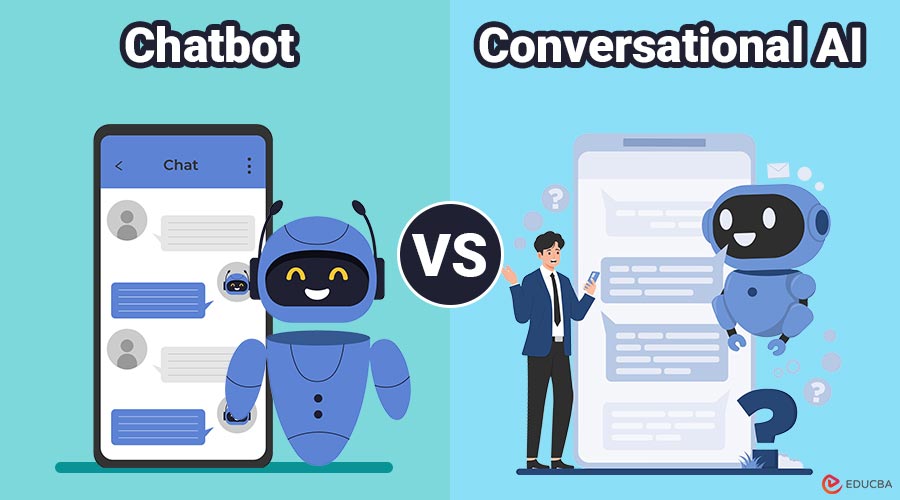
In today’s digital-first world, businesses adopt intelligent tools to boost customer engagement and streamline operations. Chatbot vs Conversational AI is a key distinction, as chatbots provide rule-based interactions, while conversational AI leverages NLP, ML, and AI for human-like dialogue. This blog highlights the definitions, differences, features, use cases, advantages, disadvantages, and applications of these technologies, helping businesses choose the right one for their specific needs.
Table of Contents:
- Introduction
- What is a Chatbot?
- What is a Convertsational AI?
- Key Differences
- Use Cases
- Advantages and Disadvantages
- Real-World Examples
- Which One Should Businesses Choose?
What is a Chatbot?
Chatbot is software application designed to simulate basic conversations with users. Most chatbots follow pre-defined rules, meaning they can only respond to specific inputs or keywords.
Characteristics:
- Rule-based Operation: Pre-programmed scripts or decision trees determine the responses.
- Keyword Recognition: They recognize specific phrases but may fail with variations.
- Limited Context Understanding: Cannot handle complex or multi-turn conversations effectively.
- Quick Deployment: Easier to set up with minimal cost.
Example:
An FAQ chatbot on an e-commerce website that answers questions like “What are your delivery charges?” or “How can I return a product?”
What is a Conversational AI?
Conversational AI refers to intelligent systems using AI, NLP, and machine learning to imitate human-like conversations, understand context, learn from interactions, and deliver accurate, personalized responses.
Characteristics:
- Contextual Understanding: Can handle complex, multi-turn dialogues.
- Natural Language Processing: Understands varied phrases, tones, and even intent behind user queries.
- Continuous Learning: Improves over time by analyzing user interactions.
- Integration Capabilities: Can connect with CRM system, databases, and APIs to provide dynamic responses.
Example:
A conversational AI-powered virtual assistant in banking that not only answers “What’s my balance?” but also proactively offers insights like, “Your electricity bill is due in three days. Would you like me to set up an automatic payment?”
Key Differences Between Chatbot and Conversational AI
Here are the key differences presented in a clear, structured comparison:
| Feature | Chatbot (Rule-Based) | Conversational AI (AI- Driven) |
| Technology | Pre-defined scripts, rule-based systems | NLP, machine learning, deep learning |
| Understanding | Limited to exact keywords or phrases | Understands intent, context, and variations in language |
| Complexity | Simple, straightforward interactions | Handles multi-turn, context-rich conversations |
| Learning Ability | No learning – static responses | Learns and improves with every interaction |
| Personalization | Minimal, one-size-fits-all answers | Personalized, adaptive responses |
| Use Cases | FAQs, booking confirmations, simple tasks | Virtual assistants, customer support, sales enablement |
| Deployment | Quick and inexpensive | Requires more resources, integration, and training |
| User Experience | Often robotic and limited | Human-like, engaging, and intuitive |
Use Cases of Chatbot and Conversational AI
Here are some practical use cases of how chatbots and conversational AI are applied across industries:
Chatbot:
- Customer Support FAQs – Chatbots handle basic questions like store hours, return policies, product details, or pricing. Citrusbug builds AI Chatbots that streamline these interactions to reduce response time and improve efficiency.
- Order Tracking – Provide shipment updates instantly by retrieving tracking details, delivery status, and estimated arrival information.
- Appointment Booking – Allow users to quickly schedule appointments through simple dialogues without requiring complex interactions.
- Feedback Collection – Collect customer feedback, ratings, or surveys after transactions, enabling businesses to measure satisfaction effectively.
Conversational AI:
- Banking and Finance – Virtual assistants analyze accounts, provide tailored insights, detect fraud, and support financial decision-making.
- E-commerce – AI recommends products, provides personalized shopping guidance, manages carts, and enhances user experiences effectively online.
- Travel and Hospitality – Conversational AI agents assist bookings, cancellations, and itinerary suggestions and deliver seamless travel experiences.
- HR and Internal Operations – Employees use AI for payroll inquiries, leave requests, onboarding support, and internal assistance.
Advantages and Disadvantages of Chatbot and Conversational AI
Here are the advantages and disadvantages of both approaches presented clearly for comparison:
Advantages of Chatbot:
- Quick deployment and cost-effective.
- Simple setup for FAQs and repetitive queries.
- Reduces workload on customer support agents.
Disadvantages of Chatbot:
- Cannot handle complex or unpredictable queries.
- Limited personalization.
- Frustrates users if the query doesn’t match pre-set rules.
Advantages of Conversational AI:
- Natural, human-like interactions.
- Contextual and personalized responses.
- Learns and improves continuously
Disadvantages of Conversational AI:
- Higher implementation cost.
- Requires data, training, and time to achieve accuracy.
- Complex integration with legacy systems.
Real-World Examples
Here are practical examples that highlight chatbots and conversational AI in action:
1. Pizza Delivery – Chatbot Example
A pizza chain deploys a chatbot that takes orders by offering customers menu options through buttons. Customers can choose a pizza, provide their address, and complete the order quickly. While efficient, the bot cannot respond if a customer types: “What’s the healthiest option on your menu?”
2. Virtual Healthcare Assistant – Conversational AI Example
A healthcare provider uses conversational AI to enable patients to describe their significations in natural language, such as “I have a throbbing headache and mild fever.” The assistant uses NLP to analyze symptoms, checks medical records, and suggests possible causes or recommends scheduling a doctor’s appointment.
Which One Should Businesses Choose?
The choice between a chatbot and conversational AI depends on the complexity of interactions your business needs.
Choose Chatbots if:
- Your customer queries are predictable and repetitive.
- You need a quick, low-cost solution.
- Your business is small to mid-sized with limited data.
Choose Conversational AI if:
- You want to offer personalized, dynamic support.
- Your business handles diverse, complex queries.
- You aim to create a human-like customer experience.
Final Thoughts
While Chatbot vs Conversational AI share the goal of improving customer interactions, they operate at very different levels of sophistication. Chatbots are best for handling basic, repetitive tasks, while conversational AI delivers dynamic, personalized, and context-aware support. Choosing between the two depends on your business goals, budget, and customer expectations. As AI continues to advance, conversational AI is poised to become the dominant technology shaping the future of digital communication.
Frequently Asked Questions (FAQs)
Q1. Are chatbots and conversational AI the same?
Answer: No. Chatbots are rule-based systems with limited capabilities, while conversational AI uses advanced AI technologies to deliver intelligent, context-aware responses.
Q2. Can a chatbot evolve into conversational AI?
Answer: Yes, businesses often start with chatbots and later enhance them with AI capabilities like NLP and ML.
Q3. Do conversational AI systems require constant training?
Answer: Yes, they learn and improve over time, but continuous data and feedback are essential for accuracy.
Q4. Can conversational AI completely replace human agents?
Answer: Not entirely. While conversational AI can handle most routine queries, human agents remain crucial for complex, emotionally sensitive, or high-stakes interactions.
Recommended Articles
We hope that this EDUCBA information on “Chatbot vs Conversational AI” was beneficial to you. You can view EDUCBA’s recommended articles for more information.


