


Why CBDCs Matter for Forex Liquidity?
Central Bank Digital Currencies (CBDCs) represent a digital version of a country’s official currency, issued and guaranteed by its central bank. Unlike cryptocurrencies, governments control CBDCs and issue them as legal tender to enhance payment systems and maintain monetary control. The CBDCs impact on European Forex Liquidity is an important topic as Europe prepares to launch its digital euro. This new form of currency aims to facilitate faster, safer, and more transparent transactions.
The European Central Bank (ECB) is currently testing and preparing for the digital euro, with a focus on ensuring that it integrates smoothly with existing banking and financial systems (BIS, 2024). However, the rise of CBDCs also brings potential risks to the liquidity—the ease of buying and selling—in Europe’s foreign exchange (Forex) markets.
How CBDCs Impact on European Forex Liquidity Could Change the Market?
While Central Bank Digital Currencies (CBDCs) promise enhanced efficiency and resilience in domestic payment systems, they may also create structural risks for the functioning of foreign exchange (FX) markets. In Europe, where the euro relies heavily on cross-border capital flows and bank-led market making, CBDCs could weaken liquidity and increase volatility. TradingPedia points out that this risk is particularly relevant in the euro area, where FX stability depends on the interplay between central bank policy and decentralized market activity.
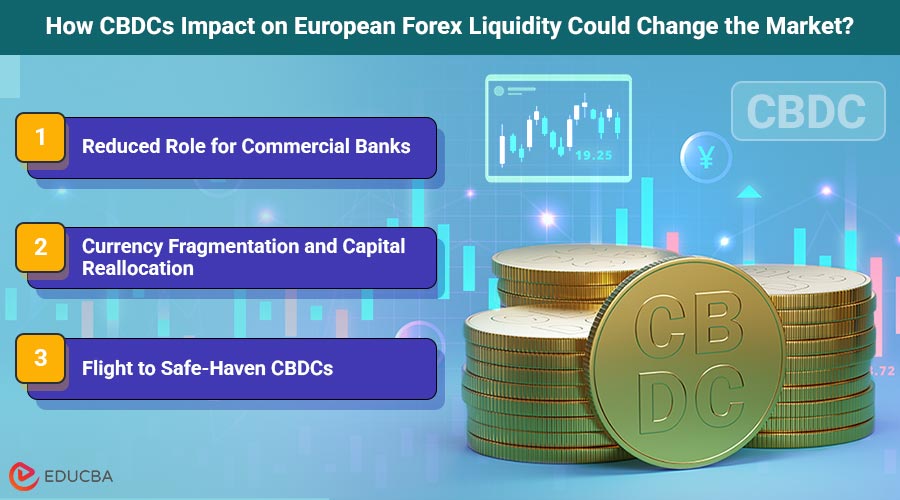
Reduced Role for Commercial Banks
If structured for direct public access, CBDCs could reduce the role of commercial banks in handling deposits and processing payments. With retail CBDCs, households and firms could store digital euros directly with the European Central Bank (ECB), bypassing bank deposits entirely. As noted by the IMF (2024), this shift would reduce banks’ funding base and impair their ability to provide essential services, including credit, FX hedging, and market-making. Banks currently play a dominant role in providing intraday liquidity in FX markets. The Bank for International Settlements (BIS, 2024) warns that if CBDCs diminish their presence, euro liquidity could decline, leading to wider spreads, lower trading volumes, and weaker price discovery.
Currency Fragmentation and Capital Reallocation
If retail or wholesale CBDCs evolve to support cross-border functionality, interoperability challenges could disrupt capital mobility. According to the World Economic Forum (2024), if national CBDCs are not interoperable or are subject to cross-border frictions, traders may avoid holding or converting euros due to higher operational costs or restricted access. Traders may avoid holding or converting euros if operational costs rise or access is restricted. This is particularly concerning for smaller or emerging market FX pairs involving the euro, such as EUR/SEK or EUR/HUF. The IMF cautions that fragmentation could lead to a drying up of liquidity in these pairs, thereby undermining market depth and efficiency.
Flight to Safe-Haven CBDCs
In times of financial stress, CBDCs could enable faster shifts into perceived “safer” currencies. If investors view digital versions of the US dollar or Chinese yuan as more stable or accessible, they may move capital out of the euro system more rapidly than before. BIS (2024) refers to this as “currency substitution risk”, especially in jurisdictions facing capital outflows.
Final Thoughts
The digital euro is a step toward modernizing Europe’s financial system. However, as the ECB moves forward, it must carefully manage the CBDCs impact on European Forex liquidity. Without proper planning, CBDCs could reduce euro liquidity, increase market risks, and hurt smaller currency markets. European leaders must find a balance between financial innovation and forex market stability to avoid future problems.
Recommended Articles
We hope this guide on CBDCs impact on European Forex liquidity helps you understand the evolving dynamics of currency markets in the digital age. Explore these recommended articles for more expert insights on market trends.

