

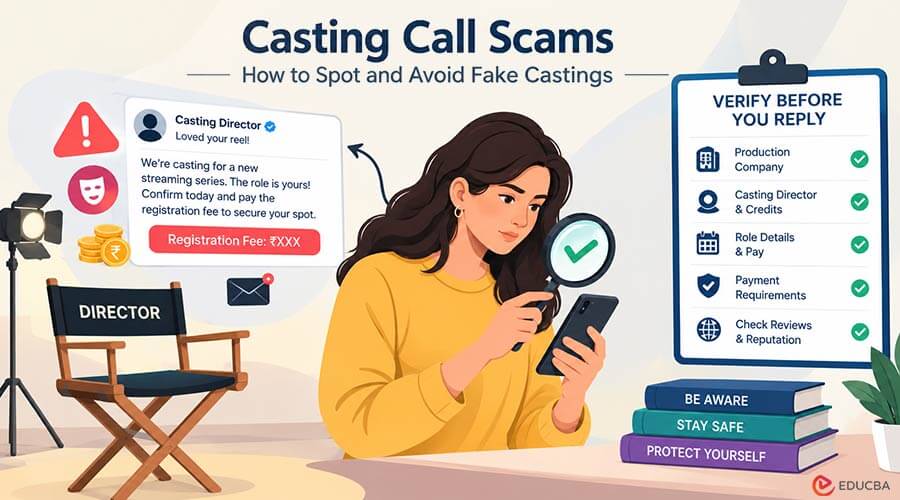
Fake castings charge fees, harvest data, and fish for self-tapes. Casting call scams can target working actors through social media, email, and casting platforms. This checklist helps you verify a casting call before you reply.
A spotlit director’s chair with a glowing star lure dangling from a fishing line.
Twenty minutes of verification decides whether a production deserves your footage, your ID, and your bank details.
The message lands in your DMs on a Tuesday: a “casting director” loved your reel, a streaming series is shooting in Vancouver next month, and the role is yours if you can confirm today. Flattering, specific, urgent. Usually fake. Casting call scams are common enough that the US Federal Trade Commission put out a consumer alert on virtual casting scams in December 2025.
How Do Casting Call Scams Actually Work?
Every fake casting is fishing for one of three things. The first is money up front: a registration fee, a “priority slot”, a mandatory headshot package from their photographer. The second is your personal data, usually framed as payroll paperwork, which is why they want ID scans and banking details before any audition happens.
The third payload is the quietest: your footage. Self-tapes and ID pages together are raw material for impersonation, and some operations collect them with no intention of ever casting anyone. Urgency is the engine in all three versions, because a rushed actor skips checking.
Red Flags in a Casting Notice
A casting notice with warning marks hovering over its missing details
Read the casting notice the way a producer would read a contract. No production company named anywhere. Union status missing. The role, dates, and pay described in vibes rather than numbers. An email address written with odd spacing or brackets to dodge spam filters. A push to continue on WhatsApp or Instagram after first contact on a legitimate platform.
These signs can help you identify casting call scams before you share personal information or audition footage.
Any one of these can have an innocent explanation. A verifiable notice, by contrast, names the company, states union status, lists shoot dates and compensation, and survives a phone call to the office it claims to come from. When a notice fails on three or four points at once, you are not reading sloppiness.
Verify the People, Not Just the Project
Profile cards linked in a verification chain under a magnifying glass
Work through the humans in order. The casting director should exist on IMDb with traceable credits. The production company should have a site, a slate, and socials older than the notice. The agency asking you to sign should have a reputation you can read.
Verification-first review platforms are built for that last check: WebVouch, for instance, publishes a review only after checking it and weighs how feedback accumulates over months rather than trusting the star average, so an agency cannot remove the one-star stories that mention fees. Read the pattern, not the score alone. A cluster of glowing reviews from a single week is its own tell, and the answer to do fake Google reviews expire is: not fast enough to protect the next person who reads them.
The Money Rule That Settles Everything
Legitimate casting never charges the actor to audition. No registration fees, no admin fees, no mandatory paid classes or headshots as a condition of being seen. Casting platforms charge membership for access, which is a different transaction with a receipt and a cancel button.
The moment money flows from actor to “production” before any work exists, you are the customer, not the talent. That single rule resolves most borderline cases without any further research and can help you avoid many casting call scams.
If You Already Paid or Sent Footage
Cut contact without explaining why. Dispute the payment with your card issuer while the transaction is fresh, and report the account on whatever platform first reached you. In Canada, file with the Canadian Anti-Fraud Center; in the US, with the FTC. Tell your agent and your union local, because the same operation is already messaging someone else from your market. More checklists like this one live on the WebVouch blog.
Frequently Asked Questions (FAQ’s)
Q1. What are casting call scams?
Answer: Casting call scams are fraudulent casting opportunities designed to trick actors into paying money, sharing personal information, or submitting audition footage under pretenses. Scammers may impersonate casting directors, production companies, or agencies to make the opportunity appear legitimate.
Q2. Do real casting directors reach out on Instagram?
Answer: It happens, but rarely, and a real one gives you everything you need to verify them independently: a name with credits, a production company, and an office you can call. Treat any unsolicited DM as unverified until that cross-check succeeds, no matter how flattering the message reads.
Q3. Is paying for a casting platform subscription a scam?
Answer: No. Established platforms charge actors a membership fee for access to vetted listings, and that model is public and cancellable. The scam signature is different: money demanded by the casting side itself, per audition or per role, as a condition of being considered.
Q4. Can a self-tape be misused?
Answer: Yes. Footage paired with ID pages gives an impersonator a working identity kit, which is why collection of tapes with no callback pattern is a payload in itself. Send auditions through platforms rather than private links, and keep documents out of frame.
Final Thoughts
Casting opportunities can move quickly, but there is no good reason to skip basic verification. Before sharing your self-tape, personal documents, or payment details, independently verify the casting director, production company, role details, contact information, and payment requirements.
The safest approach is simple: verify first, respond second. If a casting call creates pressure, demands money to audition, or avoids reasonable questions about the production, step back. Taking a few minutes to investigate can help you avoid casting call scams and protect both your career and personal information.
Recommended Articles
We hope this guide helps you understand Casting Call Scams and verify casting opportunities before sharing your personal information, payment details, or audition footage. Explore our recommended articles to learn more about scam prevention, online fraud, identity security, review authenticity, and safer online practices.