
What is a Call to Action?
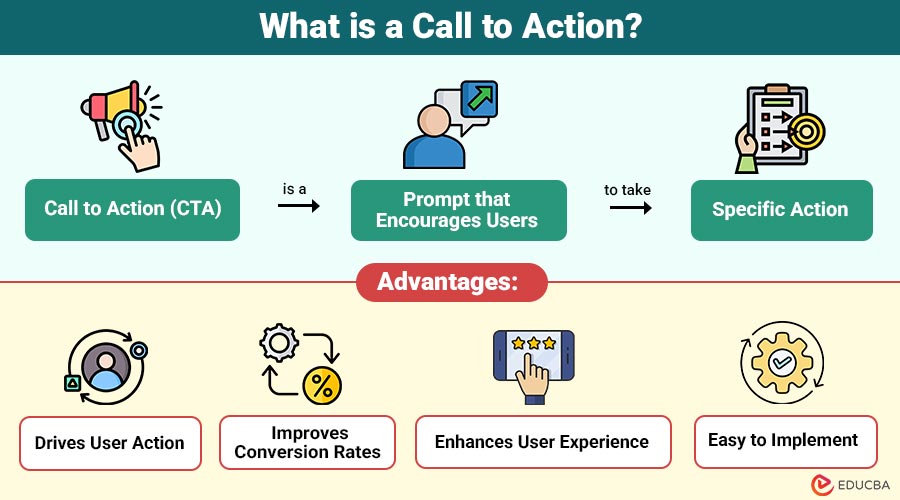
A Call to Action (CTA) is a prompt that encourages users to take specific action. It is typically displayed as a button, link, or phrase that directs users toward a desired outcome.
Common Examples of CTAs:
- Buy Now
- Sign Up
- Download Free Guide
- Get Started
- Learn More
- Subscribe Today
A CTA eliminates confusion by telling users exactly what to do next, making it a crucial component of conversion-focused marketing.
Table of Contents:
- Meaning
- Importance
- Types
- Key Elements
- Examples
- Common Mistakes to Avoid
- How to Optimize Your CTA?
- Advantages
- Disadvantages
Key Takeaways:
- A call to action guides users, reduces confusion, and drives meaningful engagement across digital platforms.
- Effective CTAs improve conversion rates by consistently using strong verbs, urgency, and compelling value propositions.
- Well-designed CTAs enhance user experience through clarity, visibility, and strategic placement within content and interfaces.
- Continuous testing and optimization ensure CTAs are relevant, engaging, and aligned with evolving user behavior trends.
Why is a Call to Action Important?
CTAs are important because they bridge the gap between user interest and action.
1. Guides User Behavior
It guides user behavior by clearly directing users toward the next step in their online journey.
2. Improves Conversion Rates
It improves conversion rates by encouraging users to take actions such as purchases and sign-ups now, effectively and consistently.
3. Enhances User Experience
It enhances the user experience by reducing confusion and decision fatigue during browsing and interactions and by smoothly engaging.
4. Measures Success
It measures success by accurately and consistently tracking campaign effectiveness and offering concise insights into marketing performance.
5. Boosts Engagement
It boosts engagement by motivating users to interact with content more frequently and meaningfully across all platforms.
Without a CTA, users may leave your website or content without taking any action, resulting in missed opportunities.
Types of Call to Action
CTAs vary depending on the goal of your marketing strategy. Below are the most common types:
1. Lead Generation CTAs
Lead generation CTAs encourage users to share their contact information, enabling businesses to capture potential customers, nurture relationships, and build a qualified database for future marketing and sales efforts.
Examples:
- Download Free eBook
- Sign Up for Newsletter
- Get Your Free Trial
2. Sales CTAs
Sales CTAs prompt users to take immediate purchasing actions, guiding them toward completing transactions, increasing conversions, and directly contributing to revenue growth through clear and action-driven messaging.
Examples:
- Buy Now
- Add to Cart
- Shop Now
3. Engagement CTAs
Engagement CTAs are designed to increase user interaction with content, encouraging deeper exploration, improving user experience, boosting retention, and strengthening the connection between users and the brand.
Examples:
- Read More
- Watch Video
- Explore Features
4. Social Sharing CTAs
Social sharing CTAs encourage users to distribute content across platforms, helping brands increase visibility, expand audience reach, and enhance online presence through user-driven promotion and engagement.
Examples:
- Share This Post
- Follow Us
- Like & Subscribe
5. Event Promotion CTAs
Event promotion CTAs motivate users to participate in events by prompting registrations or sign-ups, increasing attendance, boosting engagement, and supporting marketing goals through timely and persuasive communication strategies
Examples:
- Register Now
- Save Your Seat
- Join the Webinar
Key Elements of an Effective CTA
An effective CTA is not just about adding a button—it requires strategic design and messaging.
1. Clear and Concise Language
Clear and concise language uses simple words to communicate CTA’s purpose quickly and without confusion for users.
2. Action-Oriented Verbs
Action-oriented verbs are strong command words that motivate users to perform desired actions on CTA buttons immediately.
3. Sense of Urgency
By generating time-sensitive motivation and immediate-response pressure, a sense of urgency motivates consumers to take prompt action.
4. Value Proposition
A value proposition clearly shows the benefit users will receive after taking the desired action from the CTA.
5. Visual Appeal
Visual appeal improves CTA effectiveness by using design elements that quickly and effectively capture attention and increase user engagement.
6. Strategic Placement
Strategic placement refers to positioning CTAs in optimal locations where users are most likely to act promptly.
Examples of Effective CTAs
Here are some examples that demonstrate how effective CTAs drive user action and engagement:
1. SaaS Platform
- CTA: “Start Free Trial”
- Why it works: Removes risk and encourages exploration
2. Blog Website
- CTA: “Subscribe for Weekly Tips”
- Why it works: Highlights value and consistency
3. Landing Page
- CTA: “Get Instant Access”
- Why it works: Creates urgency and immediacy
Common Mistakes to Avoid
Here are common mistakes that can reduce the effectiveness of your CTAs and lower conversions:
1. Vague CTAs
Vague CTAs refer to unclear action phrases that confuse users and reduce click-through conversion rates significantly
2. Too Many CTAs
Too many CTAs overwhelm users with excessive options, causing confusion and lowering overall conversion performance rates significantly
3. Lack of Visibility
Lack of visibility occurs when CTAs blend into the design, making them difficult for users to notice quickly.
4. No Value Proposition
The absence of a value proposition leaves users unclear about the benefits of clicking the CTA.
5. Ignoring Testing
Failing to test different CTA versions limits optimization and prevents identifying the most effective-performing option’s results.
How to Optimize Your CTA?
Here are some effective strategies to improve CTA performance and increase conversions:
1. Use Data Analytics
Data analytics involves tracking CTA performance metrics like CTR, conversion rate, and bounce rate to optimize effectiveness and results improvement
2. Experiment with Design
Experimenting with design involves testing button colors, sizes, placements, and text variations to improve CTA performance and the effectiveness of engagement rates.
3. Leverage Psychology
By utilizing psychological concepts like urgency, scarcity, and social proof, CTA conversions can be greatly increased and user behavior can be influenced.
4. Align with User Intent
Aligning with user intent ensures CTA matches what users are searching for, improving relevance, engagement, and conversion success rates effectively
Advantages of Call to Action
Here are the key advantages of using CTAs in marketing and digital content:
1. Drives User Action
CTAs encourage users to take immediate actions like clicking, signing up, or purchasing products effectively
2. Improves Conversion Rates
Well-designed CTAs significantly increase conversions by guiding users toward desired goals and actions on websites
3. Enhances User Experience
CTAs improve navigation and clarity, helping users understand next steps and reducing confusion during browsing
4. Easy to Implement
CTAs are simple to add to websites, emails, and ads without requiring complex technical implementation
Disadvantages of Call to Action
Here are some disadvantages that can impact the effectiveness of CTAs if not managed properly:
1. Poor Design Reduces Engagement
Poorly designed CTAs can confuse users, reduce engagement, and negatively impact overall conversion performance rates
2. Overuse Overwhelms Users
Too many CTAs on a page overwhelm users, causing decision fatigue and significantly reduced action rates
3. Requires Continuous Optimization
CTAs need constant testing and improvement to maintain effectiveness and adapt to changing user behavior trends
4. Can Be Ignored Easily
If CTAs lack visibility or relevance, users may ignore them, reducing overall marketing effectiveness outcomes
Final Thoughts
A Call to Action is a strategic element that guides user behavior and improves business outcomes. It helps generate leads, increase sales, and enhance engagement through clear language, strong design, and smart placement. Well-optimized CTAs significantly boost conversions, and even small improvements can lead to major gains in overall marketing effectiveness and results.
Frequently Asked Questions (FAQs)
Q1. How long should a CTA be?
Answer: A CTA should ideally be short, clear, and action-oriented—usually 2–5 words.
Q2. What makes a CTA effective?
Answer: Clarity, urgency, strong action verbs, and a clear value proposition make a CTA effective.
Q3. Can multiple CTAs be used on a page?
Answer: Yes, but they should be limited and aligned with the user journey to avoid confusion.
Recommended Articles
We hope that this EDUCBA information on “Call to Action” was beneficial to you. You can view EDUCBA’s recommended articles for more information.

