


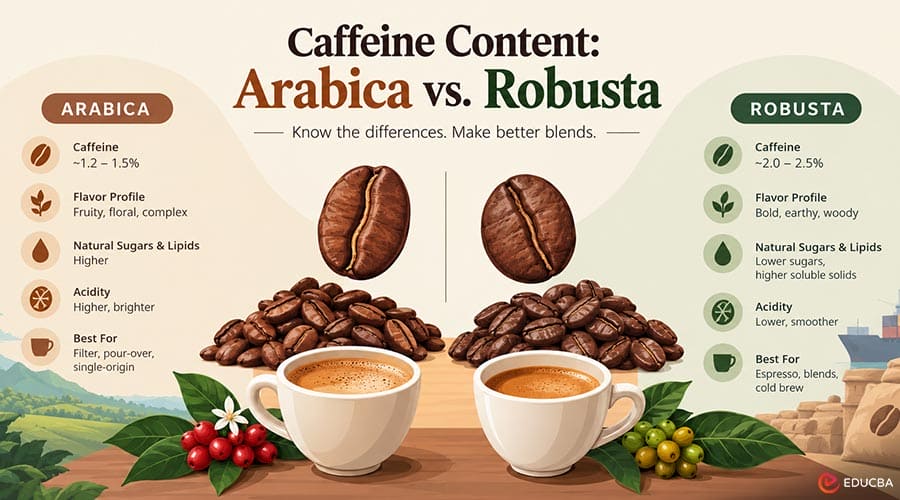
For roasters, café owners, and beverage procurement directors, understanding bean chemistry is a vital step when developing a commercial product line. Beyond flavor profiles and aroma, caffeine concentration strongly influences how coffee extracts, how blends taste, and how consumers experience the final cup.
Evaluating Caffeine content: Arabica vs. Robusta provides essential guidance for B2B buyers seeking to craft balanced espresso blends, high-energy cold brews, or delicate single-origin filter coffees.
Chemical Differences Between Coffee Varieties
Arabica (Coffea arabica) and Robusta (Coffea canephora) are two commercially important coffee species with different chemical compositions. These natural differences directly influence physical bean density, extraction solubility, and sensory characteristics.
1. Caffeine Levels
When comparing Caffeine content: Arabica vs. Robusta, Robusta naturally contains nearly double the caffeine concentration found in Arabica. Caffeine naturally helps coffee plants protect themselves from pests and certain environmental pressures. Higher caffeine can contribute to bitterness, while differences in chlorogenic acids, sugars, lipids, and other compounds also influence Robusta’s characteristic sensory profile. Conversely, Arabica’s lower caffeine levels allow delicate floral notes, fruit aromatics, and nuanced acidity to remain dominant in the cup.
2. Lipids and Natural Sugars
During roasting, sugars and other precursors undergo complex chemical reactions that shape aroma, flavor, and color, while lipids influence coffee’s sensory properties and mouthfeel. Arabica varieties have higher levels of natural lipids and sucrose than Robusta. Robusta has lower sugar levels but higher soluble solids, which accelerate extraction and yield a denser, heavier body.
3. Chlorogenic Acids
Both varieties contain chlorogenic acids, which contribute to acidity and antioxidant properties. However, Robusta has a higher concentration of these acids, which, paired with elevated caffeine, adds a distinct woody, herbal complexity that grounds commercial blends.
Commercial Impact on Beverage Menus and Blends
Understanding how chemical attributes function under commercial extraction allows roasters and beverage developers to tailor blends for specific market needs:
- Espresso Crema and Body: Higher caffeine and soluble solids in Robusta enhance visual crema thickness and foam stability. This makes Robusta an ideal addition for espresso menus, ensuring the extraction retains its structure when combined with textured milk.
- Acidity Balance: Pure Arabica extractions can sometimes deliver crisp citrus acidity that requires careful extraction tuning. Introducing Robusta lowers overall cup acidity while providing a dark cocoa foundation that stabilizes beverage flavor profiles.
- Filter and Single-Origin Offerings: Specialty filter menus and pour-over bars typically favor high-grade Arabica varieties, such as Bali Kintamani. Lower caffeine content paired with rich natural sugars highlights clean fruit notes and elegant aromatics.
Systems-Driven Quality Control in Raw Supply
Whether a blend emphasizes Arabica or Robusta, consistent cup quality requires strict control throughout post-harvest production. Chemical stability and physical bean density are determined long before raw coffee reaches the roastery.
Bali Origins manages raw coffee production through systemized steps to ensure repeatable physical standards:
- Farm Selection: Sourcing begins with farm selection from trusted plantations, ensuring that only perfectly ripe cherries are gathered for processing.
- Controlled Processing: A controlled washing process removes mucilage uniformly without introducing off-flavors or unwanted batch variations.
- Monitored Drying: Monitored drying protocols stabilize internal moisture content across every lot, protecting bean integrity and ensuring uniform heat absorption during roasting.
Guided by our certified processing team, we evaluate every batch of green and roasted beans against global standards to ensure long-term consistency and supply stability for commercial partners.
Secure Your Commercial Coffee Supply Today
Designing a signature coffee lineup requires reliable raw materials, structured processing, and technical precision. Partnering with a processing-focused coffee manufacturer provides the batch consistency and scalability needed to support growing B2B beverage programs.
For wholesale coffee sourcing, understanding factors such as Caffeine content: Arabica vs. Robusta can help businesses evaluate suitable beans and processing requirements for different markets.
Final Thoughts
Understanding the differences in Caffeine content: Arabica vs. Robusta helps commercial coffee buyers make informed decisions about blends, extraction, flavor profiles, and beverage applications. While Arabica offers refined aromatics and balanced acidity, Robusta provides higher caffeine, stronger body, and greater crema potential.
However, bean selection represents only one part of consistent coffee production. Consistent commercial batches depend on dependable sourcing, well-regulated processing, and thorough quality control throughout production. By combining the right coffee variety with consistent processing standards, businesses can develop dependable products that meet the needs of diverse global markets.
Recommended Articles
We hope this guide helps you understand the differences between Arabica and Robusta, including caffeine levels, chemical composition, extraction, and their role in commercial coffee blends. Explore our recommended articles for more insights on coffee processing, bean quality, roasting, sourcing, and commercial coffee production.

