


What is Bulge Bracket?
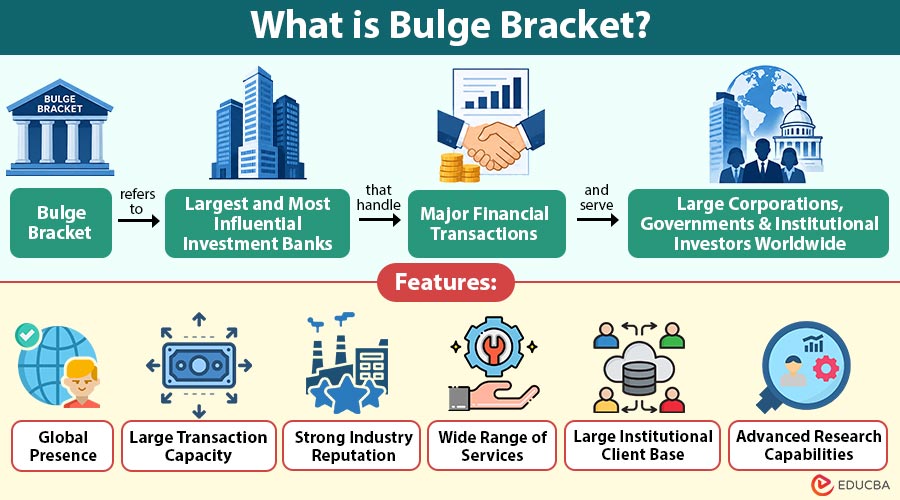
Bulge bracket refers to the largest and most influential investment banks that handle major financial transactions and serve large corporations, governments, and institutional investors worldwide.
These banks operate across international financial markets and provide services such as underwriting, mergers and acquisitions, securities trading, and corporate financial advisory. They usually have a strong market presence, extensive resources, and offices in major financial centers.
The term is commonly used in investment banking to describe firms that rank among the leading institutions in the industry. These banks often participate in large transactions involving billions of dollars and work with some of the world’s biggest organizations.
For example, a multinational company planning to acquire another large business may approach a bulge bracket bank for financial advice, transaction planning, and funding support.
The term also comes from the traditional arrangement of investment banking league tables, where the names of leading banks appeared in larger or more prominent positions.
Table of Contents:
- Meaning
- Importance
- Working
- Features
- Services Offered by Bulge Bracket Banks
- Examples
- Benefits
- Challenges
- Difference
- Career Opportunities
Key Takeaways:
- Bulge bracket banks handle large financial transactions for corporations, governments, and institutional investors across international markets.
- Their global networks and financial resources support complex deals, capital raising, and corporate expansion.
- Bulge bracket banks employ finance professionals across investment banking, equity research, trading, risk management, and asset management.
- These institutions face regulatory pressures, operating expenses, market competition, and financial risks despite their strong industry positions.
Importance of Bulge Bracket Banks
Bulge bracket banks play an important role in the global financial system by supporting large transactions and connecting businesses with investors.
The following points explain their importance:
1. Supports Capital Formation
They help companies and governments raise funds through equity and debt offerings, making financial resources available for expansion and development.
2. Facilitates Business Growth
Their advisory services help organizations complete acquisitions, enter new markets, restructure operations, and pursue opportunities that support long-term growth.
3. Connects Global Markets
Their international networks connect investors, companies, and financial institutions, supporting transactions across different countries and financial markets.
4. Improves Market Liquidity
Their trading activities support the buying and selling of financial securities, helping institutional investors participate more efficiently in capital markets.
5. Provides Financial Expertise
Their experienced professionals offer financial analysis, market research, valuation guidance, and transaction support for complex corporate decisions.
6. Supports Economic Development
By helping businesses access capital and complete major transactions, they contribute to investment activity, business expansion, and broader economic growth.
How Does a Bulge Bracket Bank Work?
A bulge bracket bank works by connecting companies, governments, investors, and financial markets through various banking and investment services.
The following steps explain its general working process:
1. Understand Client Requirements
The bank studies the client’s financial objectives, business activities, funding requirements, and investment plans before recommending suitable financial solutions.
2. Provide Financial Advice
Its investment banking team evaluates market conditions, business valuations, financial risks, and possible opportunities to support important corporate decisions.
3. Arrange Financial Transactions
The bank helps clients raise capital, issue securities, complete acquisitions, and manage other large financial transactions through its international network.
4. Connect Investors and Businesses
It connects companies seeking funds with institutional investors and other market participants interested in purchasing financial securities or investment opportunities.
5. Manage and Complete Transactions
Banking professionals coordinate documentation, negotiations, regulatory requirements, pricing, and other activities required to complete financial transactions successfully.
6. Maintain Client Relationships
The bank continues working with clients by providing financial guidance, market insights, and support for future business and investment requirements.
Features of Bulge Bracket Banks
Bulge bracket banks have several characteristics that distinguish them from smaller investment banking firms. The following points explain their major features:
1. Global Presence
These banks maintain offices across major financial centers, allowing them to serve international clients and participate in transactions across different countries.
2. Large Transaction Capacity
They have substantial financial resources, experienced professionals, and extensive networks to manage complex transactions involving significant amounts of capital.
3. Strong Industry Reputation
Their established market presence and experience in major financial deals help them maintain credibility among corporations, governments, and institutional investors.
4. Wide Range of Services
They provide multiple financial services, including investment banking, asset management, securities trading, underwriting, and financial advisory solutions for different clients.
5. Large Institutional Client Base
Their clients generally include multinational corporations, government organizations, pension funds, insurance companies, and other major financial institutions.
6. Advanced Research Capabilities
They maintain research teams that study economic trends, financial markets, industries, and companies to support investment decisions and client strategies.
Services Offered by Bulge Bracket Banks
Bulge bracket banks provide several financial services to businesses, governments, and institutional investors. The major services include:
1. Mergers and Acquisitions
They advise companies on purchasing, selling, or combining businesses by providing valuation support, transaction planning, negotiation assistance, and financial analysis.
2. Equity Underwriting
These banks help companies raise funds by issuing shares to investors through initial public offerings and other equity-related transactions.
3. Debt Underwriting
They assist organizations in raising borrowed capital through bonds and other debt instruments while managing pricing, documentation, and investor participation.
4. Sales and Trading
Their trading divisions buy and sell financial securities, currencies, commodities, and other instruments on behalf of institutional clients and investors.
5. Asset Management
They manage investment portfolios for individuals, institutions, and organizations by selecting financial assets according to investment objectives and risk preferences.
6. Financial Advisory
They provide guidance on corporate restructuring, capital allocation, business expansion, and other financial decisions that affect long-term business performance.
7. Equity Research
Their research teams examine companies, industries, and financial markets to prepare reports that help institutional clients understand investment opportunities and risks.
Examples of Bulge Bracket Banks
Several major financial institutions are commonly associated with the bulge bracket category. The following are well-known examples:
1. JPMorgan Chase
JPMorgan Chase is a major global financial institution that provides investment banking, corporate banking, asset management, and financial advisory services to large organizations.
2. Morgan Stanley
Morgan Stanley offers corporate and institutional investors investment banking, wealth management, institutional securities, and investment management services.
3. Bank of America
Bank of America operates across consumer banking, corporate banking, investment banking, and global markets, serving businesses and institutional clients worldwide.
4. Citigroup
Citigroup provides corporate banking, investment banking, treasury services, securities trading, and financial solutions to organizations operating across international markets.
5. Barclays
major British financial institution offering investment banking, corporate banking, capital markets, and financial services to global clients.
Benefits of Bulge Bracket Banks
Working with a bulge bracket bank offers several benefits to large organizations and institutional investors.
1. International Network
Their presence in multiple countries helps clients access international markets, financial institutions, investors, and business opportunities through established relationships.
2. Extensive Financial Resources
Their large operating capacity allows them to manage complex financial transactions and support clients with significant funding requirements.
3. Experienced Professionals
They employ specialists across different financial areas, providing clients with expertise in investment banking, trading, research, and corporate finance.
4. Wide Service Coverage
Clients can access several financial services through one institution, reducing the need to coordinate with multiple independent financial service providers.
5. Strong Market Access
Their established relationships with institutional investors and financial organizations help clients reach potential funding sources and market participants.
Challenges Faced by Bulge Bracket Banks
Despite their strong market position, bulge bracket banks face several operational, financial, and regulatory challenges.
1. Strict Regulations
They must follow complex banking regulations across different countries, requiring continuous monitoring, compliance activities, and significant administrative resources.
2. High Operating Costs
Maintaining international offices, advanced technology, skilled employees, and regulatory systems creates substantial operating expenses for these financial institutions.
3. Market Competition
They face competition from other global banks, boutique investment firms, private equity companies, and emerging financial technology businesses.
4. Financial Market Risks
Changes in interest rates, currency values, economic conditions, and security prices can affect trading activities and overall financial performance.
5. Reputational Risks
Compliance failures, financial misconduct, or unsuccessful transactions can damage public confidence and affect relationships with clients and investors.
Difference Between Bulge Bracket and Boutique Investment Banks
The table below highlights the differences between the two:
| Basis | Bulge Bracket | Boutique Investment Banks |
| Size | Large global financial institutions. | Generally smaller specialized firms. |
| Operations | Operate across international markets. | Often focus on selected markets or regions. |
| Services | Offer a wide range of financial services. | Usually specialize in specific financial services. |
| Clients | Serve multinational companies and institutional investors. | Often serve middle-market companies and specialized clients. |
| Resources | Have extensive financial and operational resources. | Usually operate with comparatively limited resources. |
| Transactions | Handle large and complex financial deals. | Often focus on smaller or specialized transactions. |
Career Opportunities in Bulge Bracket Banks
Bulge bracket banks offer various career opportunities for professionals interested in finance, investment banking, and financial markets. The common roles include:
1. Investment Banking Analyst
Analysts prepare financial models, conduct company valuations, research industries, and assist senior bankers with mergers, acquisitions, and capital-raising transactions.
2. Equity Research Analyst
These professionals examine company performance, industry developments, and financial statements to prepare investment reports and market recommendations.
3. Sales and Trading Associate
They work with financial securities, monitor market movements, execute transactions, and support institutional clients with trading-related requirements.
4. Risk Management Analyst
Risk analysts identify financial and operational risks, evaluate potential losses, and help banks maintain suitable risk management practices.
5. Asset Management Professional
These professionals manage investment portfolios, study financial markets, and develop investment strategies based on client objectives and risk preferences.
Final Thoughts
Bulge bracket banks are major financial institutions that support global businesses, investors, and financial markets. They provide services such as investment banking, underwriting, trading, and financial advisory. Their international presence, financial resources, and industry expertise make them important participants in large financial transactions. However, they must continuously manage regulatory requirements, market risks, and competition to maintain their position in the industry.
Frequently Asked Questions (FAQs)
Q1. Why is it called a bulge bracket?
Answer: The term originated from investment banking league tables, where leading banks received more prominent placement in presentations of major financial transactions.
Q2. Who typically works with bulge bracket banks?
Answer: Large corporations, multinational businesses, government organizations, institutional investors, and major financial institutions commonly work with these banks.
Q3. Are bulge bracket banks suitable for small businesses?
Answer: They generally focus on large organizations and complex transactions, making smaller businesses more likely to approach regional or boutique investment banks.
Q4. How do bulge bracket banks earn revenue?
Answer: They generate revenue through advisory fees, underwriting commissions, trading activities, asset management charges, and other financial services.
Recommended Articles
We hope that this EDUCBA information on “Bulge Bracket” was beneficial to you. You can view EDUCBA’s recommended articles for more information –

