


Why Most Businesses Get Brand Identity Wrong?
A strong brand identity is really just the collection of visual and verbal cues, logo, colors, tone, and messaging that let people recognize a business without thinking twice. Creating a strong brand identity helps businesses establish a recognizable presence, build customer trust, and stand out from competitors by following effective strategies. Simple in theory. And yet, a large share of companies never get past the informal stage: industry surveys have found that around 95% of organizations have some form of brand guidelines, but only about a quarter consistently enforce them. That gap shows up in small, cumulative ways: social posts that don’t match the packaging, a website tone that swings from formal to casual depending on who happened to write the copy that week. Customers pick up on it even when they can not name what’s off. A business without a defined identity does not disappear; it just becomes easy to forget, which, honestly, might be worse.
Start With Brand Strategy to Build a Strong Identity
Most founders make the same mistake: they open Canva before they’ve settled a single strategic question. Real brand identity work starts with three things: core values, target audience, and what actually sets the company apart. A neighborhood bakery and a fintech startup obviously shouldn’t sound alike, yet plenty of small business sites read as if the same template wrote them both. To build a strong brand identity, businesses should begin by identifying their core purpose, target audience, and unique market position before making decisions about visual elements and design.
Take a hypothetical but common scenario: a mid-sized logistics company rebranding after years of inconsistent messaging. Before anyone touches a color palette or picks a font, the smart move is to interview actual customers about what a value like “reliability” means to them in practice. That kind of research shapes everything downstream, the tagline, the photography style, even the scripts customer service reps use. Skip that groundwork, and you usually end up fixing things later, at a much higher cost than getting it right from the start. Bringing in a web and brand design partner during the strategy phase, rather than after launch, tends to save time and budget.
The Core Elements of a Brand Identity
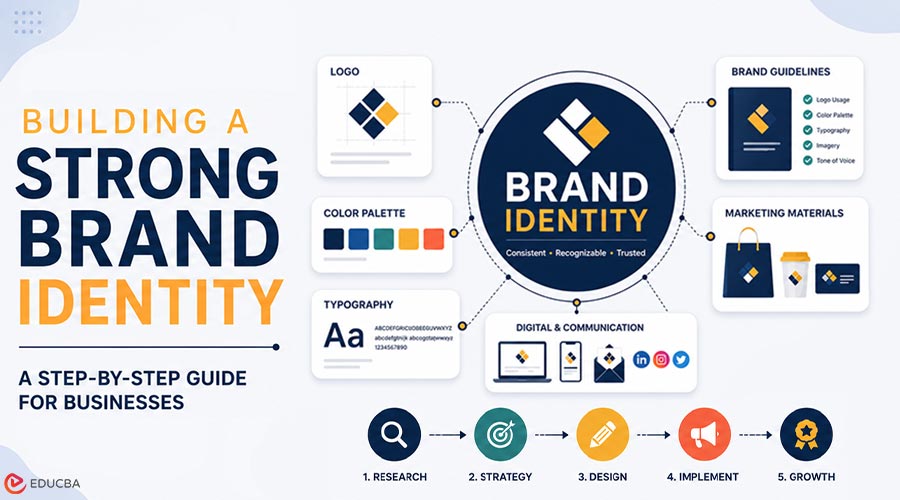
Once the strategy’s locked, the visual and verbal systems come together. These elements form the foundation businesses need to build a strong brand identity that remains consistent across every customer interaction. A complete brand identity usually includes:
- Logo and wordmark – The anchor visual, used consistently across every touchpoint
- Color palette – Typically 2–4 primary colors, chosen for psychological fit rather than personal taste
- Typography – A small set of fonts (2–3 max) for headings, body copy, and UI
- Tone of voice – How the brand sounds in writing, from social captions to error messages
- Imagery style – Photography, illustration, or iconography, kept consistent throughout
Companies that document these elements in a shared style guide tend to run into far fewer inconsistencies across teams than those that rely on informal habits passed down verbally. That lines up with what most in-house marketing teams already know from experience: without a shared reference point, every new hire ends up interpreting the brand a little differently.
Maintaining Brand Identity Consistency Across Every Touchpoint
A brand identity only works when it looks and sounds consistent across every touchpoint. Consistency plays a crucial role in building a strong brand identity, helping customers easily identify and remember a brand across touchpoints such as websites, packaging, email signatures, social media platforms, and app interfaces. According to Lucidpress’s (now Marq) State of Brand Consistency research, companies that present their brand consistently across platforms have reported revenue increases of up to 23%, largely because repeated, coherent exposure builds recognition faster than branding that varies across platforms.
Picture a subscription skincare brand that redesigns its packaging without updating its website. Customers who order online get confused when the box arrives and looks like it came from a totally different company. That kind of mismatch, even when temporary, chips away at trust in ways that are genuinely hard to trace back to a single cause.
This isn’t just a design nitpick; it is a growth problem. A business that looks even slightly different on Instagram, at checkout, and in its email receipts is quietly teaching customers to second-guess every future interaction. And that distrust compounds. A first-time buyer who feels even mildly confused is statistically much less likely to come back, no matter how good the product actually is. Consistency, in that sense, is not really about looking polished – it’s about removing friction from the one thing a brand can fully control: how it shows up.
Common Brand Identity Mistakes Businesses Should Avoid
A handful of patterns keep showing up:
- Changing the logo or colors every year without a real reason
- Writing marketing copy in one tone and support emails in another
- Treating the brand as “finished” after launch instead of revisiting it as the business grows
- Skipping user testing on how the identity actually reads to outsiders
Consider a familiar type of case: a regional restaurant chain holding onto a decade-old logo out of pure inertia rather than loyalty. When chains like this finally refresh their identities to match what younger customers expect from a modern food brand, foot traffic at new locations often increases faster than at older ones, a pattern documented in multiple retail rebranding case studies.
There’s a subtler mistake worth naming here, too: confusing personal preference with brand strategy. Founders often lean toward colors or fonts they personally like, rather than what their audience actually responds to. A B2B software company chasing a playful, consumer-app look might feel “fun” internally while quietly alienating the enterprise buyers it’s actually trying to reach. Brand decisions should be tested against audience expectations, not a founder’s Pinterest board – a distinction that sounds obvious on paper but is often ignored.
Final Thoughts
Building a strong brand identity is not just a one-time design task. It is an ongoing process involving strategy, visual elements, and daily brand communication. Successful businesses treat identity as infrastructure, not decoration. They document, review, and apply it consistently as the company grows. Businesses without in-house expertise can benefit from external support early on instead of fixing issues later. Regardless of the business stage, the goal remains the same: ensure the brand looks and sounds consistent everywhere it appears.
None of this needs a massive rebrand budget or a six-month agency retainer. Even small, deliberate steps can help build a memorable brand identity. These include defining a color palette, creating tone-of-voice rules, and reviewing logo usage. Companies that treat branding as ongoing maintenance often create stronger customer connections over time. The true test of a brand identity is not how it looks in a pitch deck. It is whether customers still recognize and remember it years later.
Recommended Articles
We hope this guide on building a strong brand identity helps you create a recognizable and consistent brand presence. Explore these recommended articles for additional insights and strategies to strengthen your branding efforts and improve customer connection.

