


What Is BATNA?
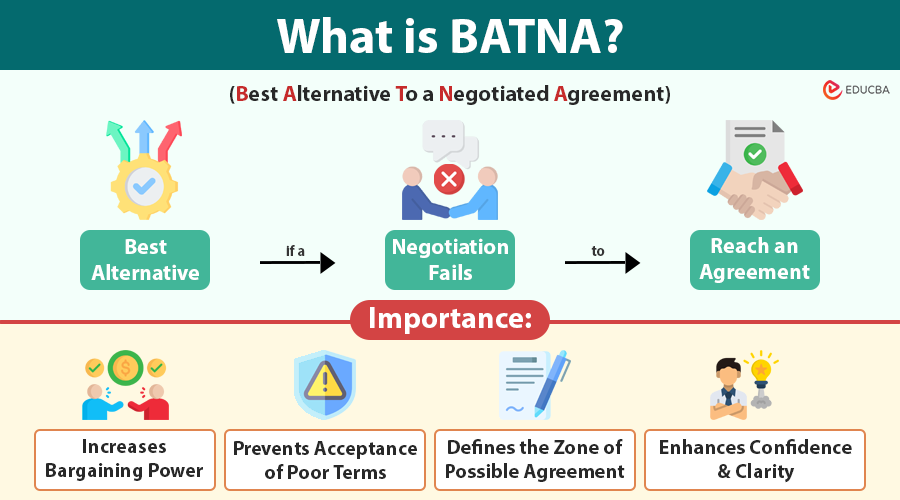
BATNA (Best Alternative to a Negotiated Agreement) is the most favorable alternative you can pursue if a negotiation does not result in an agreement. It serves as your backup plan and helps you determine whether to accept or walk away from a deal.
You are negotiating a job offer with Company A, which offers $70,000 per year. Meanwhile, Company B has already offered you $75,000. If Company A will not match or exceed that, your BATNA is to accept Company B’s offer.
A well-defined BATNA allows you to negotiate from a position of strength, avoid desperation-driven decisions, and remain grounded in what is realistically achievable without the deal on the table.
Table of Contents
- Meaning
- Importance in Negotiation
- Negotiation Diagram
- Real-life Examples
- How to Identify?
- How to Use it in Negotiation?
- Common Mistakes in Analysis
- How to Discover the Other Party’s BATNA
- BATNA vs Reservation Price vs ZOPA
- How to Improve?
- BATNA in Business, Law, and International Relations
Why Is BATNA Important in Negotiation?
A strong BATNA offers several strategic advantages:
1. Increases Bargaining Power
When you know you have a viable alternative, you are less likely to feel pressured into accepting unfavorable terms. This psychological advantage often translates into better outcomes, as the other party knows you are not dependent on the deal.
2. Prevents Acceptance of Poor Terms
Without a clear alternative, negotiators might settle for agreements that are worse than their actual options. For instance, a supplier might accept low margins because they are unaware that another buyer is willing to pay more. This backup option acts as a filter to screen out weak deals.
3. Defines the Zone of Possible Agreement (ZOPA)
Understanding both your BATNA and estimating the other party’s BATNA helps define the negotiation zone where a mutually beneficial deal can occur. If there is no overlap between your BATNA and theirs, no agreement is likely.
4. Enhances Confidence and Clarity
Negotiators equipped with a strong BATNA often display higher confidence, clarity, and calmness. They are better able to focus on facts rather than emotions and can make rational decisions aligned with their interests.
Understanding BATNA Through a Negotiation Diagram
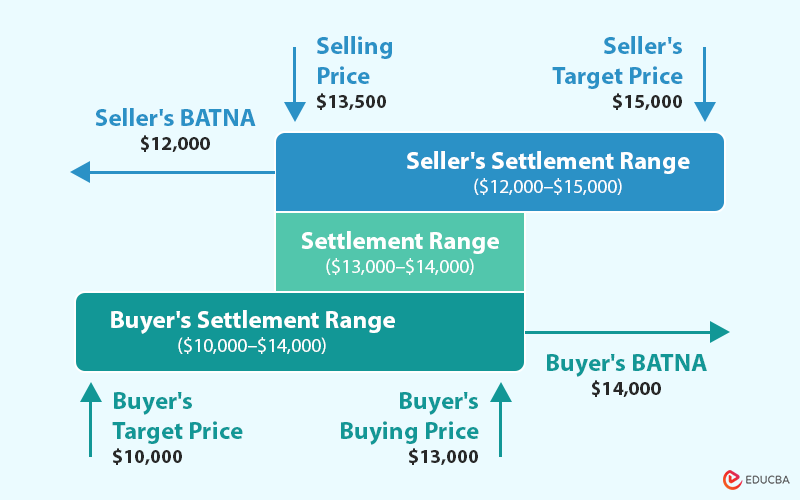
This diagram visually explains how BATNA works in a real negotiation scenario by showing the acceptable price ranges for both the buyer and the seller, as well as where their interests overlap.
Let us break it down with an easy-to-follow example involving the sale of a used car.
Seller’s Perspective
| Term | Amount | Explanation |
| Seller’s Target Price | $15,000 | The ideal price the seller hopes to get. |
| Selling Price | $13,500 | The price the seller is currently asking for in the negotiation. |
| Seller’s BATNA | $12,000 | The best alternative is another buyer willing to pay $12,000 if this deal fails. |
| Seller’s Settlement Range | $12,000–$15,000 | The realistic range that the seller is willing to accept to close the deal. |
Buyer’s Perspective
| Term | Amount | Explanation |
| Buyer’s Target Price | $10,000 | The ideal price the buyer wants to pay. |
| Buyer’s Buying Price | $13,000 | The amount the buyer is currently offering in the negotiation. |
| Buyer’s BATNA | $14,000 | The buyer’s best alternative is another seller offering a similar car for $14,000. |
| Buyer’s Settlement Range | $10,000–$14,000 | The realistic range that the buyer is willing to pay to make the deal. |
Possible Settlement Range (Zone of Agreement)
- The overlapping area between the buyer’s and seller’s acceptable ranges is $13,000–$14,000.
- This is the zone of possible agreement (ZOPA)—where both parties can realistically strike a deal.
- If either party moves outside this overlap, negotiations will likely fail.
Key Takeaway
This diagram makes it clear how knowing your BATNA and your counterpart’s possible range can help both sides:
- Buyers avoid overpaying.
- Sellers avoid underselling.
- Both can walk away if the offer does not meet their minimum conditions.
Understanding this zone gives you the power to negotiate logically, not emotionally.
Examples of BATNA in Real-Life Situations
| Scenario | Example |
| Job Offer Negotiation | Accepting a competing offer with a higher salary or better benefits |
| Business Partnership | Choosing to grow organically without a partner or seeking funding from a venture capital firm |
| Buying a Car | Purchasing a similar model from another dealer who offers a better financing plan |
| Divorce Settlement | Proceeding to trial and letting a judge divide assets instead of accepting an unfair settlement |
| Supplier Negotiation | Shifting to a local manufacturer with faster delivery times and comparable pricing |
These examples show that backup strategies aren’t limited to corporate or legal settings. It applies to everyday decisions that involve choices, trade-offs, and potential agreements.
How to Identify Your BATNA?
Creating a BATNA is not automatic; it involves a systematic process of exploring and evaluating your options. Here is how:
1. List All Alternatives
Begin by brainstorming all possible actions you could take if the negotiation fails. This list should include realistic, achievable options that could serve your interests. Quantity matters at this stage, be expansive.
2. Evaluate Each Alternative
For every option you have listed, assess the pros and cons. Consider cost, time, risks, strategic alignment, and long-term impact. This step helps you filter the best from the rest.
3. Choose the Best One
Select the option that offers the most value or the lowest risk if talks break down. This becomes your fallback plan. It becomes your benchmark when evaluating offers during negotiation.
4. Develop and Strengthen It
Strengthen your backup plan to increase negotiation leverage. This might involve securing a commitment from another party, gathering more market information, or creating a more compelling Plan B. A stronger BATNA increases your negotiation leverage.
How to Use BATNA in Negotiation?
Once you have identified your BATNA, it becomes a powerful strategic asset. Here is how to use it at different stages:
Before Negotiation
- Preparation is key. Invest time in building a detailed understanding of your best alternatives.
- Establish a reservation price (the minimum acceptable deal) based on your BATNA. You should say no to any offer that falls below this limit.
- Anticipate the other party’s BATNA to understand their potential flexibility and pressure points.
During Negotiation
- Let your strongest option guide your decisions. If a deal does not surpass your BATNA, reject it.
- Avoid premature disclosure. Reveal it only when strategically beneficial. If it is strong, it can intimidate the other party. If weak, keep it hidden.
- Be willing to walk away. Your BATNA gives you that freedom. This signals confidence and prevents you from being manipulated.
After Negotiation
- Evaluate the final offer against your BATNA. If it is better, accept. If not, pursue your alternative.
- Maintain your BATNA relationships or options. They may still serve you in future negotiations or fallback scenarios.
Common Mistakes in BATNA Analysis
Even seasoned professionals can miscalculate BATNA. Some common errors include:
- Overestimating your BATNA: This creates unrealistic expectations, leading to unnecessary walkaways. It is common in corporate settings where internal bias skews perception of alternatives.
- Underestimating your BATNA: This results in accepting poor deals. It often happens when people lack self-awareness or information about available opportunities.
- Failing to update BATNA: Markets change. What was a strong BATNA a month ago might be less viable now. Reevaluate your options continuously.
- Ignoring the other party’s BATNA: Not considering their backup plan is a major strategic oversight. If their BATNA is better than your offer, they will not agree. You must offer more value than what they can achieve elsewhere.
How to Discover the Other Party’s BATNA?
While you may never know their BATNA with certainty, there are strategies to make educated guesses:
- Ask strategic questions like “What other options are you considering?” or “What are your timelines?”
- Watch for signals. A party pushing for a quick deal may have a weak BATNA.
- Conduct competitive intelligence. Learn about their market options, existing contracts, or resource limitations.
- Use silence as a tactic. The more they talk, the more you learn. Let them fill the gaps.
Understanding the other side’s BATNA lets you frame your offer more attractively and avoid over-concessions.
BATNA vs Reservation Price vs ZOPA
These three concepts are often confused, but each plays a distinct role in negotiation strategy:
| Term | Meaning |
| BATNA | Your best fallback plan if no deal is reached |
| Reservation Price | The lowest/highest price you are willing to accept before walking away |
| ZOPA | The range between your reservation price and the other party’s |
Together, they help you define limits, anticipate possibilities, and know when to say “yes” or “no.”
How to Improve Your BATNA?
Improving your BATNA is a dynamic, ongoing process. Here are strategies to build stronger alternatives:
- Expand your options: In job searches, apply to more companies. In business deals, court more suppliers or buyers.
- Strengthen existing alternatives: Enhance your fallback by negotiating more favorable terms or securing commitments.
- Enhance your market position: Build skills, grow networks, or develop proprietary solutions that increase your desirability.
- Invest in intelligence: The more you know about your options and the other party’s constraints, the better you can negotiate.
- Build backup relationships: Maintain connections with alternative partners or service providers, even when not actively negotiating.
A powerful BATNA puts you in control of the negotiation process rather than at the mercy of it.
BATNA in Business, Law, and International Relations
In Business
Companies use BATNA when negotiating vendor contracts, strategic partnerships, acquisitions, or client terms. For example, if a buyer knows they can source raw materials elsewhere, they will not accept high prices from one supplier.
In Legal Disputes
Lawyers evaluate whether to settle or go to trial based on BATNA. If trial outcomes are likely worse than a settlement, then a settlement becomes preferable.
In Diplomacy and International Relations
Nations use BATNA when negotiating trade deals or military alliances. For example, during Brexit negotiations, the EU’s BATNA was maintaining the union’s internal integrity, while the UK’s was trading under WTO rules.
In every context, the stronger the BATNA, the better the leverage and decision-making clarity.
Final Thoughts
Having a solid fallback is not just a theoretical framework, but a real-world strategy that empowers individuals and organizations to make better deals. By identifying, evaluating, and strengthening your best alternative, you enter negotiations with clarity, confidence, and control.
Whether you are signing a big contract or choosing a rental, knowing your BATNA can help you make a smart deal and avoid costly mistakes.
Frequently Asked Questions (FAQs)
Q1. Is BATNA only useful in formal business negotiations?
Answer: No, BATNA is useful in any situation that involves decision-making between two or more parties, including job offers, apartment leases, purchases, family discussions, and more. It helps you make logical choices when you cannot easily reach an agreement.
Q2. How is BATNA different from a Plan B?
Answer: While similar, BATNA is more strategic than a generic “Plan B.” It is specifically the best available alternative if the current negotiation fails. A Plan B could be broader and less defined, whereas a BATNA is typically evaluated and prepared in detail before entering negotiations.
Q3. What happens if both parties have strong BATNAs?
Answer: If both sides have strong BATNAs, they may choose not to reach an agreement if neither sees enough value in the deal. In such cases, the negotiation often turns into a game of leverage or timing, or may be postponed until conditions change.
Q4. What if I cannot find a good BATNA? Should I still negotiate?
Answer: Yes, but with caution. A weak BATNA does not mean you should avoid negotiating; it means you should be more flexible and focused on value creation in the negotiation. Also, try to improve your BATNA during the process, if possible.
Recommended Articles
We hope this comprehensive guide on BATNA was helpful. Explore related articles on:

