


Introduction
Applications that function seamlessly on both the web and mobile devices have become an integral part of daily life. From social media to online banking and from shopping to entertainment, everyone expects flawless, user-friendly, and, most importantly, functional connectivity to the applications. APIs act as vital connectors between systems, ensuring seamless integration by enabling data exchange and collaboration between applications for smooth functionality. Without APIs, software development could hardly have become this scalable, modular, or even interactive. This article helps in understanding the significance, types, advantages, and best practices of APIs in contemporary web and mobile development.
Understanding APIs
API stands for Application Programming Interface. It is basically a collection of protocols and tools that enable software applications to speak to one another. It establishes the structure for requests and responses, making interactions between different services smooth and efficient. In other words, an API is a bridge between different applications in order to exchange information and services without needing to know anything about the application’s implementation.
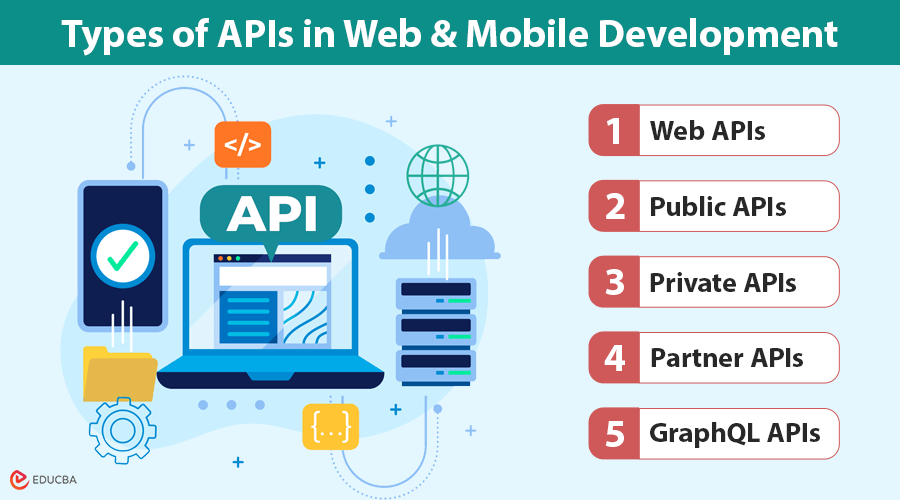
Types of APIs in Web and Mobile Development
APIs come in different types, each tailored to specific use cases and levels of accessibility:
1. Web APIs (REST and SOAP APIs)
- RESTful APIs (Representational State Transfer): These APIs use functions like GET, POST, PUT, AND DELETE in a synchronized manner over an HTTP web service. They are very lightweight, scalable, and most commonly used these days.
- SOAP APIs: Those APIs are defined as Simple Object Access Protocols, which use XML messaging to transfer data. These APIs have more security but are less flexible than REST APIs and are particularly suitable for enterprise applications.
2. Public APIs
Public APIs are APIs made available to developers and third parties, allowing external developers to use the services of applications such as Google Maps, Twitter, or PayPal in their applications.
3. Private APIs
Private APIs are used internally within a company to ensure seamless integration between its services. The private APIs maintain security and efficiency when integrating internal systems.
4. Partner APIs
Partner APIs enable shared access to the API with only some business partners to facilitate the movement of data exchanged with that partner securely. For example, an Amazon API for third-party sellers lets sellers create product listings and transactions.
5. GraphQL APIs
Created and introduced by Facebook, GraphQL APIs will provide clients with options to request the particular data structures that are required, considerably improving the optimization and limitations of data transfer compared to REST APIs.
Key Roles of APIs in Web and Mobile Development
1. Enriching Application Features
Third-party services can be incorporated into applications through APIs: payment gateways, authentication schemes, or geolocation services. The Google Maps API, for example, provides an app with direct access to navigation features without implementing mapping functions.
2. Enhancing Development Productivity
APIs enable developers to concentrate on the core internal logic of the application and not on creating features common to other applications from scratch. It possesses pre-existing services that accelerate developments, avoid errors, and reduce redundant coding efforts.
3. Cross-Platform Compatibility Enablement
With applications running across web, iOS, and Android platforms, APIs act as the bridge that ensures seamless communication and data consistency, delivering a unified experience across all devices.
4. Improvement in User Experience
APIs assist in delivering personalized user experiences by syncing data in real time, updating data in real time, and providing dynamic content. Social networking sites like Facebook and Twitter employ APIs to enable users to share content seamlessly across applications.
5. Enabling Microservices Architecture
Most modern applications are built using microservices. They break an application into various independent services that can communicate via an API. Integration can take somewhat modular, scalable, and maintainable software solutions.
6. Powering IoT Applications and Cloud Computing
APIs enable the Internet of Things (IoT) and cloud-based applications. For example, a smart home device uses APIs to communicate with mobile apps and cloud servers for remote configuration and user interaction.
Benefits of Using APIs in Web and Mobile Development
1. Improved Scalability
With the functionality of APIs, applications can expand their operations without requiring the redevelopment of the entire system. This modular approach enhances scalability, making it more efficient and cost-effective.
2. The Paradigm of Security
APIs providing data transmission will authenticate this occurrence with an authentication protocol, e.g., OAuth or API keys, so only authorized and rightful users and apps can access and use particular data and services.
3. Seamless Third-Party Integrations
Applications can utilize third-party services, including payment gateways (Stripe, PayPal), analytics tools (Google Analytics or GA4), communication services (Twilio, Slack), and web scraping APIs like Scrapingdog to enhance their capabilities.
4. Faster Development and Deployment
APIs come with pre-engineered services; thus, the professional programmer can readily develop and deploy an application without writing extensive code to achieve each specific feature.
5. Lesser Maintenance Work
With APIs, app developers can modify or update services without altering the entire application. This is advantageous to maintenance: changes are therefore made at the service level without disrupting the overall system.
Best Practices in API Development and Integration
Going with the best practices is crucial for the maximum benefits of APIs in modern-day development.
1. Follow RESTful Design Principles
RESTful APIs follow a stateless design with clear endpoints, enhancing usability and efficiency by leveraging standard HTTP protocols.
2. Make Secure
- Utilize all authentication elements like OAuth 2.0, JWT (JSON Web Tokens), and API keys.
- Rate-limit traffic to avoid API abuse and prevent DoS attacks.
- Protect data in transit by using HTTPS.
3. Optimize for Performance
- Cache frequently requested data for faster response times.
- Limit the payload of data being sent back to the ones really needed by the client.
- Implement pagination in cases of large datasets to provide efficient delivery.
4. Bring Comprehensive Documentation
- Use proper tools like Swagger, API Blueprint, or Postman to document the API.
- Any good API documentation should cover sample requests, sample responses, and authentication methods to allow developers to integrate APIs without any hiccups.
5. Version APIs
Have separate versions of APIs to ensure backward compatibility and that migration is as smooth as possible when services are being updated.
6. Error Handling
Provide error messages and HTTP status codes to assist developers in troubleshooting issues.
Future Trends in API Development
1. API-First Development
API-first development means designing APIs before building the application, ensuring greater scalability, seamless integration, and a more adaptable architecture.
2. GraphQL Adoption
Adoption is increased due to the flexibility of fetching data that it withholds. The clients can request only the data they need, thereby improving performance.
3. AI-Powered APIs
One area of expanding application functionality is artificial intelligence-integrated APIs, such as Google’s AI-powered APIs for natural language processing and image recognition.
4. Serverless APIs
Serverless APIs may have simplified the deployment of APIs, but there is very little to no requirement for the management of infrastructures, and it can be an excellent solution for an optimized scale.
Conclusion
APIs are the core of modern web and mobile development for integration, scalability, and user experience. From microservices to IoT and AI, APIs continue to shape the future of software development. Thus, by adopting best practices and new API technologies, developers can build efficient, secure, and high-performance applications that respond to constantly evolving user expectations. APIs will remain a key enabler of innovation and digital transformation in different sectors with advancements in technology.
Recommended Articles
We hope this guide on APIs in modern web and mobile development has helped you understand their significance, types, and best practices. Check out these recommended articles for more insights on API integration and development.

