


What is Answer Engine Optimization?
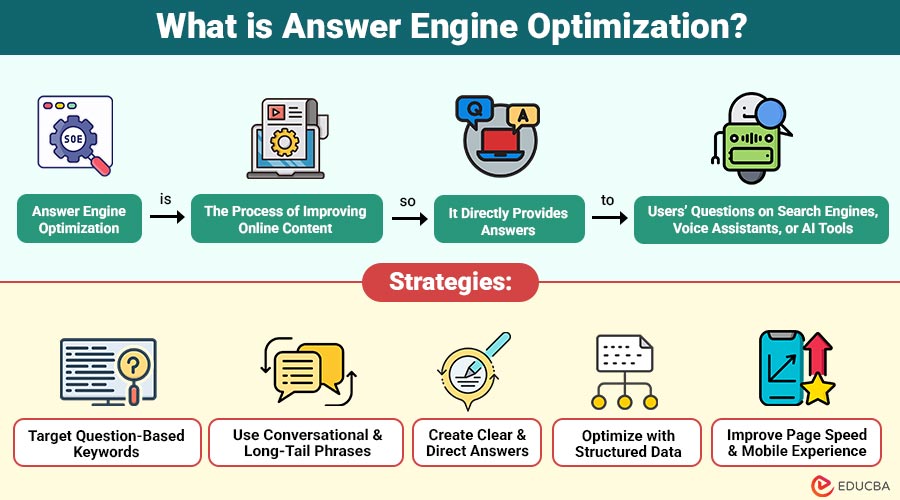
Answer Engine Optimization is the process of improving online content so it directly provides answers to users’ questions on search engines, voice assistants, or AI tools. Unlike traditional SEO, which focuses on ranking pages, AEO aims to provide concise, clear, and relevant answers that search engines can display instantly.
For example, if someone asks, “How to boil an egg?” an AEO-optimized page would offer a short, step-by-step answer that appears in a featured snippet or voice assistant response, improving visibility and user engagement.
Table of Content:
- What is Answer Engine Optimization?
- How Answer Engines Work?
- Components
- Strategies
- AEO vs Traditional SEO
- Tools and Technologies
- Common Challenges
- Future
Key Takeaways
- Answer Engine Optimization focuses on delivering clear, direct answers for voice assistants and AI tools, making content easier to access.
- Using structured data, featured snippets, and question-based content increases visibility in answer-driven search results.
- AEO requires concise writing, natural language keywords, and regular content updates to stay relevant.
- As AI and voice search grow, AEO will play a major role in helping brands remain competitive and provide faster, more accurate information to users.
How Answer Engines Work?
Answer engines are AI-powered systems designed to provide precise answers to user queries, rather than simply displaying a list of links. Here’s how they work:
- Understanding User Queries: Answer engines first analyze what the user is asking. They look for the intent behind the question, whether it is informational, transactional, or navigational. For example, if you ask, “Best restaurants near me,” the engine understands you want nearby dining options.
- Natural Language Processing (NLP): NLP helps the engine understand human language, including slang, synonyms, and context. This enables the engine to interpret questions exactly as humans ask them, resulting in more accurate responses.
- Searching for Relevant Content: Once the query is understood, the engine scans a vast database of web pages, documents, and structured data to find the most relevant information.
- Extracting and Summarizing Answers: The engine then extracts the key information and summarizes it into a clear, concise answer that directly addresses the question.
- Delivering the Answer: Finally, the engine presents the answer to the user, either as text, voice, or a combination, depending on the platform.
Components of Answer Engine Optimization
AEO encompasses several key components that enable content to be recognized by AI-driven answer systems. Here are the main elements explained simply:
- Structured Data (Schema Markup): This is a code added to your webpage that helps search engines better understand your content. It highlights important details, such as FAQs, ratings, or product information, so that answer engines can easily extract accurate answers.
- Featured Snippet Optimization: This focuses on creating clear, short, and direct answers that can appear at the top of search results. When your content is formatted properly, it increases the chance of becoming a featured snippet, which answer engines often read aloud.
- Question-Based Content (FAQ & Q&A): Creating content that directly answers common questions makes it easier for answer engines to match your page with user queries. Simple language and clear headings facilitate the extraction of answers.
- Content Clarity and Relevance: Answer engines prefer content that is easy to read, well-structured, and directly related to the topic. Short sentences, bullet points, and accurate information improve your chances of being selected.
Strategies to Optimize for Answer Engines
Here are simple and effective strategies to improve your content for answer engines:
- Target Question-Based Keywords: Focus on keywords that start with “what,” “how,” “why,” or “when.” These help you see what users want to know and enable you to create content that gives clear, direct answers to their questions.
- Use Conversational and Long-Tail Phrases: People often use natural language when speaking to voice assistants. Using a friendly, conversational tone and adding long-tail phrases helps answer engines connect your content with spoken questions more accurately.
- Create Clear and Direct Answers: Make sure each section of your content provides a straightforward answer in the first 1–2 sentences. Short, precise responses improve your chances of being featured by answer engines.
- Optimize with Structured Data: Adding schema markup helps answer engines recognize FAQs, reviews, and important details on your page. This improves visibility in voice search and featured snippets.
- Improve Page Speed and Mobile Experience: Fast-loading, mobile-friendly pages perform better because search engines prioritize user-friendly and responsive websites.
AEO vs Traditional SEO
| Aspect | AEO (Answer Engine Optimization) | Traditional SEO |
| Meaning | Focuses on providing direct, short, and accurate answers for voice assistants and AI search tools. | Focuses on improving website ranking in search engine results pages (SERPs). |
| Content Style | Concise, conversational, and question-focused content that gives instant answers. | Detailed, long-form, keyword-rich content designed for users and search crawlers. |
| Search Intent Target | Targets question-based and natural language queries, such as voice search. | Targets broad, competitive, and high-volume keyword searches. |
| Optimization Method | Uses structured data, featured snippets, and Q&A formats to help answer extraction. | Uses on-page SEO, backlinks, keywords, meta tags, and content depth. |
| User Interaction | Designed for zero-click answers read aloud by assistants. | Designed for users who click and browse multiple web pages. |
Tools and Technologies for AEO
Here are the main tools and technologies that help improve Answer Engine Optimization in simple language:
- Keyword Research Tools (e.g., AnswerThePublic, SEMrush): These tools help find question-based keywords that people commonly ask. They display real queries, enabling you to create content that directly aligns with user intent.
- Structured Data Generators (e.g., Schema.org, Merkle Schema Tool): These tools help you create and add schema markup to your website. This markup enhances the clarity of your content for search engines, increasing your likelihood of showing up in featured snippets & voice search results.
- Content Optimization Tools (e.g., Grammarly, Hemingway, Surfer SEO): These tools enhance readability, clarity, and structure. Answer engines prefer simple, well-organized content, so clear writing increases the chances of being selected.
- Analytics and Performance Tools (e.g., Google Search Console): These tools help track which queries trigger your content and how your pages perform in search engine results. This data enables you to refine your AEO strategy over time.
- AI Writing and Summarization Tools: AI tools help create concise, direct answers, making your content more suitable for search engines.
Common Challenges in AEO
Here are some simple and clear points explaining the main challenges in Answer Engine Optimization:
- Understanding User Intent: Users ask questions in various ways, particularly in voice search. Predicting the precise phrases that people use can be difficult, which complicates the creation of perfectly matched responses.
- High Competition for Featured Snippets: Many websites try to rank for the same questions. Since answer engines show only one snippet or direct answer, they create strong competition for that top spot.
- Keeping Content Updated: Answer engines prefer fresh and accurate information. Regularly updating pages to maintain relevance can be time-consuming, but it is necessary.
- Implementing Structured Data Correctly: Adding schema markup can be confusing for beginners. A minor mistake in the code can hinder answer engines from interpreting the content correctly.
- Adapting to AI Algorithm Changes: AI-based answer engines evolve quickly. Frequent updates necessitate that businesses continually adjust their strategies to remain visible.
- Limited Control Over Voice Search Results: Unlike traditional search, voice assistants typically give only one answer, reducing visibility for other websites.
Future of Answer Engine Optimization
Here are key points explaining the future of AEO in simple and clear language:
- More Voice Search Usage: As smart speakers and voice assistants grow, more people will ask questions using voice. This means businesses must create content that sounds natural and easy to read aloud.
- Smarter AI Algorithms: Answer engines will become better at understanding context, emotions, and user needs. Content must be more precise, helpful, and conversational to match this improvement.
- Rise of Zero-Click Answers: More users will receive answers directly from AI tools without needing to open websites. Brands must prioritize structured data and clear, concise responses to maintain visibility.
- Greater Importance of Schema Markup: Search engines will rely even more heavily on structured data to extract accurate answers, making markup even more essential.
- Personalized Answers: Future answer engines will provide personalized responses based on user behavior, requiring tailored and user-focused content.
Conclusion
Answer Engine Optimization is becoming essential as users expect fast, direct, and accurate answers across voice assistants and AI-driven platforms. By creating clear, structured, and question-focused content, businesses can stay visible in an evolving search landscape. AEO not only improves user experience but also strengthens overall digital presence, making it a valuable part of modern marketing strategies.
Frequently Asked Questions
1. How long does AEO optimization take to show results?
Answer:- AEO results typically appear within a few weeks, depending on content quality and competition.
2. Is AEO only useful for voice search?
Answer:- No, AEO also improves visibility in featured snippets and AI-driven search responses.
3. Do small businesses benefit from AEO?
Answer:- Yes, AEO helps small businesses get discovered through precise, answer-focused content.
4. Can AEO work without schema markup?
Answer:- It can, but schema markup greatly improves clarity and increases the chances of being selected.
Recommended Articles
We hope this guide on Answer Engine Optimization helped you understand modern search trends. For more digital marketing tips, explore these related articles below:


