


How to Audit Your Brand’s AI Search Visibility in 2026?
The way people search has fundamentally changed. In 2026, users no longer scroll through pages of results. They ask questions in ChatGPT, Google AI Overviews, Perplexity, and Gemini, and expect direct, trusted answers. Brands that do not optimize for these platforms lose visibility without even realizing it. This is where an AI search visibility audit becomes essential. A proper AI visibility audit helps you understand how AI answer engines perceive your brand, whether they trust your content, and why they may or may not cite you in their responses. This blog will help you learn exactly how to audit your brand’s AI search visibility in 2026, what signals matter most, and how tools like Addlly AI make this process simple and effective.
Why AI Search Visibility is Different From Traditional SEO?
Traditional SEO focused on ranking signals: backlinks, keyword density, and page authority. AI search works differently. Platforms like ChatGPT and Perplexity do not rank pages. They generate answers by evaluating content quality, entity clarity, semantic depth, and data trustworthiness. Your brand may rank on page one of Google yet remain completely invisible to AI engines. That gap is the core problem an AI visibility audit solves. Without understanding how AI systems read your content, you cannot fix what is holding you back.
Key differences between traditional SEO and AI search visibility include:
- AI engines assess content intent, not just keyword match
- Brand entity consistency matters more than domain authority alone
- Structured data and schema play a larger role in AI content parsing
- Search engines value topical depth over thin
- Keyword-targeted content and reward clear, direct answers over long-form keyword stuffing
What is an AI Search Visibility Audit?
An AI search visibility audit is a structured review of how AI-powered answer engines interpret, trust, and cite your brand’s content. It goes beyond checking rankings or crawl errors. It evaluates the signals AI models use to decide whether your content is accurate, authoritative, and relevant enough to include in generated responses.
This type of audit is rooted in Generative Engine Optimization (GEO), the practice of aligning content with how AI answer engines evaluate and surface information. A GEO-based audit looks at your entire content ecosystem, from entity signals to schema markup, to identify what is working and what is preventing AI citation. To go deeper on this, you can optimize your content for AI answer engines using proven GEO strategies.
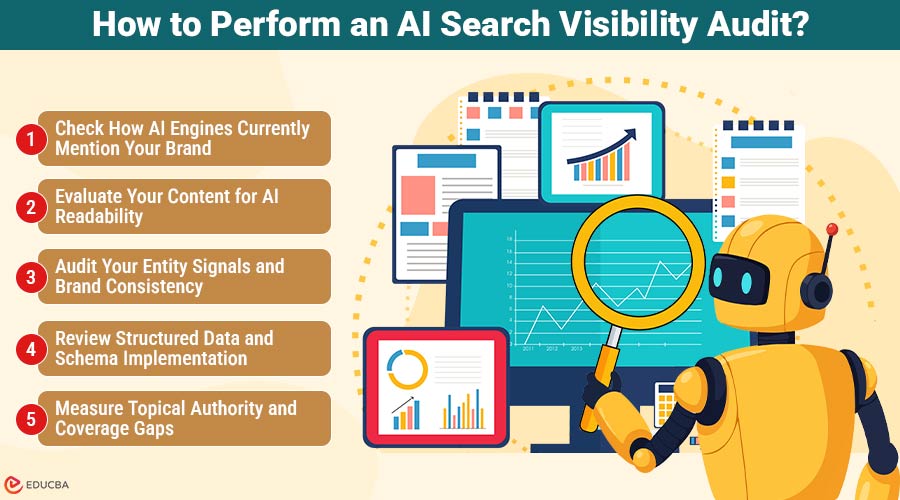
How to Perform an AI Search Visibility Audit?
Follow these steps to conduct a comprehensive AI search visibility audit and identify key areas for improvement.
1. Check How AI Engines Currently Mention Your Brand
Start by testing how major AI platforms respond to questions about your industry, product category, and brand name directly. Search for queries your target customers would ask and see whether your brand appears in the generated answer, is cited as a source, or is missing entirely.
Test across multiple AI platforms, including ChatGPT, Perplexity, Google AI Overviews, and Microsoft Copilot. Track where your brand appears, where it does not, and which competitors’ AI systems cite instead. This baseline gives you a clear picture of your current AI visibility gaps.
2. Evaluate Your Content for AI Readability
AI engines prefer content that is clear, structured, and answers questions directly. Review your core pages, service pages, and blog content to assess their Readability score from AI. AI systems overlook content that buries answers in long paragraphs, uses vague language, or lacks logical structure, and favor clearer alternatives.
Focus your evaluation on these areas:
- Whether your pages answer specific user questions clearly and early
- Check whether your content uses a logical structure with descriptive headings
- Whether each page has a clear topical focus with enough depth
- Whether sentences are concise and scannable by machine processing
3. Audit Your Entity Signals and Brand Consistency
Entity recognition is one of the most important signals in AI search. AI engines need to clearly understand who your brand is, what it does, and how it relates to other entities in your industry. If your brand is described inconsistently across your website, AI models may fail to recognize it as a defined, trustworthy entity.
During your audit, ensure your brand name, description, and core offerings remain consistent across all pages. Evaluate internal linking to ensure related pages reinforce topical relationships. Also, review how your brand appears in third-party sources such as directories, partner pages, and press coverage, as these external references help AI engines validate your entity.
4. Review Structured Data and Schema Implementation
Structured data acts as a direct communication layer between your website and AI systems. Schema markup tells AI engines exactly what your content represents, whether it is a product, service, article, review, FAQ, or organization. Without a proper schema, AI models must guess the context of your content, which lowers accuracy and reduces the likelihood of citations.
Audit your schema implementation by checking for missing markup on key pages, errors in existing schema code, and opportunities to add relevant schema types that you have not yet used. Pay particular attention to the Organization, Product, FAQ, Article, and BreadcrumbList schema, as AI answer engines commonly use them to understand brand context.
5. Measure Topical Authority and Coverage Gaps
AI engines favor brands that demonstrate deep subject expertise. If your content covers only surface-level topics or has significant gaps in key subject areas, AI systems will turn to more comprehensive sources. A topical authority audit maps your existing content against the full range of topics your audience asks about.
Identify which questions your brand can answer authoritatively and which areas remain underserved on your site. Filling these gaps with well-structured, expert content deepens your topical coverage and signals to AI engines that your brand is a reliable source in your field.
Common AI Visibility Issues Found During Audits
Most brands discover similar patterns when they first audit AI search visibility. Understanding the most common issues helps prioritize fixes and allocate resources effectively.
- Content optimized for keywords rather than direct question-answering
- Brand entity described differently across key pages
- Missing or broken schema markup on product and service pages
- Thin content on high-priority topics that AI models skip
- Weak internal linking that fails to reinforce topical relationships
- No FAQ content that matches common AI search queries
Each of these issues directly reduces the likelihood that AI engines will cite your brand. Identifying and fixing them is the core purpose of an AI visibility audit.
How Addlly AI Simplifies AI Search Visibility Auditing?
Here is how Addlly AI streamlines the AI search visibility audit process and delivers actionable insights.
1. Purpose-Built for AI Search Environments
Addlly AI evaluates how AI-powered answer engines perceive and cite brand content. Unlike traditional SEO tools that focus on Google rankings, Addlly AI focuses on the signals that determine AI visibility. This makes it one of the most relevant AI visibility tools available for brands operating in 2026’s AI-first search landscape.
2. Clear, Actionable Audit Findings
Addlly AI translates complex AI visibility data into clear, prioritized recommendations. Instead of overwhelming teams with technical reports, it highlights what needs to change, why it matters, and how to fix it. This makes AI visibility improvements accessible even to marketing teams without deep technical SEO knowledge.
3. Ongoing Visibility Tracking
A one-time audit is not enough. AI search systems evolve continuously, and content that performs well today may become less effective as AI models update. Addlly AI supports ongoing monitoring so brands can track progress, measure citation improvement, and stay aligned with how AI search is developing over time.
What to Do With Your AI Search Visibility Audit Results?
Audit results are only valuable when acted upon. Once you have completed an AI search visibility audit, the next step is to build a structured improvement plan based on what you find.
Prioritize improvements using these steps:
- Start with high-traffic pages that have the greatest AI citation potential
- Rewrite content to lead with clear, direct answers to user questions
- Standardize brand and entity language across all core pages
- Implement or fix schema markup on service, product, and FAQ pages
- Build out topical content to close coverage gaps identified in the audit
- Set a schedule for quarterly re-audits to maintain alignment with AI search evolution
Treat the audit as the beginning of an ongoing strategy, not a one-off task. AI search visibility compounds over time when brands consistently improve content quality, entity clarity, and structured data coverage.
Final Thoughts
AI search is no longer a future trend. It is the current reality of how consumers find brands, compare options, and make decisions. If your brand is not visible in AI-generated answers, you are missing a growing share of discovery that traditional SEO cannot recover. Auditing your AI search visibility in 2026 is the most important step you can take to understand where you stand and what needs to change. By evaluating content readability, entity clarity, schema implementation, and topical authority, you gain a clear path to becoming a brand that AI engines trust and cite. Tools like Addlly AI make it easier to conduct and act on your AI search visibility audit, helping you build long-term visibility in an AI-first search landscape.
Frequently Asked Questions (FAQs)
Q1. What is an AI search visibility audit?
Answer: An AI search visibility audit is a structured review of how AI answer engines such as ChatGPT, Perplexity, and Google AI Overviews interpret and cite your brand’s content. It identifies gaps in entity clarity, content structure, schema markup, and topical authority that prevent your brand from being included in AI-generated responses.
Q2. How is a GEO audit different from an SEO audit?
Answer: An SEO audit evaluates factors that affect Google rankings, such as backlinks, page speed, and keyword usage. A GEO audit evaluates how AI systems read, understand, and trust your content. It focuses on clarity, entity recognition, structured data, and semantic depth rather than traditional ranking signals.
Q3. How often should I audit AI search visibility?
Answer: Audit AI search visibility every three to six months. AI systems evolve regularly, and content strategies that work today may become less effective as AI models update their evaluation methods. Regular audits ensure your content stays aligned with current AI search standards and maintains citation frequency.
Q4. Can small businesses benefit from an AI visibility audit?
Answer: Yes. Small businesses often compete in niche categories where AI citations can drive significant discovery. An AI visibility audit helps small brands identify specific improvements that improve citation frequency without requiring large content budgets. Tools like Addlly AI deliver clear, actionable results for brands of all sizes.
Q5. What is the first step in auditing AI search visibility?
Answer: The first step is to test how major AI platforms currently respond to industry and brand-related queries. Run searches across ChatGPT, Perplexity, and Google AI Overviews to see where your brand appears, where it is missing, and which competitors are cited instead. This baseline assessment shapes the rest of your audit strategy.
Recommended Articles
We hope this guide on AI search visibility audit helps you improve your brand’s presence. Check out these recommended articles for more insights and strategies.


