
What is AI Orchestration?
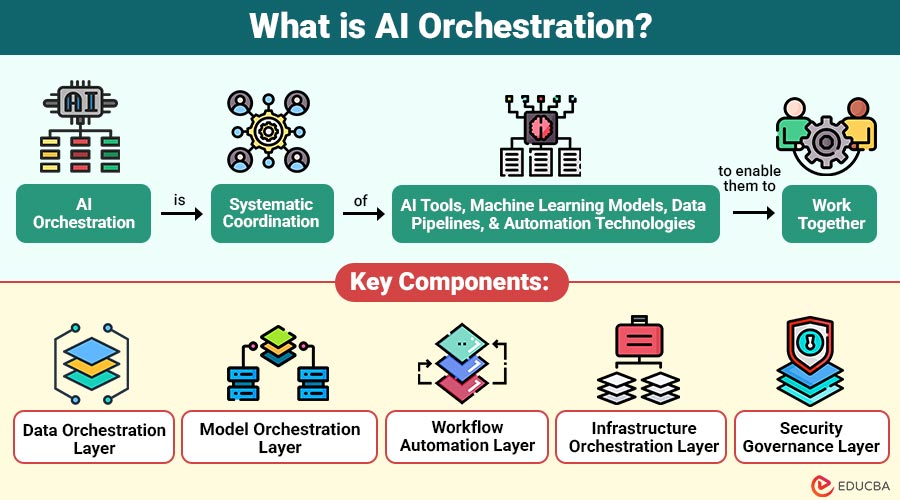
AI orchestration is the systematic coordination of AI tools, machine learning models, data pipelines, and automation technologies to enable them to work together. Instead of running multiple separate AI systems, orchestration brings them into a single governed flow.
It automates:
- Model selection
- Model execution
- Data movement
- Decision routing
- Task sequencing
- Monitoring and performance optimization
AI orchestration ensures that the right model or tool is triggered at the right time based on business logic, context, and policies.
Table of Contents:
- Meaning
- Why do Businesses Need AI Orchestration?
- Working
- Key Components
- Use Cases
- Benefits
- Challenges
- Tools
- Real-World Examples
Key Takeaways:
- AI orchestration coordinates models, data pipelines, and automation tools, enabling seamless, efficient, and governed AI workflows.
- It accelerates deployment, ensures governance, and optimizes resources, delivering faster, more accurate, and more scalable AI solutions.
- Orchestration connects many AI systems so businesses can make better decisions, personalize experiences, predict outcomes, and work more efficiently.
- Adopting AI orchestration transforms isolated AI experiments into enterprise-level value, providing a competitive advantage and measurable business impact.
Why do Businesses Need AI Orchestration?
Here are some key reasons why businesses increasingly rely on AI orchestration for efficiency and scalability:
1. Fragmented AI Ecosystems
Businesses use many models, tools, and platforms, causing scattered workflows that waste time, slow collaboration, and create operational inefficiencies.
2. Scaling AI is Difficult
As AI adoption grows, managing increased data, compute, storage, and infrastructure requirements becomes complex without coordinated, automated orchestration systems.
3. Ensures Uniform Governance
Orchestration enforces consistent rules for data access, security, compliance, and model management, ensuring standardized operations across all AI workflows.
4. Faster Time-to-Value
Automated start-to-finish workflows help build, deploy, improve, and watch over AI models faster, allowing companies to get results much quicker.
How AI Orchestration Works (Step-by-Step)
AI orchestration connects and automates all stages of the AI lifecycle:
1. Ingesting and Preparing Data
- Collects data from multiple sources
- Applies preprocessing & feature engineering
- Validates data quality
2. Triggering Model Training
- Chooses the right model or algorithm
- Allocates compute resources automatically
- Handles retraining schedules
3. Managing Model Deployment
- Deploys models to production environments
- Supports cloud, on-premise, and edge devices
- Uses CI/CD pipelines for updates
4. Monitoring and Feedback Loop
- Tracks model performance (accuracy, drift, latency)
- Sends alerts when thresholds cross
- Automatically retrains or rolls back models
5. Scaling and Optimizing Infrastructure
- Dynamically schedules CPU/GPU resources
- Automatically scales up or down
6. Ensuring Governance and Security
- Manages access control
- Logs audit trails
- Enforces compliance standards
Together, these steps create an automated, intelligent AI ecosystem.
Key Components of AI Orchestration
Here are the main key components, each handling a specific aspect of AI workflows and infrastructure:
1. Data Orchestration Layer
Manages data pipelines and ETL processes, ensures data quality, and handles smooth movement across multiple sources.
2. Model Orchestration Layer
Handles AI model training, retraining, and versioning, and monitors model performance for optimal results and efficiency.
3. Workflow Automation Layer
Creates complete AI pipelines with conditional logic, triggers, and event-based execution for automated workflows. In many enterprise setups, an AI Gateway platform sits alongside this layer to manage model routing, API access, traffic control, observability, and policy enforcement across multiple LLMs and AI services.
4. Infrastructure Orchestration Layer
Automates provisioning and scaling of compute resources across cloud, on-premises, hybrid, and edge environments efficiently.
5. Security and Governance Layer
Enforces data governance, regulatory compliance, audit logging, and access control across AI systems and processes.
Use Cases of AI Orchestration
Here are some use cases where AI orchestration streamlines processes and enhances efficiency:
1. Customer Service Automation
Orchestrates chatbots, LLMs, and sentiment analysis, automatically routing complex customer queries to human agents.
2. Fraud Detection
Connects real-time transaction data, runs anomaly detection models, and automatically triggers alerts for suspicious activity.
3. Predictive Maintenance
Coordinates sensor data, applies machine learning models to detect equipment failure, and triggers automated maintenance workflows.
4. Personalized Recommendations
Orchestrates user behavior data with recommendation engines, powering personalized content for e-commerce and OTT platforms.
5. Marketing Automation
Integrates campaign data, uses LLMs for content generation, and sends targeted, personalized messages to customers.
6. Supply Chain Optimization
Forecasts demand using predictive models, adjusts inventory levels, and automates procurement for efficient supply chain management.
Benefits of AI Orchestration
Here are the key benefits implementing across workflows and systems:
1. End-to-End Automation
Reduces manual effort across workflows, accelerates AI deployment, and streamlines operations to enable fully automated processes.
2. Cost Efficiency
Optimizes cloud and on-premises computing resources automatically, lowering operational expenses while maximizing AI infrastructure utilization.
3. Improved Accuracy
Minimizes human errors, ensures consistent model execution, and delivers reliable, precise results across all AI-driven workflows.
4. Faster Model Updates
Automatic retraining and version updates keep AI models fresh, accurate, and able to adjust when data changes.
5. Governance & Compliance
Maintains safe, secure, and regulated AI operations, enforcing policies, auditing activities, and ensuring adherence to compliance standards.
Challenges in AI Orchestration
Here are the main challenges organizations face when implementing AI orchestration effectively:
1. Integration Complexity
To ensure smooth AI orchestration across many systems, platforms, and tools, meticulous preparation, coordination, and technical know-how are required.
2. Data Quality Issues
Poor-quality, inconsistent, or incomplete data significantly reduces AI performance, even when sophisticated orchestration workflows are applied.
3. Managing Multiple Models
Handling multiple models requires version control, drift monitoring, and performance tracking to ensure reliable AI outcomes consistently.
4. High Initial Setup Cost
Establishing AI orchestration requires significant upfront investment in tools, infrastructure, cloud resources, and skilled personnel.
5. Governance Overhead
Regulatory and compliance requirements differ across industries, adding complexity and overhead to AI orchestration management processes.
Popular AI Orchestration Tools
Here are some widely used tools that streamline and automate AI and machine learning workflows:
1. Kubeflow
2. Airflow (Apache)
Workflow orchestration platform for managing, scheduling, and monitoring complex data and machine learning pipelines seamlessly.
3. Prefect
Modern orchestration tool offering low-code pipeline design, automation, and reliable execution for diverse ML workflows.
4. MLflow
Provides model tracking, experiment management, and deployment tools to streamline machine learning lifecycle operations effectively.
5. AWS Step Functions and SageMaker
A serverless orchestration tool that automatically runs and scales ML pipelines in the cloud without needing much infrastructure management.
Real-World Examples
Here are real-world examples of AI orchestration across various industries:
1. E-commerce
AI orchestration integrates multiple AI systems to streamline operations and enhance customer experience. Examples:
- Recommendation Engines—Orchestrates product suggestions based on user behavior and purchase history.
- Price Optimization Models – Dynamically adjust pricing across products and regions to maximize profitability.
- Customer Segmentation—Groups customers based on demographics, purchase patterns, and engagement metrics.
- A/B Testing Pipelines—Automates experiments to test UI, offers, and promotions effectively.
2. Banking & Financial Services
Ensures seamless operation across risk, compliance, and customer engagement systems:
- Credit Scoring Models—Combines multiple models to assess creditworthiness in real-time.
- Fraud Detection Pipelines – Integrates monitoring, anomaly detection, and alert systems for instant fraud prevention.
- Risk Profiling—Aggregates data from trading, lending, and market risk models to create comprehensive profiles.
3. Logistics & Transportation
Orchestration improves efficiency and delivery accuracy across AI-driven systems:
- Route Optimization—Combines traffic predictions, weather forecasts, and delivery priorities for optimal routing.
- Fleet Management—Monitors vehicle health, fuel efficiency, and predictive maintenance using multiple AI models.
- Demand Forecasting—Integrates historical data and real-time orders to plan warehouse and transportation needs.
Frequently Asked Questions (FAQs)
Q1. Is AI orchestration the same as machine learning operations (MLOps)?
Answer: Not exactly. MLOps focuses on lifecycle management of ML models. AI orchestration is broader—it coordinates ML models, LLMs, workflows, APIs, and infrastructure.
Q2. Does AI orchestration work with large language models?
Answer: Yes. It manages prompt flows, retrieval, agents, memory, and tool usage.
Q3. What skills are needed to implement AI orchestration?
Answer: Teams typically need skills in data engineering, DevOps, MLOps, cloud platforms, automation workflows, and model management.
Q4. Is AI orchestration expensive to implement?
Answer: Initial setup can be costly, but long-term savings come from automation, reduced errors, optimized resources, and faster deployments.
Final Thoughts
AI orchestration is the backbone of modern intelligent systems. It ensures seamless coordination between data pipelines, ML models, LLMs, automation tools, and infrastructure. As more industries start using AI, orchestration helps them launch AI faster, scale it easily, follow rules, and run it reliably. Companies that use AI orchestration get a big competitive edge because it turns AI from small experiments into real, large-scale business value.
Recommended Articles
We hope that this EDUCBA information on “AI Orchestration” was beneficial to you. You can view EDUCBA’s recommended articles for more information.


