


Overview
Candidates who practice with AI interview simulators are 3.7x more likely to reach the final rounds. Not 10% more likely. Not “slightly better.” Nearly four times. And it makes sense when you think about it. Most people prepare for interviews by reading questions from a blog and mumbling answers to themselves. That is not practice. That is wishful thinking. This piece covers what AI mock interview tools actually do in 2026, which interview types they benefit most, and where they fall short.
What Counts as a High-Stakes Interview?
Not every interview qualifies. A 30-minute chat with a recruiter over Zoom? Stressful, sure. But you will get another shot at a different company next week. High-stakes is different. It means:
| Trait | What it really means |
| One shot | If they reject you, you may have to wait months before you can try again. |
| Compressed time | The interview may last only a few minutes. |
| Expensive failure | You lose time, money, and sometimes long-term opportunities. |
Job interviews at top companies fit here. University admissions at Oxford or Johns Hopkins. Scholarship finals for Fulbright or Chevening. And then there are visa interviews — a US consular officer looks at your file, asks three questions, and decides your future in under five minutes.
The problem with all of these: knowing the “right answers” does not help much when a real person is staring at you, asking follow-ups you did not expect, and making a judgment call based on how confident you sound.
How an AI Mock Interview Works in 2026?
Early AI interview tools were basically flashcard apps with a microphone icon. You would pick a question, read a model answer, and maybe record yourself. Not that different from practicing in front of a mirror. The current generation is a different animal. Here is what a session actually looks like:
Step 1. You Talk Out Loud
Do not type. The AI uses speech recognition, and this distinction matters more than people realize. It conducts interviews. The skills you need — thinking on your feet, managing your pace, not saying “umm” twelve times — only develop when you actually open your mouth.
Step 2. The AI Listens and Pushes Back
You mention you picked a university for its “great program.” It asks which program. You say computer science. It asks what specifically about the CS department. You mention a professor. It asks about their research. This back-and-forth is what separates a useful tool from a PDF with questions.
Step 3. You Get a Real Report
Not just “good job” or “needs improvement” — but specifics:
- You hesitated at the 40-second mark
- Your answer about funding contradicts what you said earlier about your sponsor
- You used 14 filler words in a 3-minute session
- Your response to “why this university” could apply to any school — too generic
Some tools now do video analysis, too —tracking eye contact, posture, and facial expressions. Personally, I think voice-based is the sweet spot for most people. Video adds useful data but also adds friction (webcam, good lighting, quiet room). Voice works from your phone at 11 PM. That accessibility matters.
Worth Noting:
If a tool only lets you type your answers, skip it. You are practicing essay writing, not interview skills. Completely different muscles.
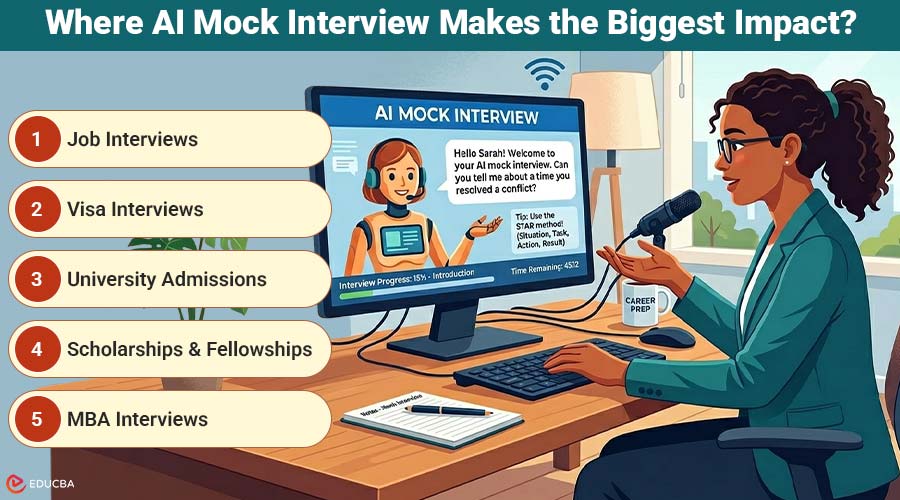
Where AI Mock Interview Makes the Biggest Impact?
Not every interview benefits equally. Here is where the gap between “prepared” and “unprepared” is widest.
1. Job Interviews
This is where the market started and where you will find the most options. Final Round AI, Interview Sidekick, LockedIn AI, Interviews.chat — there is a tool for pretty much every role now. The biggest win? Behavioral questions.
Everyone knows about the STAR method — Situation, Task, Action, Result. Simple enough in theory. In practice, under pressure, most people spend two minutes rambling about the Situation, then rush through the Result in 15 seconds. Or they tell a story that does not actually answer the question.
AI catches this immediately:
- “Your answer did not include a measurable result.”
- “You spent 70% of your response on context.”
- “The story you told does not address the leadership aspect of the question.”
That kind of feedback, after a few sessions, rewires how you structure your answers. For technical rounds — coding, system design, case studies — the tools simulate real problems with time pressure. Way better than asking your roommate to quiz you from a textbook.
2. Visa Interviews
Most people do not even think about practicing for a visa interview. They prepare documents, complete the DS-160, book an appointment, and walk in, hoping for the best. That is a mistake. And the numbers show it. The F-1 student visa rejection rate hit 41% in FY 2024 — the highest in ten years. For Indian applicants, it has gotten worse through 2025. One guy on Reddit described getting his 214(b) rejection slip handed to him before he even finished his first answer. Ten seconds. Done.
Here is why visa interviews are actually the best use case for AI practice:
- The officer reacts to YOU: Mention a scholarship? They will drill into your funding details. Mention a professor? They want to know the lab, the research, and the specific project. Say something vague? They move to the next question — or print the denial.
- Contradictions kill applications: Your DS-160 says your uncle is sponsoring you. In the interview, you mentioned your father’s savings. Officers are trained to spot that mismatch, making it a clear red flag. Good AI tools flag these contradictions before you sit in front of a real officer.
- How you say it matters as much as what you say: Confidence is not just a nice-to-have — officers use it as a signal. Hesitation and nervous pauses make them wonder what you are hiding.
There are now tools built specifically to practice for an AI visa interview simulator that cover F-1, B1/B2, H-1B, and other visa types, with questions pulled from what officers actually ask. Not generic career questions with a “visa” label slapped on top. Candidates who do 5-10 practice sessions walk in with noticeably better composure.
Important Distinction:
Visa interview prep ≠ job interview prep. A job interviewer wants to know if you can do the work. A visa officer wants to know whether you will return home. Completely different evaluation. Use a tool that understands this.
3. University Admissions
Oxford, Cambridge, medical schools — these interviews test how you think, not what you have memorized. An interviewer might ask a physics applicant to estimate the number of piano tuners in London. There is no “right answer.” They want to watch your brain work.
AI tools for this are newer and less mature than job-interview tools, but they are getting more interesting. The good ones throw genuinely unexpected questions and evaluate your reasoning process, not just your conclusion.
4. Scholarships and Fellowships
Fulbright, Rhodes, Chevening — the interview stage is where most shortlisted candidates fall. You made it past the application. Your CV is strong. Now they want to see if you can articulate your vision in person without sounding like you memorized a script.
The irony: the most prepared candidates often sound the most rehearsed. AI practice helps you find the balance — structured enough to be clear, natural enough to be believable.
5. MBA Interviews
“Tell me about a time you led through ambiguity.” “Why our program?” “What will you contribute to the cohort?”
Every MBA applicant prepares answers for these. The problem is that interviewers can tell. A good AI mock tool pushes back — “Can you be more specific?” “What was the actual outcome?” — and forces you past the surface-level version of your story.
Quick Checklist: Are You Interview-Ready?
Before booking a session with any tool, gut-check yourself:
- Can you explain your purpose (job/visa/program) in under 30 seconds?
- Have you said your answers out loud at least once?
- Do your interview answers match what is on your application/resume/DS-160?
- Can you handle a follow-up question without freezing?
- Have you timed yourself? (Most people talk too long)
If you checked fewer than 3, you need practice. That is exactly what these tools are for.
Picking the Right AI Mock Interview Tool
The market is getting crowded. Here is a quick filter:
| Your Situation | What to Look for | Red Flag |
| Job interview prep | Role-specific questions, STAR feedback, technical rounds | Same questions for every role |
| Visa interview prep | Visa-type scenarios, adaptive follow-ups, and contradiction checks | Generic job interview tool with “visa mode” |
| Admissions | Reasoning-based questions, academic probing | Only behavioral questions |
| Confidence practice | Voice practice, pacing analysis, filler-word detection | Text-only input |
What Things Cost in 2026?
- Free Tiers: Google Interview Warmup is decent for basics. Many tools offer 1-3 free sessions. Good enough to see if AI practice clicks for you.
- Budget ($5-20/month): Unlimited practice sessions. This is where most people should start. Enough for serious prep without overpaying.
- Premium ($30-50/month): Video analysis, role-specific coaching, detailed analytics dashboards. Consider it worthwhile if you are interviewing at top-tier companies or have already faced rejection.
Honestly, even the free tiers of most tools give you more useful practice than reading “top 50 interview questions” articles ever will.
Where AI Prep Falls Short?
While powerful, an AI mock interview is not perfect:
- You still need to know your stuff: If you cannot explain your research interests or your funding plan, no amount of delivery coaching will save you. The tool polishes how you present — it does not create the substance.
- Real humans are weird: They interrupt. They go on tangents. They have moods. One visa officer might be warm and chatty; the next, cold and rapid-fire. AI gets you maybe 80% of the way there. The remaining 20% is just… being a human talking to another human.
- No tool guarantees results: Sometimes you do everything right and still get denied. That happens. What the tools do is dramatically reduce avoidable failures — those caused by poor structure, lack of practice, or unforced errors.
The Honest Take:
AI mock interviews are a rehearsal space, not the whole show. For visa interviews, you still need your documents in order. In job interviews, you still need to research the company. For admissions, you still need subject knowledge. The AI is where you practice presenting all of that under pressure. Do not skip the other parts.
Final Thoughts
The people who walk into high-stakes interviews feeling calm are not the ones with the most impressive degrees or the biggest financial backing—they are the ones who have practiced. Out loud. Under pressure. With something actively challenging their answers. In the past, that kind of preparation required an expensive coach or a very patient friend. Today, an AI mock interview can deliver the same experience in just 20 minutes.
The worst way to prepare for any interview is to show up unprepared. The second worst is to read sample answers the night before and hope you remember them. What actually works is simple: practice your answers out loud, identify where you struggle, improve them, and repeat the process. An AI mock interview helps you do exactly that. Most tools offer free tiers, and the results speak for themselves. The risk of trying one is minimal. The real risk lies in not practicing—especially when rejection rates for high-stakes interviews, such as F-1 visa interviews, continue to rise.
Recommended Articles
We hope this guide to AI mock interview strategies helps you prepare with confidence. Check out these recommended articles for more insights and proven techniques to succeed in high-stakes interviews.

