


The Role of AI in .NET Development Company
Artificial Intelligence is an emerging trend in modern .NET development, rapidly impacting operations, innovation, and the delivery of business solutions. With AI-driven tools and frameworks widely available, development teams can streamline processes, improve code quality, and accelerate project delivery. Intelligent automation and predictive analytics influence every stage of the software lifecycle. Technologies like ML.NET, Azure Cognitive Services, and AI-driven DevOps practices open new paths for efficiency, scalability, and performance in AI in .NET development. As businesses increasingly demand smart, intuitive applications, AI has become a key driver of modernization and competitive advantage in the .NET development landscape.
AI-Powered Development Workflows
AI-driven development workflows are changing how modern Software Development Companies create value in .NET projects, making them faster, wiser, and more reliable. These AI-powered code-generation and refactoring tools help developers automate routine work and focus on tackling complex business challenges. Intelligent assistants speed up coding by suggesting actions that reduce human error. AI-driven testing automatically finds bugs and generates test cases that optimize debugging for software quality.
In DevOps, AI improves the performance of Continuous Integration/Continuous Deployment pipelines by predicting failures and optimizing deployment schedules, among many other things, much more smoothly. This boosts productivity and helps .NET development teams build fast, scalable applications much sooner. Because AI keeps improving, it fits naturally into development workflows, helping companies stay competitive, innovate faster, and deliver excellent digital solutions.
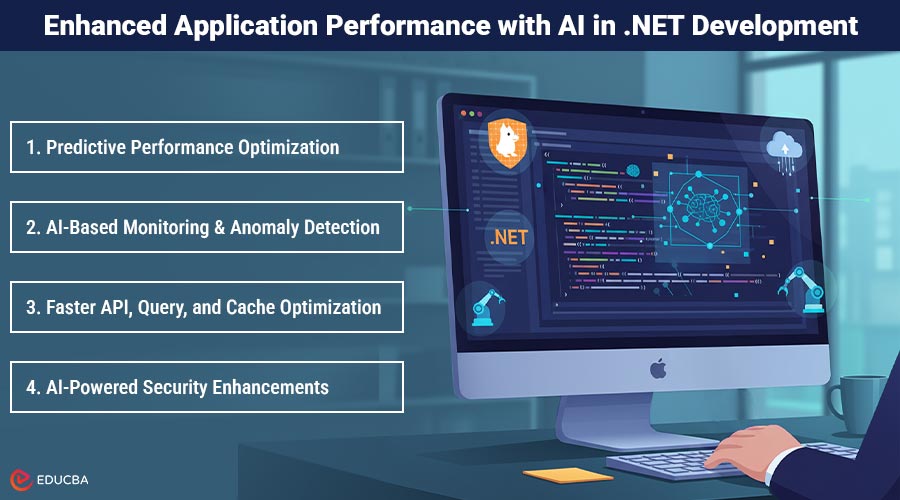
Enhanced Application Performance with AI in .NET Development
AI is becoming a key component for improving the performance and reliability of applications developed by modern .NET companies. Performance optimization is now a major differentiator for organizations offering .net development services.
1. Predictive Performance Optimization
Machine learning models help:
- Identify system bottlenecks
- Understand user behavior
- Optimize resource allocation
This ensures applications remain fast, scalable, and user-friendly.
2. AI-Based Monitoring & Anomaly Detection
AI-driven monitoring tools allow a .NET development company to:
- Detect anomalies in real time
- Prevent application downtime
- Automate configuration adjustments
- Improve load balancing
This leads to higher system stability, even during peak usage.
3. Faster API, Query, and Cache Optimization
For an ASP.NET development company, AI improves:
- Database query optimization
- Smart caching
- API response speed
Predictive analytics also anticipates traffic spikes, enabling systems to stay prepared and maintain consistent performance.
4. AI-Powered Security Enhancements
AI strengthens application security through:
- Real-time threat detection
- Rapid vulnerability analysis
- Automated patch suggestions
This helps safeguard .NET applications against evolving cyber threats.
Business Impact of AI in .NET Development Company
AI offers significant business benefits to every modern development company in many ways, from building to delivering and maintaining software. Quicker times, improved code quality, and more reliable applications are what this means to an ASP.NET development company. AI-powered tools also support predictive analytics, helping businesses anticipate user needs, optimize performance, and reduce operational costs.
Increased personalization is enabled by AI, allowing the creation of customized software solutions to meet highly specific business needs. It also increases system stability through AI-powered testing and monitoring, reducing downtime and improving customer satisfaction. Basically, adding AI to any .NET development company improves project accuracy, uses resources more efficiently, and helps teams make better decisions. AI also helps a .NET company stay competitive, keep innovating, and deliver high-value digital solutions to clients.
Future Trends of AI in .NET Development
The future of both AI and .NET development is moving fast, bringing new opportunities for ASP.NET development companies willing to stay on the edge. With ever-improving AI capabilities, .NET development companies are increasingly using generative AI to automate more coding, improve test coverage, and handle smarter, more complex integrations, enabling quicker development cycles and even more intelligent application behaviors. Another growing trend is automated development pipelines, where AI handles CI/CD tasks, predicts problems, and improves deployments.
Businesses looking for the best .NET development company will prefer those that use AI-powered microservices, serverless architecture, and advanced machine learning models built with ML.NET and Azure AI. These companies offer customized .NET development and use AI to create more personalized, data-driven solutions from predictive analytics to smarter, AI-enhanced user experiences. As AI continues to reshape the .NET world, the companies that adopt these technologies will lead the next wave of digital innovation.
Final Thoughts
AI is redefining what a modern .NET development company can achieve. With predictive analytics, intelligent automation, and machine learning, teams can now deliver solutions that are faster, smarter, and more scalable. From performance optimization to strengthened development workflows, AI in .NET development empowers professionals to build applications that align with dynamic business needs.
As more organizations adopt AI-driven techniques, the .NET ecosystem will continue to evolve becoming more innovative, efficient, and impactful. AI is not just an addition; it is a transformative force shaping the future of .NET development and elevating the value companies deliver to their clients.
Recommended Articles
Explore more insights on AI in .NET development by checking out these recommended articles to help you enhance your digital solutions and stay ahead in the evolving tech landscape.


