


Updated September 3, 2026
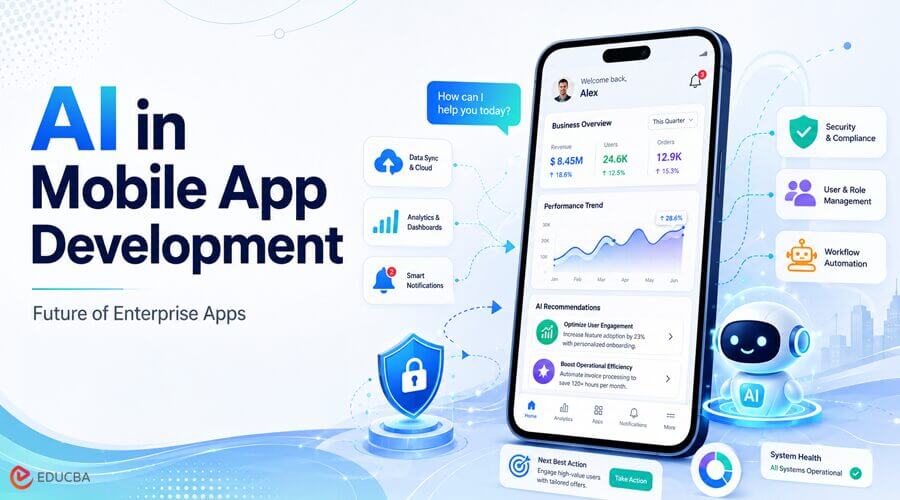
Not long ago, enterprise mobile apps were basically digital stand-ins for paperwork. They let employees check a box, gave customers a way to log in and pay a bill, maybe helped a team message each other. That was the bar. It is not anymore.
Today, businesses expect their apps to actually understand the people using them, learn from data, make decisions on their own, and get better every time someone opens them. This shift has made AI in Mobile App Development an increasingly important part of modern enterprise technology strategies.
That expectation is driving demand for intelligent mobile applications across nearly every industry. AI is no longer a bonus feature bolted on at the end of a project; it is often the engine driving the product. Predictive analytics, conversational interfaces, personalized recommendations, workflow automation- these have quietly become table stakes rather than differentiators. As mobile app development trends keep shifting, companies are less focused on “does the app work” and more on “does the app adapt.”
Why AI in Mobile App Development Matters More Now Than It Used To?
Businesses today are dealing with customers, markets, and internal operations that change faster than a static app can keep up with. A rigid application built around fixed rules and screens tends to fall behind quickly.
AI in Mobile App Development helps close that gap by pairing data with automation and machine learning, which tends to produce a few concrete benefits:
- More personalized experiences for each user
- Faster decision-making at the business level
- Less manual, repetitive work for staff
- Stronger customer engagement
- Smoother day-to-day operations
- Systems that improve the more people use them.
Instead of making users dig around for information or repeat the same steps every time, a good intelligent app anticipates the request, surfaces what is needed, automates what can be automated, and cuts out the friction in between.
Where AI is Actually Showing Up in Mobile Development?
The conversation around AI in Mobile App Development has moved well past chatbots. AI now touches nearly every stage of an app’s lifecycle.
- Personalization: Apps look at behavior, purchase history, and engagement patterns to shape what each user sees. Streaming services, eCommerce platforms, and banking apps have been leaning on this for a while now, largely because it keeps people coming back.
- Smarter search: Natural language processing means people can type or say something the way they would actually ask a friend, instead of guessing the right keywords. It is a small thing, but it removes a surprising amount of friction.
- Predictive recommendations: Machine learning is good at spotting patterns that a person would probably miss. That shows up in things like:
- Product recommendations
- Health care reminders
- Alerts for fraud detection
- Sales prediction
- Inventory management.
None of this is theoretical anymore; it is what makes AI-powered mobile apps genuinely useful rather than just a flashier version of the same old interface.
How is AI Making Enterprise Mobile Apps Smarter?
Large organizations are juggling thousands of employees, customers, suppliers, and moving parts at once. Older enterprise apps mostly just digitized the processes that already existed on paper. The newer generation goes further; they can:
- Flag equipment likely to fail before it actually does
- Suggest next steps for sales teams.
- Catch unusual financial transactions.
- Push approval workflows through automatically.
- Sort support requests by urgency.
The upshot is that businesses can react faster while spending less to do it. This is one of the biggest reasons enterprises are investing in AI in Mobile App Development rather than simply updating the visual design of legacy applications.
Enterprise App Modernization is Not Really Optional Anymore
A lot of companies are still running on systems built years ago, systems that were not designed with AI, or even much flexibility, in mind. That is why enterprise app modernization has become such a common thread in IT roadmaps: businesses are replacing legacy architectures with cloud-native platforms that support intelligent services.
Modernization projects often require a combination of AI expertise, cloud architecture, and user-centric design. As a result, organizations are increasingly relying on Mobile app development services to modernize legacy applications while ensuring they remain scalable, secure, and ready for future innovations.
That modernization work usually involves some combination of:
- Moving to cloud infrastructure
- Bringing in AI services
- Tightening up API connectivity
- Strengthening security
- Refreshing the UI
- Adding real-time analytics.
Most companies are not tearing everything down and starting over; they are modernizing in stages, which tends to be less disruptive and easier to budget for.
Building AI-Powered Apps Takes More Than Just AI
Here is the part that gets skipped over a lot: AI by itself does not make an app successful. You need a real mobile application strategy that ties the technology back to what the business is actually trying to achieve.
Successful AI in Mobile App Development requires businesses to think about the technology, data, infrastructure, user experience, and business objectives together.
Before any development starts, it is worth answering a few honest questions:
- What business problem is being addressed here?
- What data do we have available?
- How are we going to measure success?
- What are the user flows that are not working?
- Can we even implement it with our current infrastructure?
Skip that groundwork, and even the most advanced AI feature can end up delivering almost nothing.
Good Design Still Comes First
Adding intelligence to an app is supposed to make things simpler, not busier. One mistake that shows up constantly: burying users under recommendations, alerts, and “smart” features they never asked for.
A solid mobile app user experience is really just about helping people finish what they came to do, with as little friction as possible. In AI in Mobile App Development, this means designing AI features around actual user needs instead of adding AI simply because the technology is available.
That usually comes down to:
- Simple, predictable navigation
- Recommendations that are actually relevant
- Suggestions that respond to context
- Minimal typing or tapping required
- Speed
- Consistency across screens.
When AI is doing its job well, users notice the results, not the technology behind it.
It All Comes Back to Data Quality
Every intelligent system runs on data, full stop. If that data is messy, outdated, or incomplete, no machine learning model will produce anything useful.
Teams serious about intelligent app development usually spend more time than expected just cleaning and organizing data before any AI feature goes live. A few things worth getting right early:
- Data collection: Gather it ethically, and be upfront with users about what is being collected and why.
- Data security: Enterprise apps are handling sensitive business and customer information, so this is not optional.
- Ongoing monitoring: User behavior shifts over time, and models need regular updates to keep up; this is not a “set it and forget it” situation.
Automation is Becoming the Default, Not the Exception
Automation is quickly becoming one of the defining traits of next-generation mobile apps. Rather than having employees repeat the same manual steps day after day, these apps can:
- Generate reports on their own
- Schedule meetings
- Process invoices
- Sort and categorize support tickets
- Route customer requests to the right team
- Kick off workflows automatically.
By combining automation with AI in Mobile App Development, businesses can create applications that not only perform predefined tasks but can also identify patterns, prioritize actions, and support faster decision-making.
Different Industries, Different Priorities
Industry-specific knowledge becomes more relevant for enterprise mobile application development, since priorities are different from industry to industry:
- Health care focuses on diagnostic assistance and user engagement
- Financial services are highly concerned about risks and frauds
- Manufacturing is focused on predictive maintenance
- Retail is primarily concerned about customization and forecasting.
Generic app-building know-how only gets a team so far without that domain context. Successful AI in Mobile App Development requires businesses to align AI capabilities with the specific needs, risks, regulations, and workflows of their industry.
Smarter Apps, Better Business Calls
One of the clearer wins from smart mobile applications is how they turn raw business data into something people can actually act on. Executives do not need to wait around for a weekly report anymore; a good dashboard can hand them:
- Live Business Performance Metrics
- Predictive Business Forecasts
- Proactive Operational Alerts
- Customer Intelligence and Trend Analysis
- Actionable AI Recommendations.
This is where AI in Mobile App Development can deliver value beyond the user interface. AI-powered applications can transform large volumes of business data into insights that help organizations make faster and more informed decisions.
Long Release Cycles Are Fading Out
The old model of build it, ship it, leave it alone for a year does not really hold up anymore. Enterprise app development has shifted toward continuous, incremental improvement instead. That usually means regularly rolling out:
- New AI models
- Performance tweaks
- Security patches
- UX refinements
- Workflow improvements.
This constant iteration is what lets an app keep pace with customer expectations.
What Comes Next?
The next wave of AI mobile applications will lean further into context awareness, predictive capabilities, and increasing autonomy. Voice interaction, computer vision, edge AI, and real-time decision engines are already shaping how companies design their digital products, and that trend will only accelerate.
Those who invest in building scalable infrastructure, clean data, and proper AI integration today will be better prepared to adapt as technology continues to evolve. The point is not to build AI for its own sake; it is about solving real-life problems.
For organizations working through their own digital transformation, teaming up with an experienced partner for Mobile app development services can make it much easier to align AI capabilities with long-term business goals while building something that’s actually ready for whatever comes next.
Recommended Articles
We hope this guide helps you understand how AI in Mobile App Development is transforming enterprise applications, automation, personalization, and business decision-making. Explore these recommended articles for more insights into AI, mobile app development, enterprise software, automation, and digital transformation.


