
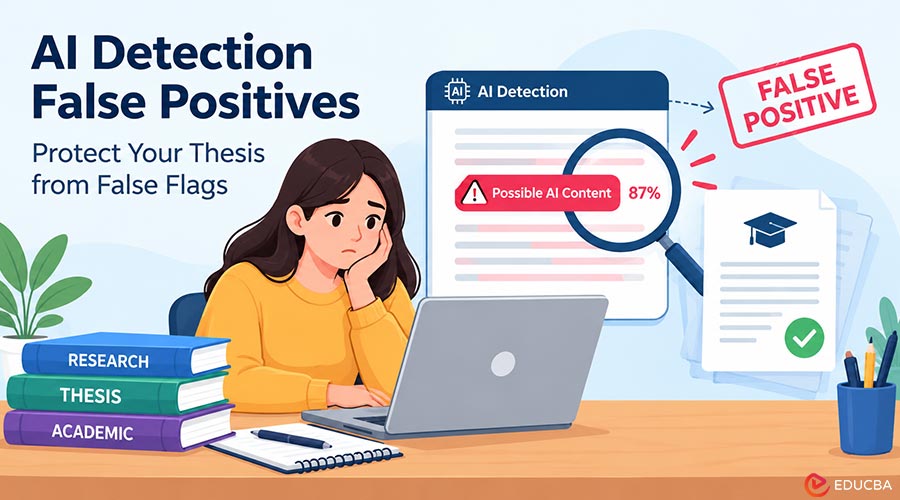
Imagine spending eight months on your thesis. You read the literature, collected the data, and rewrote the discussion chapter until midnight more times than you can count. Then an email arrives: your similarity report shows a high “AI-generated” score, and you are being asked to explain, yet you wrote every word yourself.
This is an example of AI detection false positives, a growing concern for students at universities around the world. As institutions adopt AI-detection software, a new kind of academic stress has appeared, affecting even students who complete their work independently. This article explains why AI detection false positives happen, who is most at risk, and how to build a thesis that is both strong and defensible. It also examines how thesis-writing services are adapting to this new reality.
Why Honest Writing Gets Flagged?
AI detectors do not “know” who wrote a text. They estimate statistical patterns, such as how predictable the word choices are and how uniform the sentence structure is. The problem is that polished academic writing often looks statistically similar to machine output. Several common habits can raise the risk of AI detection false positives:
- Formal, formulaic prose: Academic style rewards clear topic sentences, neutral tone, and standard phrasing. Those same qualities can be read as “predictable” to a detector.
- Heavy editing and paraphrasing tools: Grammar checkers and rewording tools smooth out the natural quirks of human writing, which can push a score upward even when the ideas are entirely yours.
- Writing in a second language: Research on detector accuracy has raised concerns that non-native English writers are flagged more often, because simpler, more constrained vocabulary can look “machine-like.” For international postgraduate students, this raises serious fairness concerns.
- Technical and methods-heavy sections: Descriptions of procedures, definitions, and standard statistical reporting follow conventions that leave little room for personal style.
- Short or highly structured passages: Detectors tend to be less reliable on small samples of text, yet a few flagged paragraphs can trigger a full review.
Detection vendors generally advise that scores should start a conversation, not prove misconduct. However, many students facing AI detection false positives find that the burden of proof falls on them.
The Real Cost of AI Detection False Positives
Even when a student is cleared, the process can be damaging. Delayed results, strained relationships with supervisors, anxiety before a defense, and in some cases formal misconduct hearings all take a toll. For students on scholarships or visa timelines, the stakes can be especially high.
That is why prevention matters. The best protection against AI-detection false positives is not to “beat the detector.” It is to leave a clear trail showing how your work came to exist.
Build a Defensible Thesis: A Practical Guide
- Keep your version history: Write in a tool that records revisions, such as Google Docs or Word with version history enabled. A visible record of your thesis growing over weeks and months is powerful evidence of authorship.
- Save your research trail: Keep your notes, annotated PDFs, search logs, reference manager library, and raw data files. A student who can show where each idea came from is hard to dispute.
- Write your own outlines and drafts first: Start with your own rough notes and arguments. Tools can help refine language later, but the thinking should be visibly yours.
- Use editing tools sparingly and transparently: If your university allows grammar or language tools, use them lightly and keep earlier drafts so you can show the before and after.
- Add your voice where the format allows: Reflective passages, justified methodological choices, and specific references to your own fieldwork are naturally personal and hard to confuse with generic text.
- Know your institution’s policy: Rules on AI tools vary widely. Some permit limited use with disclosure, and others prohibit it entirely. Read the policy, and if it is unclear, ask your supervisor in writing.
- Be ready to explain your work: If you ever face a query about AI detection false positives, the strongest response is the ability to discuss your methods, sources, and reasoning in detail. Practice explaining each chapter aloud.
How Professional Thesis Writing Services Fit In?
Reputable professional thesis writing services have adapted their approaches in response to concerns about AI detection false positives. The best ones focus on strengthening the student’s own work rather than simply producing text:
- Coaching students to develop and articulate their own arguments
- Editing and proofreading that preserves the author’s voice rather than flattening it
- Citation and reference checks that keep sources accurate and traceable
- Defense preparation so students can confidently discuss every page
- Support with false-positive appeals, including organizing drafting evidence and writing a clear, factual response
When evaluating any provider, ask how they protect your authorship and originality. A trustworthy service will welcome that question.
Final Thoughts
AI detection false positives remain a concern as universities expand their use of AI-detection software. Until detection technology improves and institutional policies become clearer, students need to be proactive: document the writing process, understand the rules, and stay prepared to explain their own research.
If you want expert help making your thesis stronger and more defensible, the right thesis writing services will guide your thinking rather than replace it. Keeping clear records of your research and drafting process can help you demonstrate your authorship if questions arise.
Disclaimer: AI detection tools may produce inaccurate results and should not be treated as definitive proof of academic misconduct. Students should follow their institution’s academic integrity policies and verify the rules regarding AI tools and external writing assistance.
Recommended Articles
We hope this guide helps you understand AI detection false positives and protect your thesis with clear evidence of your original work. Explore our recommended articles for more insights on academic writing, thesis preparation, research skills, and maintaining academic integrity.