
Updated April 25, 2026
What is Adversarial AI?
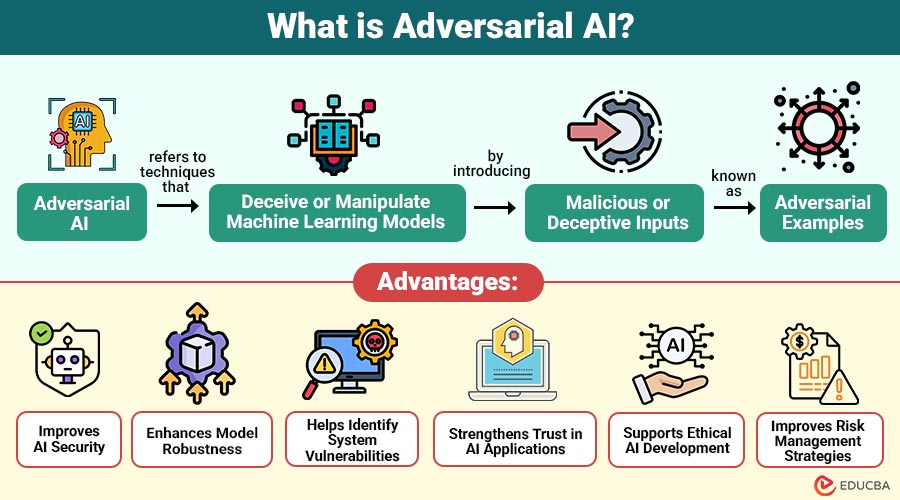
Adversarial AI refers to techniques that deceive or manipulate machine learning models by introducing malicious or deceptive inputs, known as adversarial examples. These inputs are designed to appear normal to humans but cause AI systems to make incorrect predictions or decisions.
For example, a slightly altered image of a stop sign might still look normal to a human but could be misclassified by an AI model as a speed limit sign, leading to potentially dangerous outcomes.
Table of Contents:
- Meaning
- Importance
- Working
- Types
- Key Components
- Techniques
- Advantages
- Challenges
- Real-World Examples
- Best Practices
- Future Trends
Key Takeaways:
- Adversarial AI exploits vulnerabilities in machine learning models by crafting malicious input data.
- It improves AI security robustness and trust by identifying and mitigating adversarial threats effectively.
- Adversarial AI works through evasion, poisoning, inversion, and model extraction attack techniques and methods used.
- Adversarial AI impacts critical systems such as healthcare, finance, and autonomous vehicles, posing serious risks.
Importance of Adversarial AI
Here are key reasons why adversarial AI is important in building secure and reliable artificial intelligence systems.
1. Protects Sensitive Data
Adversarial AI helps safeguard confidential information by identifying vulnerabilities, preventing data leaks, and reducing risks of unauthorized access or exposure.
2. Prevents System Failures
It minimizes risks of unexpected system failures by detecting adversarial threats early, ensuring AI systems operate accurately and consistently under diverse conditions.
3. Ensures Trust in AI Systems
By improving security and transparency, adversarial AI builds user confidence, ensuring systems behave reliably and ethically across real-world applications and environments.
4. Enhances Robustness and Reliability
Adversarial AI strengthens model resilience against attacks, improving stability, performance, and reliability even when exposed to malicious inputs or unpredictable scenarios.
5. Improves Model Generalization
Adversarial AI helps models learn diverse patterns, improving generalization and enabling better performance on unseen data across different real-world scenarios.
6. Supports Regulatory Compliance
It helps organizations meet data protection and AI governance regulations by ensuring models are secure, transparent, and resistant to adversarial threats.
How Does Adversarial AI Work?
Adversarial AI exploits vulnerabilities in machine learning models, particularly deep learning systems. These models rely on patterns in data, and attackers can manipulate these patterns in subtle ways.
Key Mechanisms:
1. Adversarial Examples
Small, carefully crafted changes are made to input data, causing models to misclassify outputs while the changes remain almost invisible to humans.
2. Model Evasion
Attackers design inputs that appear normal but exploit vulnerabilities, enabling them to bypass AI systems such as spam filters or fraud-detection mechanisms.
3. Data Poisoning
Bad or misleading data is added to training data. This makes models learn wrong patterns and give unreliable or biased results.
4. Model Extraction
Attackers repeatedly query a model, analyze its responses, and reconstruct a similar version, potentially stealing intellectual property or sensitive model behavior.
Types of Adversarial Attacks
Here are the main types of adversarial attacks used to exploit weaknesses in machine learning systems.
1. Evasion Attacks
Evasion attacks occur during inference when attackers subtly modify input data so machine learning models misclassify it without altering its intended meaning.
2. Poisoning Attacks
Poisoning attacks involve injecting malicious or misleading data into training datasets, causing models to learn incorrect patterns and significantly degrade overall performance.
3. Model Inversion Attacks
Model inversion attacks attempt to reconstruct sensitive training data by exploiting model outputs, revealing private information such as images, text, or personal attributes.
4. Membership Inference Attacks
Membership inference attacks aim to determine whether specific data points were used during training by analyzing model responses and confidence scores.
5. Transfer Attacks
Transfer attacks reuse adversarial examples crafted for one model to successfully attack another model, even when architectures, datasets, or parameters differ significantly.
Key Components of Adversarial AI
Here are the components that define how adversarial AI systems and attacks function.
1. Target Model
The target model is the machine learning system under attack, designed to perform predictions, classifications, or decisions based on input data.
2. Adversary
The adversary is an attacker or entity that intentionally exploits weaknesses in AI systems to manipulate outputs or gain unauthorized advantages.
3. Attack Strategy
Attack strategy refers to the specific technique used to deceive models, such as perturbations, data poisoning, or carefully crafted adversarial examples.
4. Defense Mechanism
Defense mechanisms are methods and techniques implemented to detect, mitigate, and prevent adversarial attacks, ensuring the robustness, security, and reliability of models.
Techniques to Defend Against Adversarial AI
Here are key techniques for improving the security and robustness of AI systems against adversarial attacks.
1. Adversarial Training
Adversarial training involves augmenting datasets with adversarial examples, enabling models to learn robust patterns and effectively resist malicious input manipulations.
2. Input Validation
Input validation checks incoming data for unusual or suspicious patterns. This stops harmful data from reaching and misleading models.
3. Model Regularization
Model regularization techniques reduce sensitivity to minor input variations, helping models generalize better and remain stable against adversarial perturbations and noise.
4. Defensive Distillation
Defensive distillation simplifies model decision boundaries, making it harder for attackers to exploit vulnerabilities and craft effective adversarial examples successfully.
5. Ensemble Methods
Ensemble methods combine predictions from multiple models, reducing reliance on a single system and improving resistance against adversarial attacks or manipulations.
Advantages of Adversarial AI
Here are the advantages of adversarial AI and its impact on modern machine learning systems.
1. Improves AI Security
Studying adversarial AI improves security. It helps find threats, reduce risks, and protect machine learning models from attacks.
2. Enhances Model Robustness
It enhances model robustness by enabling systems to handle noisy, manipulated, or unexpected inputs without significant performance or accuracy degradation.
3. Helps Identify System Vulnerabilities
Understanding adversarial techniques helps uncover hidden vulnerabilities in systems, allowing developers to address weaknesses and improve the overall resilience of AI systems.
4. Strengthens Trust in AI Applications
By improving reliability, security, and transparency, adversarial AI builds user trust, ensuring AI applications are dependable across critical industries and real-world scenarios.
5. Supports Ethical AI Development
Studying adversarial AI promotes ethical development by identifying biases, preventing misuse, and ensuring AI systems operate fairly and responsibly.
6. Improves Risk Management Strategies
It improves risk management by predicting possible attacks. This helps organizations prepare and reduce losses.”
Challenges of Adversarial AI
Here are the challenges faced in building and maintaining secure AI systems against adversarial threats.
1. Evolving Attack Techniques
Attackers constantly innovate new adversarial methods, making it difficult for security systems to keep pace and ensure long-term model protection.
2. Computational Complexity
Defending against adversarial attacks often demands high computational power, increasing costs, slowing performance, and requiring advanced infrastructure for effective implementation.
3. Lack of Standardization
There is no standard way to test adversarial robustness. This makes results inconsistent and hard to compare model security.
4. Trade-off Between Accuracy and Security
Enhancing model robustness against adversarial attacks can reduce prediction accuracy, forcing developers to balance security measures with overall model performance.
5. Limited Explainability
Adversarial defenses often lack transparency, making it difficult to understand how models respond to attacks and why certain predictions fail.
6. Data Dependency Issues
Adversarial robustness heavily depends on training data quality, and biased or insufficient datasets can weaken defenses against sophisticated adversarial inputs.
Real-World Examples
Here are practical examples that show how adversarial AI affects different industries and systems in real-world scenarios.
1. Autonomous Vehicles
Adversarial attacks alter road signs or lane markings, causing self-driving cars to misinterpret environments and make unsafe navigation decisions.
2. Facial Recognition Systems
Special accessories or small image changes can fool facial recognition systems. This can cause wrong identification or allow unauthorized access.
3. Healthcare AI
Manipulated medical images can deceive AI systems, leading to incorrect diagnoses, delayed treatments, or serious risks to patient health outcomes.
4. Financial Fraud Detection
Attackers create transactions that look normal to systems. This helps them avoid fraud checks and cause financial loss.
Best Practices for Handling Adversarial AI
Here are essential guidelines that help strengthen AI systems against adversarial threats and improve overall model security.
1. Regularly Update and Retrain Models
Continuously update and retrain AI models with new data to adapt against evolving adversarial attacks and maintain strong system performance.
2. Use Secure and Clean Datasets
Keep datasets clean, checked, and safe from changes. This prevents data poisoning and ensures reliable model training.
3. Implement Monitoring and Anomaly Detection
Deploy real-time monitoring and anomaly detection systems to identify unusual inputs or behaviors, enabling quick response to potential adversarial threats.
4. Conduct Penetration Testing on AI Systems
Regularly test AI systems by simulating attacks. This helps find weaknesses and improve protection.
5. Combine AI with Traditional Security Methods
Integrate AI-based defenses with traditional cybersecurity techniques to create layered security, effectively improving resilience against diverse adversarial attack vectors.
Future Trends in Adversarial AI
Here are key emerging developments that are shaping how adversarial AI will evolve and be managed in the future.
1. AI-Driven Defense Systems
AI models will detect and stop attacks in real time. This helps respond faster and improves overall security.
2. Explainable AI (XAI)
Improvements in explainable AI will make systems more transparent. This helps organizations understand decisions, find weaknesses, and build more trustworthy AI.
3. Regulatory Frameworks
Governments and organizations may introduce standardized regulations and policies to ensure the security, accountability, and ethical use of AI across industries globally.
4. Automated Threat Detection
Advanced AI systems will find, analyze, and stop attacks automatically. This reduces human effort and improves speed and accuracy.
Final Thoughts
Adversarial AI presents both risk and opportunity in modern artificial intelligence. It reveals system weaknesses while encouraging stronger, more resilient model design. As adoption grows, addressing adversarial threats becomes critical for safety and reliability. Organizations investing in proactive defenses can reduce risks, enhance trust, and fully leverage AI’s transformative potential across industries and real-world applications.
Frequently Asked Questions (FAQs)
Q1. Can adversarial attacks be prevented?
Answer: While not completely preventable, they can be mitigated using robust training and defense techniques.
Q2. Which industries are most affected?
Answer: Healthcare, finance, cybersecurity, and autonomous systems are highly impacted.
Q3. How do companies detect adversarial attacks?
Answer: Companies use anomaly detection, input validation, monitoring systems, and adversarial training techniques to identify and mitigate suspicious or malicious inputs effectively.
Recommended Articles
We hope that this EDUCBA information on “Adversarial AI” was beneficial to you. You can view EDUCBA’s recommended articles for more information.


