

Machine Learning
In machine learning, computer systems supply data sets and algorithms that allow for the autonomous acquisition of knowledge through identifying patterns within the provided data. These systems have various tasks, including image classification, natural language processing, speech recognition, and predictive analytics, with minimal human involvement. Machine learning has become increasingly popular in recent years, as advances in computing power and the availability of large amounts of data have made it possible to develop complex algorithms.
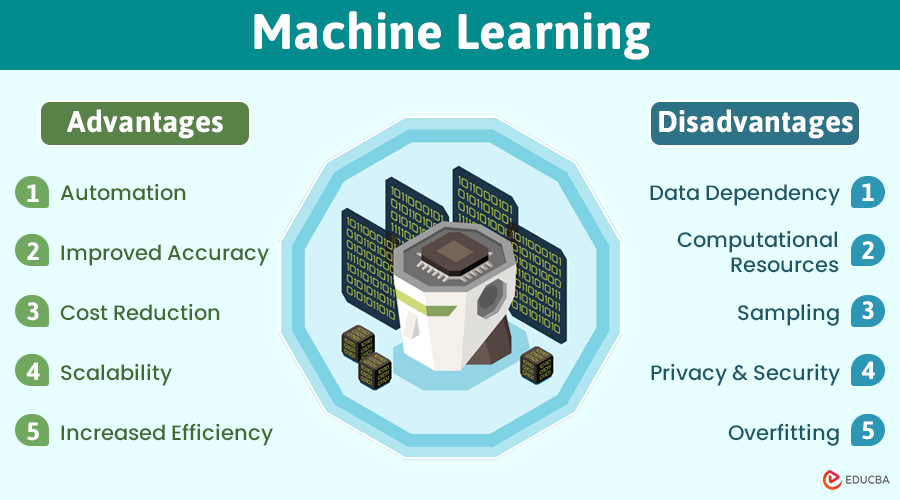
Advantages
#1 Automation
Machine learning algorithms automate analyzing and interpretation of data and can be used to build predictive models. It eliminates manual data analysis and allows organizations to make data-driven decisions quickly and accurately.
#2 Improved Accuracy
Machine learning algorithms employ pattern recognition techniques to analyze and extract meaningful insights from data, subsequently utilizing these insights to make more accurate predictions. It can be beneficial when dealing with large datasets or constantly changing data.
#3 Cost Reduction
Machine learning algorithms can automate specific processes, reducing labor costs and allowing organizations to focus on more value-adding activities. Additionally, machine learning algorithms often require fewer data and resources to operate, reducing costs.
#4 Scalability
Machine learning algorithms can often be scaled up to handle larger datasets, making them suitable for large-scale applications. It allows organizations to utilize machine learning algorithms to gain insights from their data without needing additional resources.
#5 Increased Efficiency
Machine learning algorithms can automate specific processes, reducing the time required to process and analyze data. It can improve overall efficiency and allow organizations to make more informed decisions.
Disadvantages
#1 Data Dependency
Machine learning algorithms are heavily reliant on data for performing any task. These algorithms require large amounts of data to learn and make accurate predictions. With the correct data, the results of a machine-learning model can be balanced and accurate.
#2 Computational Resources
Machine learning algorithms are computationally intensive and require a lot of resources to run. These algorithms can be expensive to train and require a significant upfront investment in hardware and software.
#3 Sampling
Creating a representative sample of the data is essential when using machine learning algorithms. If the sample is as different as expected, the model’s results can be biased accurately.
#4 Privacy and Security
Machine learning algorithms can also help uncover sensitive information from datasets. It means that there are potential privacy and security risks associated with using these algorithms.
#5 Overfitting
Overfitting occurs when a machine learning algorithm fits the data too closely, resulting in overly complex models that don’t generalize well to unseen data.
#6 Time Consumption
Training a machine learning algorithm can be a time-consuming process. Depending on the complexity of the given problem and the amount of data available, training can take anywhere from a few hours to several days.
#7 Black Box Problem
When using machine learning algorithms, it can be challenging to understand how the algorithm reached its decisions and predictions. It can make it difficult to debug and improve the model’s performance.
Tabular Comparison of Advantages and Disadvantages
|
Advantages Improved Accuracy and Efficiency: Machine learning algorithms can process large amounts of data and identify patterns that humans may not be able to detect. It can lead to more accurate predictions and improved efficiency in decision-making. Automation of Repetitive Tasks: Machine learning systems can automate repetitive and time-consuming tasks, freeing human resources for more complex and creative work. Real-time Processing: Machine learning systems can process and analyze data in real-time, which can benefit fraud detection or anomaly detection.
|
Disadvantages Data Quality: Machine learning models are only as good as the data they are working upon. The model’s predictions will also be excellent or narrow if the data is of good quality or biased. Limited Understanding: Machine learning systems can identify patterns and make predictions, but they may not be able to explain how or why they came to a particular decision on a given problem.
High computational cost: Machine learning requires a lot of data and computational power, which can be costly and time-consuming.
|
Conclusion
In this article, Advantages, and Disadvantages of Machine Learning, we have seen Machine learning can give businesses various advantages, including reducing the amount of human labor required, providing better accuracy and speed, and providing more accurate predictions. However, it can be expensive to implement, requires a lot of data to be effective, and can be challenging to maintain and update. Additionally, machine learning models can be vulnerable to bias and errors and difficult to interpret. Ultimately, machine learning can be a powerful tool for businesses, but the company needs to consider the advantages and disadvantages before investing in it.
Recommended Articles
We hope that this EDUCBA information on “Advantages and Disadvantages of Machine Learning” was beneficial to you. You can view EDUCBA’s recommended articles for more information,

