


Adaptive Study Techniques: Overview
Learning new skills has never been easier to start, and never harder to sustain. With numerous online courses, tutorials, and certifications available, many learners consume large volumes of information without retaining much of it over the long term. The challenge is no longer access to knowledge, but how effectively that knowledge is absorbed, applied, and remembered. This is where adaptive study techniques play a critical role.
As study habits evolve alongside technology, learners are increasingly experimenting with tools that support flexible learning styles, including solutions like tts that convert written material into audio for review during commutes or downtime. While helpful, tools alone do not solve the deeper issue. True skill retention depends on adopting adaptive study techniques that align with how the brain actually learns.
Why Traditional Study Methods Often Fall Short?
Many learners still rely on passive strategies such as rereading notes, highlighting text, or repeatedly watching lectures. While these methods feel productive, they often create an illusion of understanding rather than durable learning. The problem lies in how memory works. Information that people do not actively engage with tends to fade quickly.
Without retrieval, variation, and reinforcement, even well-understood concepts can disappear within days or weeks. This is especially true for professional skills that require application rather than memorization. Adaptive study techniques address this gap by adjusting how, when, and in what format learners engage with material.
Understanding Adaptive Learning At A Practical Level
Adaptive learning does not require advanced software or complex systems. At its core, it means responding to your own progress and difficulties rather than following a fixed study routine.
An adaptive learner regularly asks:
- Which concepts feel weak or uncertain?
- Which topics require more repetition or a different approach?
- How can material be revisited in varied ways?
By continuously adjusting focus based on performance, learners avoid wasting time on what they already know and concentrate on what truly needs reinforcement.
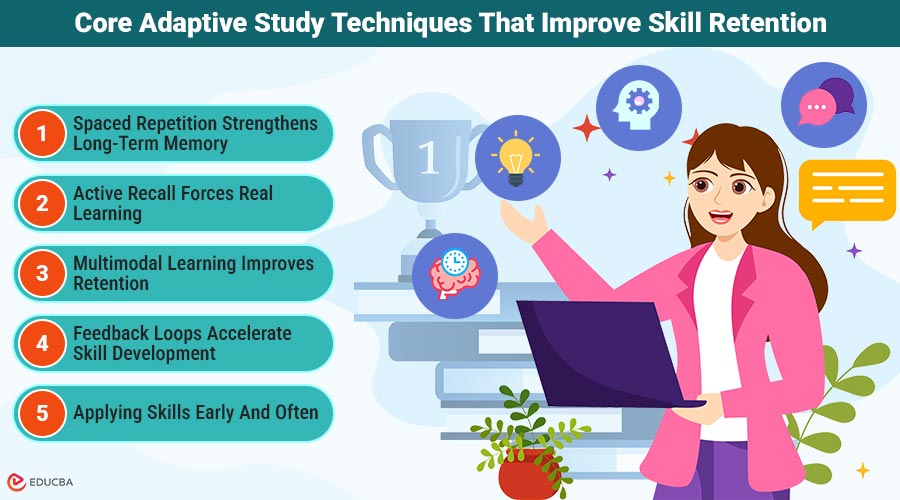
Core Adaptive Study Techniques That Improve Skill Retention
Here are the key points that demonstrate how these techniques enhance long-term skill retention.
1. Spaced Repetition Strengthens Long-Term Memory
Spaced repetition is one of the most effective adaptive techniques. Instead of reviewing information intensively in a short period, learners revisit it at increasing intervals. This approach works because it aligns with the brain’s natural forgetting curve. Each time you recall information just before you would forget it, the memory trace grows stronger and more resistant to decay.
You can apply spaced repetition to almost any skill:
- Revisiting key concepts from a course weekly and then monthly
- Scheduling brief reviews of notes instead of marathon study sessions
- Using reminders or prompts to recall information after delays
Consistency matters more than intensity.
2. Active Recall Forces Real Learning
Active recall involves retrieving information from memory without looking at notes. This could be answering questions, explaining a concept aloud, or writing down what you remember before checking accuracy. While more mentally demanding than passive review, active recall dramatically improves retention. Each retrieval attempt strengthens neural pathways associated with the knowledge.
Learners can practice active recall by:
- Summarizing lessons in their own words
- Teaching concepts to someone else
- Writing practice explanations or examples from memory
Discomfort during recall is a sign that learning is happening.
3. Multimodal Learning Improves Retention
People process information differently depending on the format. Combining multiple modes, reading, listening, speaking, and applying, creates richer mental representations.
Adaptive learners often reinforce concepts by switching formats:
- Reading a chapter, then listening to a summary
- Watching a demonstration, then writing a short explanation
- Practicing a skill, then reflecting on what worked and what did not
This variety prevents cognitive fatigue and enhances learning resilience. It also accommodates real-world constraints, allowing learners to study during moments that would otherwise go unused.
4. Feedback Loops Accelerate Skill Development
Without feedback, it is difficult to know whether learning is effective. Adaptive study relies on frequent, low-stakes feedback to guide improvement.
Feedback can come from:
- Practice tests or quizzes
- Peer review or discussion
- Self-assessment using clear criteria
The key is speed. Immediate or near-immediate feedback helps learners correct misunderstandings before they become ingrained. This is especially important for professional skills, where incorrect assumptions can persist unnoticed for long periods.
5. Applying Skills Early And Often
Retention improves significantly when learners apply new knowledge in realistic contexts. Application transforms abstract ideas into functional skills.
Even small applications matter:
- Writing a short project using a new concept
- Simulating scenarios related to the skill
- Solving real problems instead of theoretical examples
Adaptive learners do not wait until they feel “ready.” They test understanding early, identify gaps, and adjust study strategies accordingly.
6. Metacognition Helps Learners Learn Better
Metacognition, thinking about how you learn, plays a crucial role in retention. Learners who regularly reflect on what works and what does not can adapt more effectively.
Simple reflective questions include:
- Which study methods helped most this week?
- Where did confusion persist?
- What will I change next time?
Over time, this self-awareness leads to more efficient learning habits and fewer wasted hours.
What Research Says About Effective Learning?
Cognitive science consistently supports adaptive approaches. According to research summarized by the American Psychological Association, strategies such as spaced repetition, retrieval practice, and varied learning formats significantly outperform passive study methods for long-term retention.
These findings reinforce an important idea: effective learning feels harder in the moment but pays off over time. Adaptive techniques demand effort, but that effort produces durable skills rather than fleeting familiarity.
Building An Adaptive Study Routine
An adaptive study routine does not need to be complicated. A simple structure might include:
- Short, focused study sessions
- Regular retrieval practice
- Scheduled review at spaced intervals
- Periodic reflection and adjustment
The goal is flexibility, not perfection. Learning plans should evolve as skills improve and priorities shift.
Final Thoughts
Maximizing skill retention is not about finding the perfect tool or course. It is about developing the ability to adapt your learning based on feedback, performance, and context. Learners who embrace adaptive study techniques gain more than knowledge; they gain control over their learning process. In a world where continuous upskilling is essential, that ability becomes one of the most valuable skills. By shifting focus from consumption to adaptation, learners can ensure that what they study today remains useful long after the course ends.
Recommended Articles
We hope this guide on adaptive study techniques helps you boost your learning efficiency. Check out these recommended articles for more tips on mastering skill retention.

