


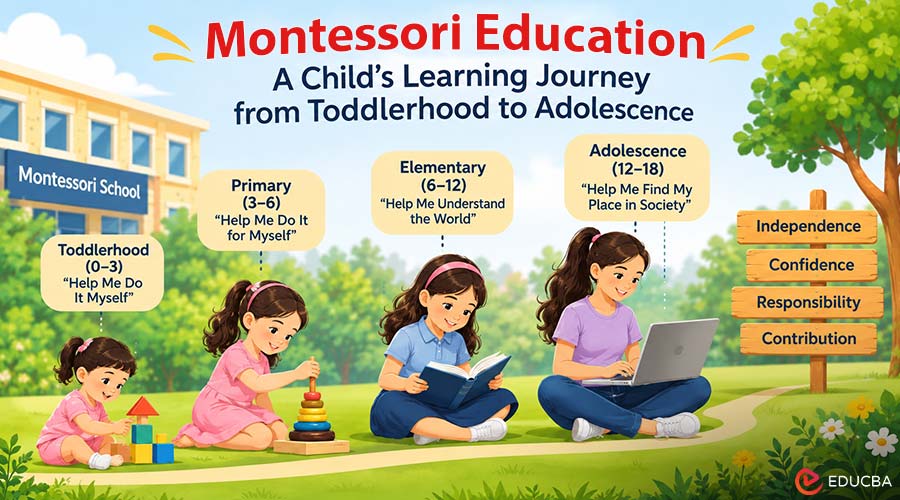
At two, pouring a glass of water may be a triumph; at nine, a child might want to understand where that water comes from. At fourteen, the question may be how a community can use water responsibly. The water has not changed. The learner has. This is why Montessori education was never intended to end at preschool.
Children do not simply need more difficult versions of familiar lessons as they grow. The questions they ask, the relationships they seek, and the responsibilities they can undertake change. The educational environment must change with them. For families exploring secondary Montessori education in Hyderabad, understanding that change from the beginning makes the later years easier to judge.
One Philosophy, Four Developmental Planes of Montessori Education
Maria Montessori described four broad planes of development: birth to six, six to twelve, twelve to eighteen, and eighteen to twenty-four. They are not rigid deadlines or school-grade divisions. They describe changing developmental needs.
The first plane is marked by the development of movement, language, and independence; the second by reasoning, imagination, and social awareness; the third by identity, belonging, and participation in society. The continuity lies in respecting the person at each stage, not in keeping the classroom the same.
Toddlerhood (0–3): “Help Me Do It Myself”
For a toddler, real work may mean carrying a cup, putting away footwear, or helping prepare food. These actions are not performances for adults. They allow a very young child to participate in family and community life, with movement, language, and growing independence developing together.
At Blue Blocks, the Toddler Community offers a rich range of experiences: purposeful movement and sensorial exploration, language through everyday conversations, caring for oneself and the environment, and first experiences of working alongside others. Children handle materials, practice familiar routines, and contribute to community life; preparing a shared fruit meal is one example, not their whole day. Settlement is gradual, and the move to the Self-Interpretive Environment follows observation of readiness rather than age alone. Throughout, adults provide attentive care while making room for meaningful participation.
Primary (3–6): “Help Me Do It for Myself”
The Montessori Primary Environment, also called the Children’s House, traditionally serves ages three to six. Practical Life, Sensorial, language, mathematics, and cultural work invite children to choose, coordinate, compare, explore, and return to meaningful activity. Familiarity gradually creates opportunities to organize a task from beginning to end, including restoring materials for the next person.
At Blue Blocks, this is called the Self-Interpretive Environment, serving children from approximately two and a half to six years across Nursery, PP1 and PP2. It is the school’s designation for its early-years setting, not a separate Montessori developmental plane. Guides observe children closely, offer appropriate presentations, and cultivate respect for self, others, and the environment.
Elementary (6–12): “Help Me Understand the World”
The Elementary child increasingly wants explanations. Why do societies make rules? How did people invent numbers? What makes a decision fair? Montessori associated this second plane with reasoning, imagination, a strong interest in peers and the beginnings of independent moral judgment.
Elementary education therefore cannot be the Primary environment with harder exercises. It invites children to investigate relationships between subjects, consult sources, test explanations and communicate what they discover. Research into a coral reef may draw on geography, biology, writing and mathematics. A study of an ancient civilization may begin with a story and become an extended group investigation. Montessori called this interconnected approach Cosmic Education.
At Blue Blocks’ Elementary program in Tellapur, children research the natural world and history, collaborate on mathematical problems, and work across subjects rather than treating each question as belonging to only one textbook. Guides give lessons, prepare resources, and monitor understanding; intellectual independence does not mean leaving inquiry to chance.
Montessori Elementary Education: How Responsibility Changes?
The Elementary years make room for longer commitments. Children can plan work with peers, gather evidence, keep records, negotiate roles, and persist when an investigation takes several attempts. Their developing sense of fairness is exercised in actual group decisions, not only in discussions about good behavior.
Montessori’s Elementary tradition also includes Going Out: purposeful visits connected to children’s research. The value is not merely leaving the campus. Children identify what they need to find out, prepare questions, participate in planning with appropriate adult supervision, and bring their learning back to the community. At Blue Blocks, parents may accompany children on Going Outs, supporting their safety while allowing them to take responsibility for planning, exploring, and learning from the experience.
Families searching for Montessori primary school Hyderabad should know that Montessori Primary usually means ages three to six, while Elementary refers to ages six to twelve. Blue Blocks’ Elementary program covers Grades 1–6.
Adolescence (12–18): “Help Me Find My Place in Society”
An adolescent’s education cannot be built by simply extending Elementary with more advanced academic content. Montessori’s third developmental plane, approximately ages twelve to eighteen, brings physical and emotional changes, along with questions of identity, dignity, and belonging. Young people need protection and understanding, but also opportunities to participate meaningfully in society.
Montessori described the adolescent as a social newborn. She also wrote about the valorization of personality: a growing sense of personal worth that can emerge when young people discover their capability through genuine work. Preparing a meal for a community or organizing a visit that others rely on offers something different from completing a simulated assignment. The results matter to somebody besides the student.
What is Montessori Erdkinder?
Erdkinder, often translated as “children of the earth”, is Montessori’s vision of adolescent education through a center for study and work.
Her original proposal brought adolescents into close contact with the land, agriculture, production and exchange, using a working rural community as the setting in which they could experience the natural, social and economic worlds together. The farm was central to that vision: study and productive work were intended to strengthen one another. Blue Blocks carries these principles into a contemporary adolescent community.
Alongside work connected with cultivation and hydroponics, adolescents engage in the Terra Eutopia paper-recycling enterprise, share responsibility for Friday community meals, and plan Going Outs to farms, research centers, community organizations, and local businesses. These experiences connect academic knowledge with the practical demands of production, exchange, collaboration, and environmental care.
In doing so, the program gives present-day expression to Montessori’s central purpose: young people discover their place in society through purposeful work that has value beyond themselves. Mentors and parents guide adolescents as they plan, act, and reflect. The crucial distinction is between an activity adults stage for students and work in which students carry real responsibility.
Montessori Secondary Education: Balancing Academics and Community Work
How does Montessori Secondary education work? Academic knowledge remains essential, but it is connected to purposeful use. Mathematics can inform a budget, science can inform an investigation into food or land, and language can inform the planning, negotiation, and presentation of research. Adolescents still need sustained academic study, feedback, and preparation for further education.
A 2005 study by Kevin Rathunde and Mihaly Csikszentmihalyi in the American Journal of Education compared students in Montessori and traditional middle-school settings. The Montessori students reported higher intrinsic motivation and more positive experiences during academic work. The study examined students’ reported experiences in particular US schools; it does not prove higher academic achievement or guarantee the same results elsewhere.
Parents exploring an adolescent community Montessori India program should ask how study, assessment, practical work, and qualifications fit together. At Blue Blocks, the Erdkinder program is connected to the Cambridge IGCSE pathway. A meaningful project should deepen academic learning, not replace it.
Secondary Montessori Education Hyderabad: What Continuity Looks Like?
Progression between Montessori environments is not automatic. At Blue Blocks, transitions from Toddler to Self-Interpretive and onward to Elementary involve observation, developmental readiness, and family preparation. The Elementary and Erdkinder programs are based at Tellapur, while the Gachibowli campus serves early childhood. Montessori’s adolescent developmental framework extends from approximately twelve to eighteen years.
At Blue Blocks, the Erdkinder program at Tellapur currently serves Grades 7–10 and integrates the Cambridge IGCSE curriculum with the Montessori approach to academic study, practical work, and community responsibility. Those searching for Montessori secondary school Gachibowli or secondary school near me Hyderabad should distinguish search terms from the actual campus location and grades offered. Families exploring secondary Montessori education Hyderabad can ask how academic preparation, mentoring, and meaningful responsibilities are integrated into everyday life.
Frequently Asked Questions (FAQs)
Q1. How does Montessori Elementary education differ from the Children’s House?
Answer: The Children’s House focuses on purposeful activities and hands-on learning for ages 3–6. Elementary (ages 6–12) encourages reasoning, collaboration, imagination, and independent research.
Q2. How does Montessori Secondary education work, and does it prepare students for examinations?
Answer: It combines academic learning with practical projects and community responsibilities. Some programs, such as Blue Blocks’ Erdkinder, follow the Cambridge IGCSE pathway.
Q3. What is the Montessori adolescent community, and is Erdkinder always a residential farm school?
Answer: It supports adolescents aged 12–18 through purposeful work, social participation, and academic learning. Erdkinder was originally linked to rural education, but modern programs may operate as day or residential schools.
Q4. Can students enter Montessori at the elementary or adolescent level, and how do parents participate?
Answer: Entry may be possible depending on the school. At Blue Blocks, parents participate through meetings, workshops, Elementary Going Outs, and community activities.
Q5. What remains when the answer is not supplied?
Answer: Montessori education helps students develop critical thinking, independence, problem-solving, and responsibility through meaningful experiences and guided learning.
Recommended Articles
We hope this comprehensive guide to Montessori education helps you understand how children grow, learn, and develop through every stage of their educational journey. Check out these recommended articles for more insights and guidance on Montessori learning approaches and child development.

