

Updated November 10, 2026
What is Constitutional AI?
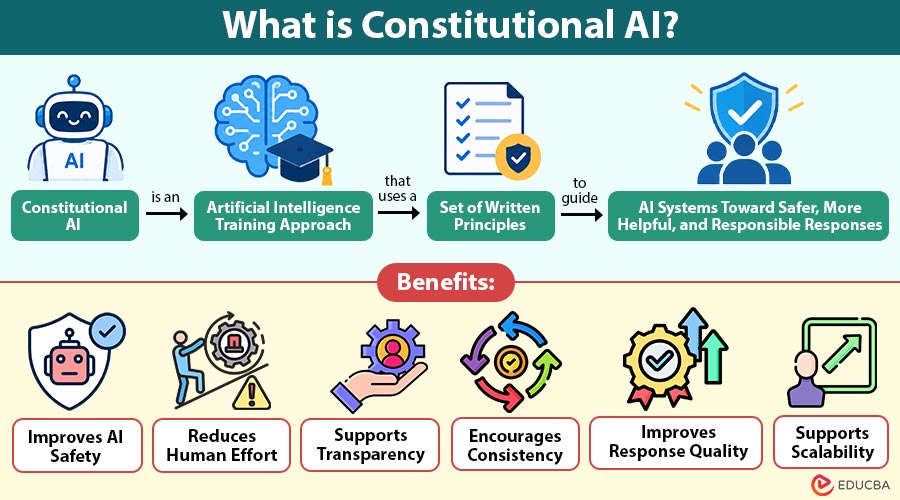
Constitutional AI is an artificial intelligence training approach that uses a set of written principles to guide AI systems toward safer, more helpful, and responsible responses.
Making sure AI tools offer practical and secure solutions has become more crucial as AI grows more pervasive in daily life. If AI systems are not properly guided, they may respond in ways that are detrimental, deceptive, biased, or unsuitable.
Constitutional AI addresses this concern by giving AI models a set of rules or principles to follow. These principles act like a guide that helps the system review its answers and improve them before responding to users.
The approach was introduced by Anthropic as a way to train AI models with less dependence on human feedback. It uses AI-generated feedback to identify problems and improve responses according to a defined set of principles.
Unlike approaches that depend mainly on people rating every response, Constitutional AI allows models to examine and revise their own outputs using these guidelines.
Table of Contents:
Key Takeaways:
- Constitutional AI uses written principles to guide AI models toward safer, more helpful, and responsible responses.
- It allows AI models to review, evaluate, and revise their outputs according to predefined ethical guidelines.
- The approach reduces dependence on human feedback while improving consistency, transparency, and safety during model training.
- Human supervision remains essential because AI-generated evaluations may overlook biases, ethical concerns, or incorrect information.
Key Principles of Constitutional AI
Constitutional AI follows a collection of written guidelines that influence how an AI model understands requests and prepares responses. These principles help developers create systems that behave responsibly.
Some important principles include:
1. Helpfulness
AI should provide useful, relevant, and clear information that directly addresses users’ questions and helps them understand the subject without confusion.
2. Honesty
AI should provide accurate information, avoid inventing facts, acknowledge uncertainty, and communicate answers based on reliable and trustworthy sources.
3. Harmlessness
AI should avoid generating content that encourages dangerous activities, harmful behavior, discrimination, or actions that may put people at risk.
4. Fairness
AI should treat all individuals equally, avoid biased responses, and ensure its outputs do not encourage unfair treatment based on personal characteristics.
5. Respect
AI should communicate politely, safeguard personal information, respect individual differences, and consider how its responses may affect others.
6. Transparency
AI developers should clearly communicate the principles guiding their systems so users can understand the values influencing AI-generated responses.
How Does Constitutional AI Work?
Constitutional AI follows a step-by-step training process in which an AI model uses written principles to review its responses, identify problems, and improve the quality of its answers.
1. Creating a Set of Principles
Developers prepare written guidelines that explain how the AI model should respond to questions while following safety, honesty, fairness, and ethical standards.
2. Generating Initial Responses
The AI model receives questions from users and creates initial answers based on its existing knowledge, training data, and understanding of the requests.
3. Reviewing Responses
The model checks its initial answers against the written principles to identify harmful suggestions, incorrect information, biased language, or inappropriate content.
4. Revising Answers
After identifying problems, the model rewrites its responses to make them safer, clearer, and more helpful while maintaining the original meaning.
5. Evaluating Responses
An AI evaluator compares different answers and selects the response that better follows the written principles and meets the expected safety standards.
6. Training the Model
Developers use the evaluation results as feedback during reinforcement learning, helping the model improve its responses and follow the selected principles consistently.
7. Testing and Improvement
Developers test the trained model with different questions, examine its behavior, and update the guidelines when necessary to address newly identified problems.
Through these steps, Constitutional AI helps models develop safer response patterns while reducing their dependence on human feedback during certain stages of training.
Types of Principles Used in Constitutional AI
There is no single fixed classification of Constitutional AI principles. However, developers can organize written guidelines into different groups based on the behavior they want their AI systems to follow.
1. Safety Principles
These guidelines prevent AI systems from providing instructions that could encourage physical harm, illegal activities, or dangerous behavior.
2. Accuracy Principles
These rules encourage models to provide correct information, avoid unsupported claims, and clearly communicate when they lack sufficient knowledge.
3. Ethical Principles
These guidelines encourage responsible behavior by addressing fairness, discrimination, privacy, respect, and the possible effects of AI-generated information.
4. Communication Principles
These rules help AI systems deliver clear, polite, relevant, and understandable answers according to the user’s actual needs.
5. Privacy Principles
These guidelines encourage responsible handling of personal information and discourage responses that could expose confidential or sensitive user details.
Benefits of Constitutional AI
Constitutional AI offers several benefits for organizations developing language models, especially when they want to improve safety without depending entirely on human evaluations.
1. Improves AI Safety
Written guidelines help models recognize harmful requests and prepare safer responses without completely avoiding useful discussions with users.
2. Reduces Human Effort
AI-generated feedback can reduce the number of manual evaluations required during training, saving time and resources for development teams.
3. Supports Transparency
A written constitution makes the guiding principles easier to review, understand, discuss, and adjust when organizational requirements change.
4. Encourages Consistency
Applying common principles across training examples helps models produce more consistent responses when users ask similar questions.
5. Improves Response Quality
Self-review allows models to correct certain problems before producing final answers, improving the usefulness and clarity of responses.
6. Supports Scalability
AI feedback can evaluate large numbers of responses, helping developers expand training activities without depending entirely on human reviewers.
Limitations of Constitutional AI
Although Constitutional AI provides a useful approach to AI safety, it cannot guarantee that every response will be correct, fair, or completely harmless.
1. Quality of Principles
Poorly written guidelines may confuse models or create unwanted behavior, making careful development and regular reviews necessary.
2. AI Evaluation Errors
An AI evaluator may misunderstand a response, overlook important details, or select an answer that does not fully follow the constitution.
3. Cultural Differences
Principles considered appropriate in one community may not match the values, expectations, or communication styles of another community.
4. Limited Human Judgment
AI-generated feedback cannot fully replace human understanding, especially when situations involve complex emotions, social issues, or ethical decisions.
5. Risk of Bias
If training data or written guidelines contain existing biases, the resulting model may continue producing unfair or unbalanced responses.
6. Ongoing Monitoring
Models can behave unexpectedly after deployment, so developers must regularly test outputs and update principles when problems appear.
Applications of Constitutional AI
Constitutional AI can support different industries where organizations need AI systems to provide helpful information while following safety and ethical guidelines.
1. Healthcare
AI assistants can follow safety guidelines when answering general health questions and avoid presenting uncertain information as confirmed medical advice.
2. Education
Educational AI tools can provide learning support, explain difficult subjects, and encourage students to use reliable information during their studies.
3. Customer Support
Businesses can use constitution-based AI assistants to provide polite responses, handle customer concerns, and avoid sharing unauthorized information.
4. Financial Services
AI systems can follow responsible communication rules when explaining financial concepts, helping users understand information without making unsupported promises.
5. Content Moderation
Platforms can use AI guidelines to identify harmful language, discriminatory content, and inappropriate material before displaying certain responses.
6. Research and Development
Research teams can apply written principles to evaluate AI behavior and improve models used in different technical and scientific projects.
Difference Between Constitutional AI and Traditional AI Training
The table below highlights the differences between the two:
| Basis | Constitutional AI | Traditional AI Training |
| Main Approach | Uses written principles to guide model behavior. | Uses training data and feedback to improve outputs. |
| Evaluation | Can use AI-generated feedback. | Often uses human evaluations and feedback. |
| Self-Review | Includes a process for reviewing and revising responses. | Does not necessarily include constitutional self-review. |
| Human Involvement | Reduces dependence on human feedback for certain evaluations. | May require substantial human feedback during training. |
| Transparency | Makes guiding principles available for inspection. | Guiding values may be less explicitly documented. |
Example of Constitutional AI
Consider an AI assistant used by an online learning platform. A student asks it to provide instructions for accessing another student’s private account.
Without suitable safety guidelines, the system might generate an inappropriate response. However, a model trained using Constitutional AI can review the request against its written principles.
It may recognize that sharing instructions for unauthorized account access could violate privacy and security rules. Instead, it can refuse that part of the request and suggest contacting the platform administrator for legitimate account access.
This example shows how written principles help AI systems respond more responsibly while still offering useful alternatives.
Final Thoughts
Constitutional AI provides a structured way to guide artificial intelligence using written principles rather than relying entirely on human feedback. It helps models review responses, reduce harmful outputs, and improve communication. Although it has limitations, this approach offers useful opportunities for developing safer, more transparent, and responsible AI systems.
Frequently Asked Questions (FAQs)
Q1. Can Constitutional AI work without human supervision?
Answer: No. Although it reduces certain manual evaluation tasks, human oversight remains important for reviewing complex decisions and unexpected model behavior.
Q2. Who decides the principles used in Constitutional AI?
Answer: AI developers and researchers select the principles based on organizational goals, safety requirements, ethical standards, and intended users.
Q3. Can the principles of Constitutional AI be changed?
Answer: Yes. Developers can revise guidelines as technologies, user expectations, organizational policies, and safety requirements evolve.
Q4. How can organizations assess the effectiveness of Constitutional AI?
Answer: Organizations can test model responses across different scenarios, examine ethical compliance, monitor user feedback, and identify areas requiring further improvement.
Recommended Articles
We hope that this EDUCBA information on “Constitutional AI” was beneficial to you. You can view EDUCBA’s recommended articles for more information